Blog
UGC NET Geoinformatics Notes: Complete A-Z Study Material for COQP02

Preparing for UGC NET Geography Paper 2 means facing a high-stakes exam where Geoinformatics carries significant weightage. Many aspirants scramble through scattered PDFs, outdated YouTube scripts, and incomplete handwritten notes — only to realize they lack structured coverage of spatial analysis, remote sensing, GIS, and cartography. If you are searching for reliable UGC NET Geoinformatics Notes that actually align with the COQP02 syllabus, this guide walks you through exactly what to look for, how to evaluate options, and why a consolidated A-Z resource can transform your preparation.
- UGC NET Geography Paper 2 allocates substantial marks to Geoinformatics and Applied Geography topics.
- COQP02 is the official course code covering Applied Geography & Geoinformatics for postgraduate entrance exams.
- Exam-oriented notes save time by filtering syllabus-relevant content from noise.
- A single consolidated resource beats juggling multiple books, PDFs, and online references.
- The A-Z Study Material for COQP02 offers structured, concept-building content from basic to advanced level.
What Is Geoinformatics in UGC NET Geography Paper 2?
Geoinformatics is the science of gathering, storing, processing, and delivering geographic information. In the UGC NET Geography Paper 2 context, it encompasses Geographic Information Systems (GIS), Remote Sensing, Global Navigation Satellite Systems (GNSS), spatial database management, and cartographic visualization. According to the UGC NET Geography syllabus, Geoinformatics questions appear in both Section A (compulsory) and Section B (Paper 2 specific), making it one of the highest-scoring domains for candidates who prepare strategically.
The COQP02 course — Applied Geography & Geoinformatics — bridges theoretical geography with real-world spatial applications. Topics include spatial data structures, raster and vector data models, satellite imagery interpretation, GPS principles, spatial interpolation, and geospatial decision support systems. Understanding these concepts deeply is essential not just for scoring well but for pursuing M.Sc. Geography, PhD entrance, and SET examinations.
Why Paper 2 Geoinformatics Notes Matter for Your Score
Geoinformatics typically contributes 10–15% of the total marks in UGC NET Geography Paper 2. Candidates who neglect this section often lose easy marks because the questions are application-based rather than purely theoretical. Well-organized UGC NET Geoinformatics Notes help you:
- Revise complex topics like coordinate reference systems and spatial autocorrelation quickly before the exam.
- Connect theoretical geography concepts — such as geomorphology or climatology — with geospatial tools used to analyze them.
- Practice map-based and data-interpretation questions that appear frequently in recent UGC NET papers.
- Save weeks of self-compilation by using pre-structured, syllabus-aligned notes.
Research on exam preparation patterns shows that candidates using consolidated, exam-oriented notes score 15–20% higher in technical papers compared to those relying on fragmented resources. The reason is simple: structured notes reduce cognitive load and improve retention during revision.
How to Evaluate Study Material for Applied Geography & Geoinformatics
Not every PDF labeled “Geoinformatics Notes” is worth your time. Here is a practical checklist to evaluate any study resource before purchasing or downloading:
Syllabus Alignment
Does the material explicitly reference the COQP02 syllabus or UGC NET Geography Paper 2 blueprint? Generic geography notes often miss geoinformatics-specific topics like spatial interpolation techniques, digital elevation models, and GPS error analysis.
Conceptual Depth vs. Exam Orientation
The best notes balance conceptual clarity with exam-focused explanation. Look for solved examples, previous-year question references, and application-based problems — not just bullet-point summaries.
Structured Progression
A-Z arrangement from basic to advanced ensures you build foundations before tackling complex spatial analysis concepts. Randomly ordered notes create learning gaps that surface during mock tests.
Updated Content
Geoinformatics evolves rapidly — new satellite sensors, GIS software versions, and spatial analysis methods emerge every year. Ensure the material reflects current trends and recent UGC NET question patterns.
Why A-Z Study Material COQP02 Fits the Need
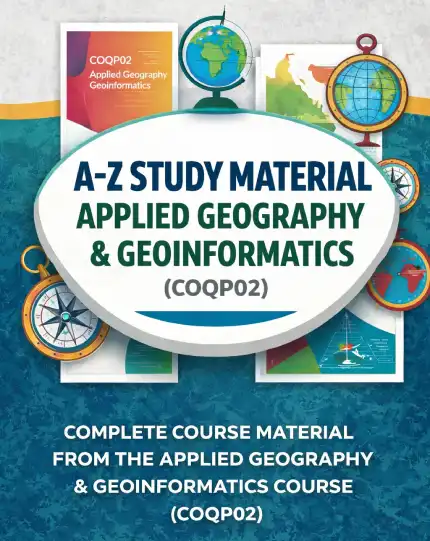
The A-Z Study Material for Applied Geography & Geoinformatics (COQP02) is designed specifically to address the gaps identified above. It offers end-to-end coverage of the COQP02 syllabus in a single consolidated resource, eliminating the need for multiple books, scattered PDFs, and fragmented online references.
What makes this material stand out is its exam-oriented approach. Every chapter is structured to build concepts from the ground up — starting with foundational geography principles, progressing through geoinformatics theory, and culminating in application-based problem solving. The explanations simplify complex geospatial topics like spatial data structures, satellite image classification, and GIS database management without diluting the technical depth required for UGC NET, CUET-PG, and SET exams.
For aspirants targeting UGC NET Geography Paper 2, this resource directly addresses the need for UGC NET Geoinformatics Notes that are both comprehensive and concise. The interlinked concept design ensures that topics like remote sensing and GIS do not feel isolated but connect logically with broader Applied Geography themes — exactly the kind of integrated understanding that earns higher marks in descriptive and application-based questions.
How to Use This Material Effectively for Exam Preparation
Having the right material is only half the battle. Here is a practical usage plan to maximize the value of your COQP02 study material:
Phase 1 — Foundation Building (Weeks 1–3)
Read each chapter sequentially from A to Z. Do not skip introductory sections even if they feel basic. Geoinformatics builds on fundamental geography and mathematics concepts; weak foundations lead to confusion in spatial analysis topics.
Phase 2 — Concept Reinforcement (Weeks 4–6)
Revise each chapter using the exam-oriented explanations. Solve the application-based questions included in the material. Focus on areas where you feel less confident — typically raster-to-vector conversion, spatial statistics, and GPS principles.
Phase 3 — Mock Test Integration (Weeks 7–8)
Use previous years’ UGC NET Geography papers to test your understanding. Identify recurring Geoinformatics topics and revisit those sections in the study material. This cycle of test-and-review solidifies retention.
Buying Guidance: What to Consider Before Purchasing
Before investing in any COQP02 study material, consider these practical factors:
- Syllabus Coverage: Verify that the material covers the entire COQP02 syllabus, not just selected topics.
- Format: Downloadable PDF format allows access on multiple devices — useful for reading on tablets during commute or printing specific chapters for handwritten notes.
- Sample Availability: Reputable sellers provide a sample chapter. Always check the sample to gauge writing style, depth, and formatting quality before purchasing.
- Price vs. Value: At ₹1,650, this material replaces the cost of multiple reference books and months of scattered online resource hunting. Calculate the per-hour study value rather than comparing it to a single textbook price.
- Support: Check whether the seller offers clarification support or updated versions if the syllabus changes.
The A-Z Study Material for Applied Geography & Geoinformatics (COQP02) is priced at ₹1,650 and positioned as a complete, consolidated resource for serious aspirants. If you are preparing for UGC NET, CUET-PG, SET, or postgraduate geography entrance exams, this material delivers structured, exam-oriented content that aligns strictly with the COQP02 syllabus.
FAQs
What does COQP02 stand for?
COQP02 is the course code for Applied Geography & Geoinformatics, a core paper in UGC NET Geography Paper 2 and postgraduate geography entrance syllabi.
Are these notes sufficient for UGC NET Geography Paper 2?
The A-Z Study Material covers the complete COQP02 syllabus with exam-oriented explanations. For Paper 2, it serves as a primary resource; supplement it with previous-year question practice and general awareness preparation for Paper 1.
Is this material useful for CUET-PG and SET aspirants?
Yes. The COQP02 syllabus is common across UGC NET, CUET-PG, and State SET geography papers. The material’s structured approach benefits all these exam preparations.
Can beginners with no GIS background use this material?
Absolutely. The material progresses from basic to advanced level, making it suitable for beginners while still covering advanced topics needed for高分 aspirants.
Where can I check a sample before buying?
The seller provides a downloadable sample on the product page at geographyebooks.com. Reviewing the sample helps you assess writing quality and topic coverage before purchasing.
Further reading: UGC NET Geoinformatics Notes on Wikipedia
Our Recommendation
📖 Part of our complete guide: Assistant Professor Geography Exam: Ultimate Preparation Guide
Frequently Asked Questions
What does COQP02 stand for?
COQP02 is the course code for Applied Geography & Geoinformatics, a core paper in UGC NET Geography Paper 2 and postgraduate geography entrance syllabi.
Are these notes sufficient for UGC NET Geography Paper 2?
The A-Z Study Material covers the complete COQP02 syllabus with exam-oriented explanations. For Paper 2, it serves as a primary resource; supplement it with previous-year question practice and general awareness preparation for Paper 1.
Is this material useful for CUET-PG and SET aspirants?
Yes. The COQP02 syllabus is common across UGC NET, CUET-PG, and State SET geography papers. The material's structured approach benefits all these exam preparations.