Blog
Tetrahedral Hypothesis of Lowthian Green | Tetrahedral Hypothesis in Geography | Dr. Krishnanand

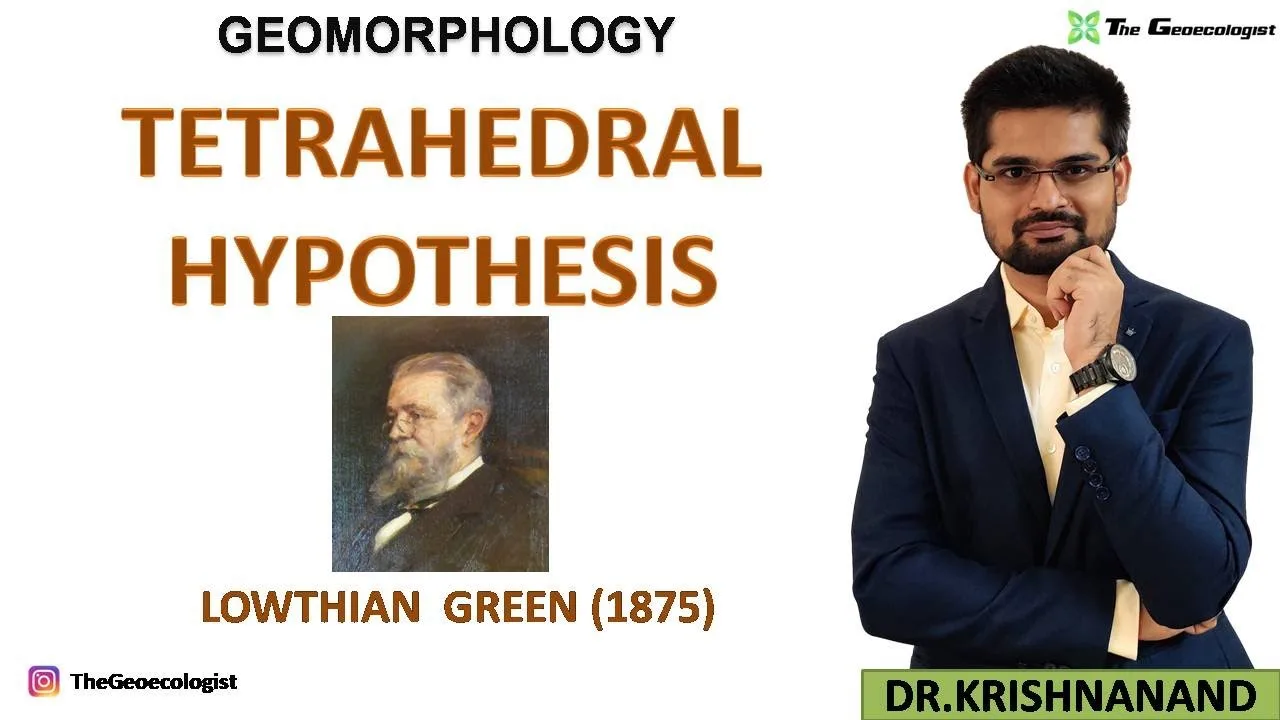
Tetrahedral Hypothesis of Lowthian Green | Tetrahedral Hypothesis in Geography | Dr. Krishnanand
Unveiling the Earth’s Shape: The Tetrahedral Hypothesis of James Geikie – A Cornerstone of Geomorphology for UPSC Aspirants
In the vast and dynamic world of physical geography, understanding the forces that sculpt Earth’s surface is fundamental. For UPSC aspirants tackling Geography Optional, grasping foundational geomorphological concepts is crucial. Among these, the Tetrahedral Hypothesis, strongly associated with Scottish geologist James Geikie (though sometimes linked to his contemporary Lowthian Green, Geikie provided the most comprehensive exposition), stands as a historically significant and conceptually fascinating theory. It offers a unique perspective on how the Earth might have evolved its major continental and oceanic features. This article delves into the hypothesis, its core tenets, and its relevance to modern geography and competitive exam preparation.
What is the Tetrahedral Hypothesis? The Core Idea
Formulated in the late 19th century (Geikie elaborated it significantly in his 1893 work “The Great Ice Age” and subsequent works), the Tetrahedral Hypothesis proposes that the Earth, despite its current near-spherical shape, possesses a fundamental tetrahedral (triangular pyramidal) bias in its continental and oceanic distribution.
Here’s a simplified breakdown of the concept:
- The Ideal Tetrahedral Earth: Geikie suggested that if the Earth were an ideal tetrahedron, the continents would be clustered near the three vertices, while the oceans would occupy the four triangular faces.
- The Real-World Analogy: While the Earth is a sphere, Geikie observed a striking pattern resembling this distorted tetrahedron:
- Continents: Landmasses are predominantly located in three vast regions that roughly correspond to three vertices of an imaginary tetrahedron superimposed on the globe:
- Vertex 1: The combined landmasses of the Northern Hemisphere (Europe, Asia, North America).
- Vertex 2: The combined landmasses of the Southern Hemisphere (South America, Africa, Australia, Antarctica).
- Vertex 3: A smaller but significant landmass cluster (Greenland).
- Oceans: The four major oceans align remarkably well with the imagined tetrahedral faces:
- Pacific Ocean: The vast, deep oceanic area opposite the combined northern continental vertex.
- Atlantic Ocean: Separating the major northern and southern continental vertices.
- Indian Ocean: Surrounding the southern continental vertex.
- Arctic Ocean: The smallest ocean, located near the Greenland vertex.
- Continents: Landmasses are predominantly located in three vast regions that roughly correspond to three vertices of an imaginary tetrahedron superimposed on the globe:
- Dynamic Interpretation: Geikie saw this configuration not as a static shape, but as a consequence of Earth’s internal forces and thermal history. He believed the initial molten Earth had a tetrahedral tendency due to gravitational and rotational forces. As the planet cooled and contracted, this fundamental bias influenced the locations where continents uplifted and oceanic basins subsided.
Significance and Reception in Geomorphology
Geikie’s Tetrahedral Hypothesis was groundbreaking for its time for several reasons:
- Early Unification: It attempted to provide a single, unified explanation for the global pattern of continents and oceans, a major puzzle before the full acceptance of plate tectonics.
- Influence of Earth’s Dynamic Nature: It emphasized that Earth’s surface is not static but shaped by powerful internal forces and evolutionary processes over geological time.
- Foundation for Later Theories: While eventually superseded by Plate Tectonics in explaining the mechanisms of continental drift and seafloor spreading, the Tetrahedral Hypothesis highlighted the importance of global-scale patterns and the influence of planetary shape and rotation on geological evolution. It paved the way for later models of continental distribution.
Why is This Hypothesis Relevant for UPSC Geography Optional?
Even though modern geology views it as a largely descriptive and superseded model, the Tetrahedral Hypothesis retains importance for UPSC aspirants:
- Historical Context: Understanding its development reflects the evolution of geological thought. Questions on the contributions of key figures like Geikie or the progression of geomorphological theories are common.
- Pattern Recognition: It trains aspirants to identify large-scale geographical patterns (continental clustering vs. oceanic basins), a skill essential for tackling map-based questions and understanding physiography.
- Contrast with Plate Tectonics: Critically comparing the Tetrahedral Hypothesis (a static or slow-moving model) with Plate Tectonics (a dynamic model driven by plate interactions) is excellent preparation for questions on the development of geomorphology or the limitations of earlier theories.
- Foundation for Geosynclinal Theory: Geikie’s work was closely linked to the Geosynclinal Theory (another major historical model of mountain building). Understanding the Tetrahedral Hypothesis provides context for studying Geosynclines.
- Building Blocks: Concepts of Earth’s shape, gravitational forces, thermal contraction, and the influence of rotation introduced here are foundational to understanding more complex modern processes.
Simplifying for UPSC: Resources like Dr. Krishnanand’s Lecture
Navigating historical geomorphological theories can be challenging. This is where dedicated resources like the lecture by Dr. Krishnanand, founder of TheGeoecolologist, become invaluable. His video specifically addresses the Tetrahedral Hypothesis as part of the World Physical Geography syllabus for UPSC Geography Optional.
Why Dr. Krishnanand’s Lecture is Beneficial:
- Simplified Explanation: As the title suggests, it breaks down the complex hypothesis into digestible concepts, focusing on the core idea and its geographical implications without overwhelming jargon.
- Exam-Oriented Focus: Dr. Krishnanand explicitly tailors the explanation for UPSC preparation, highlighting what aspirants need to know for the exam, including key terms, significance, and its place in the evolution of geographical thought.
- Beginner-Friendly: The lecture is designed to be accessible to students who are new to the subject, making it an excellent starting point.
- Visual Clarity: Likely uses diagrams and maps to illustrate the tetrahedral pattern superimposed on the Earth, aiding visual understanding.
- Contextualization: Places the hypothesis within the broader framework of geomorphology and its historical development.
E-book Supplement: “Simplified Geomorphology”
To complement the video lecture, Dr. Krishnanand’s “Simplified Geomorphology” e-book (available at https://geographyebooks.com/product/simplified-geomorphology/) serves as an excellent resource. It provides:
- Structured Reading: Offers a written, detailed explanation of the Tetrahedral Hypothesis alongside other essential geomorphological topics.
- Comprehensive Coverage: Covers a wide range of physical geography topics relevant to the UPSC syllabus in one place.
- Reference Material: Serves as a reliable reference for quick revision and clarification of concepts encountered during lecture preparation.
Conclusion
While Plate Tectonics now reigns supreme in explaining Earth’s dynamic surface, the Tetrahedral Hypothesis of James Geikie remains a fascinating chapter in geological history. For UPSC Geography Optional aspirants, understanding it is not just about memorizing an outdated theory; it’s about appreciating the evolution of scientific thought, recognizing large-scale geographical patterns, and building a strong foundational understanding of geomorphology. Resources like Dr. Krishnanand’s focused lecture video and the “Simplified Geomorphology” e-book provide targeted, accessible pathways to master this and other crucial topics, empowering aspirants to tackle the challenges of the examination confidently.
Explore Further:
- Watch the Lecture: Dive deeper into the Tetrahedral Hypothesis with Dr. Krishnanand’s dedicated video for UPSC Geography Optional.
- Download the E-book: Get your copy of “Simplified Geomorphology” by Dr. Krishnanand from GeographyEbooks.
- Stay Updated: Subscribe to THEGEOECOLOGIST on YouTube for notifications on new lectures. Follow via Email (krishna.geography@gmail.com), the Website, or Instagram for the latest updates and resources.
geographyoptional #tetrahedralhypothesis #geomorphology #upsc #ias #geography #physicalgeography #drkrishnanand #thegeoecologist
To Download E-Books & Study Material Visit The Shop Page