Blog
Simplified Political Geography: Complete 2025 Guide for UPSC & Students

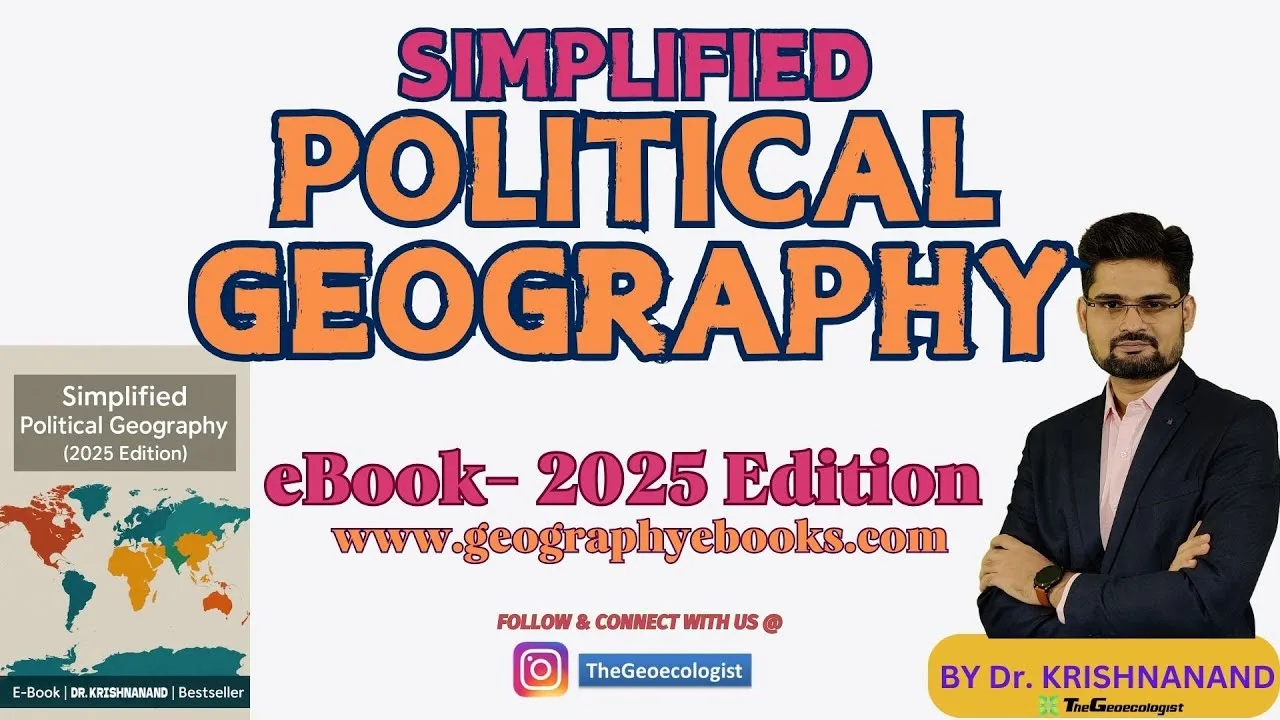
Table of Contents
- What Is Political Geography and Why simplified political geography Matters in 2025
- Why Study Simplified Political Geography for Competitive Exams
- Syllabus Alignment and Weightage
- Conceptual Clarity Over Rote Memorization
- Core Modules: Deep Dive into the 2025 Edition
- 1. Foundations: Scope, Nature, and Evolution of Geopolitical Thought
- 2. State, Nation & Nation-State: Untangling the Terminology
- 3. Geopolitical Theories: From Heartland to Indo-Pacific
- 4. Boundaries & Frontiers: Typology and Dispute Resolution
- 5. Electoral Geography: Space, Votes, and Gerrymandering
- 6. Sovereignty & Territoriality: Westphalia to Web3
- 7. Regionalism & Supranational Organizations: Fragmentation or Deepening?
- 8. Political Geography of Resources: Scarcity, Security, and Struggle
- 9. Globalization & Political Impacts: The Retreat of the Territorial State?
- 10. Contemporary Challenges: The 2025 Agenda
- Who Should Invest in This Simplified Political Geography Resource
- UPSC & State PCS Aspirants
- UGC NET / CSIR-NET Geography Candidates
- University Students, Researchers & Educators
- How to Access the Simplified Political Geography 2025 Edition
- Complementary Resources from TheGeoecologist Ecosystem
- Conclusion: Your Strategic Advantage in a Complex World
Mastering simplified political geography has never been more critical than in 2025, as shifting global power dynamics, climate-induced migration, and digital sovereignty disputes reshape the world map. Whether you are a UPSC aspirant tackling Geography Optional, a UGC NET candidate, or a policy analyst tracking geopolitical risk, a structured grasp of space-power-governance relationships is indispensable. Dr. Krishnanand’s “Simplified Political Geography (2025 Edition)” distills decades of academic rigor into an accessible, map-rich resource that bridges classical theory and contemporary crises.
- Comprehensive coverage of 10 core modules from geopolitical theories to cyber warfare.
- Exam-focused design aligned with UPSC, State PCS, and UGC NET syllabi.
- Real-world case studies including India-China borders, Israel-Palestine, and Arctic resource races.
- Visual learning with 50+ maps, diagrams, and flowcharts for retention.
- Contemporary relevance addressing climate refugees, digital sovereignty, and supranational fracturing.
What Is Political Geography and Why simplified political geography Matters in 2025
Political geography examines the spatial expression of political behavior — how boundaries, territory, and power intersect across scales from the local to the global. In 2025, the discipline has expanded beyond traditional state-centric models to encompass non-state actors, digital territories, and planetary boundaries. The simplified political geography approach adopted by TheGeoecologist makes these complex interactions tractable without sacrificing analytical depth.
The field’s relevance has surged as geopolitics re-enters mainstream discourse. From the Red Sea shipping disruptions to semiconductor supply chain wars, geographic constraints now dictate corporate strategy and national security alike. Students who internalize these spatial logics gain a decisive edge in competitive examinations and policy roles. – a key consideration for simplified political geography.
Why Study Simplified Political Geography for Competitive Exams
Syllabus Alignment and Weightage
UPSC Geography Optional Paper II devotes approximately 150 marks to political geography topics — boundaries, geopolitical theories, federalism, electoral geography, and resource conflicts. The simplified political geography framework maps directly to these sub-topics, eliminating the need to cross-reference multiple dense texts. State PCS exams (BPSC, MPPSC, UPPCS) and UGC NET Paper II increasingly feature applied questions on SAARC dysfunction, India’s Act East Policy, and Indo-Pacific construct — all covered with dated case studies in the 2025 edition.
Conceptual Clarity Over Rote Memorization
Traditional preparation often reduces Heartland/Rimland theories to acronyms. simplified political geography instead explains why Mackinder’s pivot area thesis influenced NATO’s eastern expansion and how Spykman’s marginal crescent logic underpins the Quad’s maritime orientation. Such causal understanding enables aspirants to tackle novel “analyze” and “critically examine” prompts that now dominate UPSC mains.
Core Modules: Deep Dive into the 2025 Edition
1. Foundations: Scope, Nature, and Evolution of Geopolitical Thought
The opening chapter traces the genealogy from Ratzel’s organic state theory through Kjellen’s coining of “geopolitics” to critical geopolitics of Ó Tuathail and Agnew. A timeline infographic correlates intellectual milestones with world-historical events — Berlin Conference (1885), UNCLOS III (1982), Belt and Road Initiative (2013) — helping students contextualize theoretical shifts. – a key consideration for simplified political geography.
2. State, Nation & Nation-State: Untangling the Terminology
Confusion between these terms costs easy marks. The book deploys a four-quadrant matrix: Japan (nation-state), Belgium (multi-nation state), Kurdistan (stateless nation), and Vatican City (state without nation). India’s “union of states” constitutional design receives a dedicated subsection with Article 1-4 analysis — a frequent UPSC prelims target.
3. Geopolitical Theories: From Heartland to Indo-Pacific
Mackinder’s 1904 Heartland, Spykman’s 1942 Rimland, Mahan’s sea power, and Cohen’s shatterbelt framework are presented with original map reproductions. The 2025 edition adds a “Neo-Geopolitics” section applying these lenses to:
• China’s String of Pearls vs. US Island Chain Strategy
• Russia’s Near Abroad doctrine post-2022
• India’s SAGAR (Security and Growth for All in the Region) vision
4. Boundaries & Frontiers: Typology and Dispute Resolution
Classification follows Prescott & Triggs: antecedent, subsequent, superimposed, relic. Each type is illustrated — Radcliffe Line (superimposed), Durand Line (geometric), India-Bangladesh land boundary agreement (subsequent). The India-China LAC ambiguity receives 12 pages covering 1962 war legacy, 1993/1996/2005/2013 agreements, and 2020 Galwan escalation. Israel-Palestine traces Green Line, Oslo Accords Areas A/B/C, and 2023-24 Gaza developments.
5. Electoral Geography: Space, Votes, and Gerrymandering
Beyond textbook definitions, this module analyzes India’s 2024 Lok Sabha election spatial patterns — BJP’s Hindi belt consolidation vs. INDIA bloc’s southern/eastern strongholds. US redistricting post-2020 Census, UK’s boundary review, and Malaysia’s malapportionment index provide comparative perspectives. Formulas for efficiency gap and mean-median difference are included for quantitative aptitude.
6. Sovereignty & Territoriality: Westphalia to Web3
Classic internal/external sovereignty distinction is updated with “digital sovereignty” — data localization laws (India’s DPDP Act 2023, EU GDPR, China’s PIPL), cloud jurisdiction disputes, and blockchain-based virtual territories (e.g., Decentraland, Bitnation). Secessionist case studies: Scotland 2014/2023 referendum debates, Catalonia 2017, Bougainville 2019, Kashmir post-Article 370 abrogation.
7. Regionalism & Supranational Organizations: Fragmentation or Deepening?
EU’s existential polycrisis (Brexit, rule-of-law disputes, energy shock), ASEAN’s non-interference dilemma vis-à-vis Myanmar, SAARC’s paralysis since 2016, and the rise of minilaterals (Quad, AUKUS, I2U2, BRICS+ expansion 2024) are evaluated through functionalist vs. intergovernmentalist theoretical lenses. Trade intensity indices and institutional budget charts enable data-driven answers.
8. Political Geography of Resources: Scarcity, Security, and Struggle
Water: Indus Waters Treaty resilience, Mekong dams conflict, Nile GERD negotiations. Energy: Strait of Hormuz chokepoint, Nord Stream sabotage implications, lithium triangle (Chile-Argentina-Bolivia) geopolitics. Minerals: Cobalt DRC-China-US triangle, rare earths processing monopoly. The module introduces “resource curse” and “rentier state” models with Nigeria, Venezuela, and DRC exemplars.
9. Globalization & Political Impacts: The Retreat of the Territorial State?
Hyperglobalist, skeptical, and transformationalist theses are tested against 2020-25 supply chain reshoring, friend-shoring, and techno-nationalism trends. WTO dispute settlement paralysis, OECD BEPS 2.0 digital tax, and IMF SDR allocation politics illustrate contested multilateralism. A dedicated subsection on “platform sovereignty” examines how Meta, Google, and AWS exercise quasi-state authority over digital public spheres.
10. Contemporary Challenges: The 2025 Agenda
Climate-Security Nexus: IPCC AR6 regional projections mapped onto conflict hotspots — Sahel desertification, South Asia heat-humidity limits, Arctic ice-free navigation routes. Migration Politics: UNHCR 2024 stats (117M forcibly displaced), EU New Pact on Migration, India’s CAA/NRC spatial implications, climate refugee legal vacuum. Cyber & Information Geopolitics: Tallinn Manual 2.0 norms, SolarWinds attribution, deepfake election interference (Indonesia 2024, India 2024), submarine cable vulnerability atlas.
Who Should Invest in This Simplified Political Geography Resource
UPSC & State PCS Aspirants
Geography Optional candidates gain a single-source solution for Paper II’s political geography segment. General Studies aspirants benefit from ready-to-reproduce diagrams for Mains GS-I (geographical features and their location) and GS-II (international relations, federalism). Prelims-specific “Map Pointer” boxes highlight recurring loci — Sir Creek, Doklam, Kalapani, Siachen, Nine-Dash Line.
UGC NET / CSIR-NET Geography Candidates
Paper II’s Unit IV (Political Geography) and Unit IX (Contemporary Issues) are comprehensively addressed. The book’s “Research Gaps” annotations at chapter ends guide PhD proposal formulation. Previous year question (PYQ) mapping tables for 2015-2024 NET exams are appended.
University Students, Researchers & Educators
BA/MA Geography curricula (UGC CBCS) align with chapter sequencing. Instructors receive complimentary access to PPT slides, question banks, and printable outline maps via the publisher’s portal. Policy analysts appreciate the “Briefing Note” format distilling each issue into a one-page executive summary.
How to Access the Simplified Political Geography 2025 Edition
The eBook is available for instant download at geographyebooks.com. The PDF is watermarked, searchable, and compatible with all devices. Technical support is reachable at +91 9709646047 for download issues or license queries. Institutional bulk licenses for coaching centers and university libraries are offered at discounted tiers — contact the vendor for a custom quote.
Complementary Resources from TheGeoecologist Ecosystem
Beyond the flagship text, the platform hosts:
- Simplified Economic Geography — trade theories, industrial location, SEZs, logistics corridors.
- Simplified Population & Settlement Geography — demographic transition, migration models, urban morphology.
- Video Lecture Series — 40+ hours of whiteboard explanations on the YouTube channel.
- Current Affairs Digests — monthly “Geopolitics Watch” PDFs linking news to syllabus topics.
- Test Series — full-length mocks with video solutions for UPSC Mains and NET.
Follow @TheGeoecologist on Instagram for daily map quizzes, concept flashcards, and answer-writing tips.
Conclusion: Your Strategic Advantage in a Complex World
In an era where geographic literacy separates strategic foresight from reactive crisis management, simplified political geography is not merely an exam subject — simplified political geography is a cognitive toolkit for navigating the 21st century’s defining contests. Dr. Krishnanand’s 2025 edition delivers that toolkit with scholarly precision, pedagogical clarity, and unwavering syllabus fidelity. Whether your goal is a top-100 UPSC rank, a JRF fellowship, or informed citizenship, simplified political geography belongs on your digital shelf. Download your copy today and transform how you see the world map.
Frequently Asked Questions
Yes. The book covers the entire political geography segment of Paper II — geopolitical theories, boundaries, federalism, electoral geography, resource conflicts, and contemporary issues — with UPSC-oriented case studies, diagrams, and previous year question mappings. Most aspirants use it as a standalone text supplemented by current affairs.
Absolutely. The 2025 edition contains 50+ high-resolution maps (India-China LAC, Israel-Palestine, Arctic claims, Indo-Pacific chokepoints, etc.), flowcharts for geopolitical theories, and infographics for supranational organizations. All maps are printable and optimized for both screen reading and physical revision notes.
The 2025 edition incorporates events up to mid-2024 (BRICS+ expansion, India's 2024 elections, Gaza conflict, EU migration pact, AI governance initiatives). Purchasers receive free access to quarterly "Geopolitics Watch" update PDFs for 12 months, ensuring coverage of late-breaking developments before exam dates.