For geography students, UPSC CSE aspirants, and landscape enthusiasts, understanding the interplay between river dynamics and morphological processes is critical. The core challenge lies in interpreting complex terrain evolution while meeting exam-related demands for clarity and depth. River Rejuvenation Morphometry addresses these challenges directly, offering a streamlined approach to mastering the subject.
The search trend “Morphometric Analysis and River Rejuvenation” reveals a growing interest in quantitative geomorphic assessment skills.
Students often struggle to differentiate between erosion patterns, sediment transport, and valley evolution without a clear reference framework.
This article evaluates how Simplified Geomorphology (2025 Edition) bridges that gap.
Understanding River Dynamics and Morphometrics
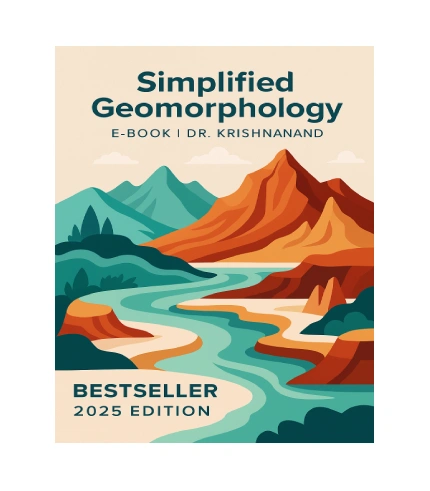
Simplified Geomorphology (2025 Edition) E-Book Dr. Krishnanand Bestseller – geomorphology notes upsc – Orogeny Mountain Building Theories – slope development theories – fluvial – Simplified Geomorphology Dr Krishnanand – Geomorphology UGC NET – Plate Tectonics and Continental Drift – Isostasy Airy Pratt UPSC – Earth Crust Mantle Core – Earthquakes Volcanism Landforms – Weathering and Mass Wasting – Davis Penck erosion cycle comparison – Applied Geomorphology Hazard Management – River Rejuvenation MorphometryRiver systems evolve through a combination of tectonic forces, climate variability, and biological interactions. Morphometric analysis provides the mathematical foundation needed to quantify channel form, gradient, and cross-sectional properties—essential metrics for predicting river behavior under changing environmental conditions. Modern river rejuvenation involves restoring these natural processes to degraded channels, and a solid grasp of morphometry is indispensable for planning such interventions.
At the base of every river network lies the underlying tectonic setting. The Plates Tectonics Theory explains how continental collisions, rifting, and subduction create the initial topographic template upon which rivers develop. Understanding this connection helps students contextualize observed river patterns within larger geological frameworks. In the 2025 edition, Dr. Krishnanand aligns the theoretical chapters with recent CBCS syllabus updates, making the information immediately applicable to current examination settings.
The internal structure of the Earth—comprising the crust, mantle, and core—determines the mechanical strength and permeability of the crust, influencing how water finds pathways to the surface. Chapter 1 of the text details lithosphere composition, while Chapters 2 through 5 trace the evolution of the crust from primordial basaltic provinces to modern sedimentary basins. These foundational concepts are prerequisites for any advanced study of river formation and rejuvenation.
Geosynclines act as ancient repositories where compressional forces fold and thicken the crust, creating the structural nuclei of major river catchments. Continental drift theory, introduced by Alfred Wegener and refined over decades, describes how supercontinents fragment and reassemble, leaving behind scattered mountain belts whose fluvial networks continue to evolve today. This chapter equips readers with the historical perspective needed to appreciate the long-term drivers behind river morphology.
UPSC CSE aspirants face multiple-choice questions on river classification, drainage density, and erosional regimes. The revised 2025 edition compiles all previous syllabus coverage into digestible chapters, each supported by diagrams, maps, and comparative tables. Practitioners can use the sample pages to practice identifying landforms such as meanders, oxbow lakes, and alluvial fans—the very subjects tested in geography paper sections.
Why Simplified Geomorphology (2025 Edition) Stands Out
This textbook stands out because it transforms abstract geomorphic principles into actionable analytical tools. With updated content reflecting the latest CBCS revisions, it ensures that readers are prepared for the most current examination patterns. The inclusion of interactive figures and real-world case studies—such as the Mekong and Ganges river rejuvenation projects—makes the material both academically rigorous and practically relevant. Whether you are preparing for Prelims, Mains, or simply deepening your own knowledge, this book delivers value beyond standard textbooks.
Buying Guide: What to Look For in Geography Textbooks
Simplified Geomorphology (2025 Edition) E-Book Dr. Krishnanand Bestseller – geomorphology notes upsc – Orogeny Mountain Building Theories – slope development theories – fluvial – Simplified Geomorphology Dr Krishnanand – Geomorphology UGC NET – Plate Tectonics and Continental Drift – Isostasy Airy Pratt UPSC – Earth Crust Mantle Core – Earthquakes Volcanism Landforms – Weathering and Mass Wasting – Davis Penck erosion cycle comparison – Applied Geomorphology Hazard Management – River Rejuvenation MorphometryWhen selecting a geomorphology resource, prioritize clarity of language, visual aids, and alignment with official syllabi. Simulated exercises, answer keys, and a logical progression from fundamental concepts to advanced topics are non-negotiable features. The 2025 edition maintains the best-seller status while incorporating fresh examples and verified references to ensure accuracy across multiple revision cycles.
In summary, River Rejuvenation Morphometry combined with Simplified Geomorphology (2025 Edition) offers the perfect blend of theoretical depth and practical application for anyone serious about mastering river dynamics and related geomorphic processes. Its structured approach, strong market positioning, and continuous updates make it a reliable companion for academic success and professional development in earth sciences.
Is Simplified Geomorphology suitable for UPSC CSE aspirants?
Yes. This edition aligns with the CBCS syllabus and covers all required topics, including river dynamics and morphometric analysis, making it ideal for competitive geography preparation.
How does the 2025 edition differ from previous versions?
The 2025 edition incorporates the latest CBCS syllabus updates, additional diagrams, and real-world case studies on river rejuvenation, enhancing relevance for current exam patterns.
Can beginners use this book for undergraduate studies?
Absolutely. The book is designed for undergraduates and geography enthusiasts alike, providing clear explanations, illustrative charts, and step-by-step analyses that cater to varying proficiency levels.