Blog
Plate Tectonics and Continental Drift Notes: The Complete Guide for UPSC Aspirants and Geography Students

The Challenge of Mastering Plate Tectonics and Continental Drift
Understanding Plate Tectonics and Continental Drift is one of the most critical topics for UPSC CSE aspirants, undergraduate geography students, and competitive exam candidates worldwide. The subject demands clarity on complex geological theories, and finding reliable Plate Tectonics and Continental Drift Notes can make all the difference between a high score and a missed opportunity. According to the UPSC CSE syllabus under CBCS guidelines, geomorphology carries significant weight in both Paper I and Paper II, making mastery of Plate Tectonics and Continental Drift non-negotiable for serious aspirants. The sheer volume of information — from Wegener’s original hypothesis to modern plate boundary dynamics — often overwhelms students who rely on fragmented online sources or outdated textbooks.
- Learn the foundational concepts of Plate Tectonics and Continental Drift from first principles
- Understand how to evaluate quality study material for Plate Tectonics and Continental Drift
- Discover why Simplified Geomorphology (2025 Edition) is a trusted resource for Plate Tectonics and Continental Drift preparation
- Get practical study strategies and buying guidance
How to Evaluate Quality Notes on Plate Tectonics and Continental Drift
When searching for the best Plate Tectonics and Continental Drift Notes, aspirants should consider several factors. First, the material must align with the latest UPSC CBCS syllabus update (2025), ensuring that topics like seafloor spreading, paleomagnetism, and slab pull theory are covered comprehensively. Second, diagrams and maps are essential — Plate Tectonics and Continental Drift cannot be understood through text alone. The US Geological Survey emphasizes that visual representations of plate boundaries, such as convergent, divergent, and transform margins, are indispensable for conceptual clarity as documented by geological authorities. Third, the notes should present theories chronologically, from continental drift to modern plate tectonics, so learners grasp the evolution of scientific thought.
Poor-quality resources often skip the mathematical and empirical evidence behind Plate Tectonics and Continental Drift, leaving students unprepared for descriptive answer-writing in UPSC mains. The best Plate Tectonics and Continental Drift Notes integrate point-wise highlighted descriptions, illustrative diagrams, and map-based exercises into a single cohesive framework.
Why Simplified Geomorphology Stands Out for Plate Tectonics and Continental Drift Notes
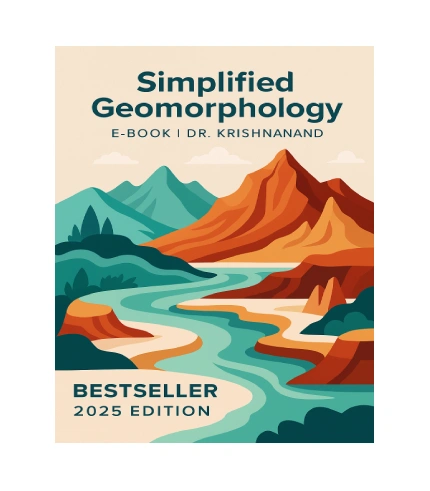
Simplified Geomorphology (2025 Edition) by Dr. Krishnanand has earned its reputation as a bestseller precisely because it addresses the exact gaps that plague Plate Tectonics and Continental Drift preparation. The book is explicitly prescribed on the CBCS geography syllabus, which means its content directly mirrors what UPSC expects. For the topic of Plate Tectonics and Continental Drift, the book provides point-wise highlighted descriptions that break down dense theoretical passages into digestible, exam-ready points.
What sets this resource apart is its integration of diagrams, maps, and images alongside the textual explanation of Plate Tectonics and Continental Drift. Chapter 3 covers Continental Drift Theory in detail (Pages 43-62), while Chapter 4 is entirely dedicated to Plate Tectonics Theory (Pages 63-84). Together, these chapters form a comprehensive treatment of Plate Tectonics and Continental Drift that few competing books match in clarity and syllabus alignment.
Core Topics Covered: From Continental Drift to Modern Plate Tectonics Theory
The 2025 Edition of Simplified Geomorphology covers an extensive range of topics relevant to Plate Tectonics and Continental Drift. Key chapters include:
- Chapter 1: Internal Structure of the Earth (Pages 6-24) — the geological foundation for understanding plate movements
- Chapter 2: Theories of Isostasy (Pages 25-42) — the balance mechanism that complements Plate Tectonics and Continental Drift
- Chapter 3: Continental Drift Theory (Pages 43-62) — Wegener’s hypothesis, evidence, and criticisms
- Chapter 4: Plate Tectonics Theory (Pages 63-84) — driving forces, plate boundaries, and geological features
- Chapter 5: Geosynclines (Pages 85-99) — the precursor concept to modern Plate Tectonics and Continental Drift frameworks
- Chapter 6: Earth Movements: Orogenesis and Epeirogenesis (Pages 100 onward) — mountain-building and continental uplift
This structured progression ensures that anyone studying Plate Tectonics and Continental Drift builds knowledge layer by layer, rather than encountering isolated facts without context.
Practical Study Strategies Using Simplified Geomorphology
To get the most from Plate Tectonics and Continental Drift preparation using Simplified Geomorphology (2025 Edition), aspirants should adopt a three-phase approach. In the first phase, read Chapters 3 and 4 sequentially to build a conceptual base of Plate Tectonics and Continental Drift. In the second phase, use the diagrams and maps in the book to create visual revision notes — this is especially effective for Plate Tectonics and Continental Drift because spatial understanding directly translates to answer accuracy. In the third phase, practice previous-year UPSC questions on Plate Tectonics and Continental Drift and cross-reference answers with the book’s point-wise explanations.
The revised 2025 content ensures that Plate Tectonics and Continental Drift notes reflect the latest syllabus additions, giving aspirants confidence that their preparation is current and complete.
Who Benefits Most from This Resource
Simplified Geomorphology (2025 Edition) is designed for a wide audience. UPSC CSE aspirants seeking comprehensive Plate Tectonics and Continental Drift coverage will find the syllabus-aligned chapters invaluable. Undergraduate geography students following the CBCS curriculum benefit from the same structured, diagram-rich approach to Plate Tectonics and Continental Drift. Even geography enthusiasts who want to understand the dynamic processes shaping Earth’s surface will appreciate the accessible language and detailed explanations of Plate Tectonics and Continental Drift theories. The book’s emphasis on clarity over jargon makes it suitable for self-learners at every level.
Where to Access Simplified Geomorphology (2025 Edition)
Simplified Geomorphology (2025 Edition) by Dr. Krishnanand is available as an e-book, making it instantly accessible for digital learners who prefer studying on tablets or laptops. The updated 2025 edition reflects the latest content aligned with the UPSC CBCS syllabus update, ensuring that Plate Tectonics and Continental Drift preparation is built on the most current information available. For anyone serious about mastering Plate Tectonics and Continental Drift, this bestseller represents a proven, syllabus-compliant, and visually rich resource that delivers measurable results in exam performance.
External reference for further reading on plate tectonics: Continental Drift — Wikipedia
Our Recommendation
📖 Part of our complete guide: Evolution of Geographical Thought: A Comprehensive Guide for UPSC Aspirants and Geography Enthusiasts
Frequently Asked Questions
What is the best resource for Plate Tectonics and Continental Drift Notes for UPSC?
Simplified Geomorphology (2025 Edition) by Dr. Krishnanand is a prescribed CBCS syllabus resource that covers Plate Tectonics and Continental Drift comprehensively with diagrams, maps, and point-wise explanations.
Does Simplified Geomorphology cover both Continental Drift Theory and Plate Tectonics Theory?
Yes, Chapter 3 covers Continental Drift Theory (Pages 43-62) and Chapter 4 is dedicated entirely to Plate Tectonics Theory (Pages 63-84), providing complete coverage of Plate Tectonics and Continental Drift.
Is the 2025 Edition of Simplified Geomorphology aligned with the latest UPSC syllabus?
Yes, the 2025 Edition features updated content aligned with the UPSC CBCS syllabus update (2025), making it ideal for current aspirants studying Plate Tectonics and Continental Drift.