

Blog
Moon Landing Conspiracy: The Truth Behind the Hoax Claims

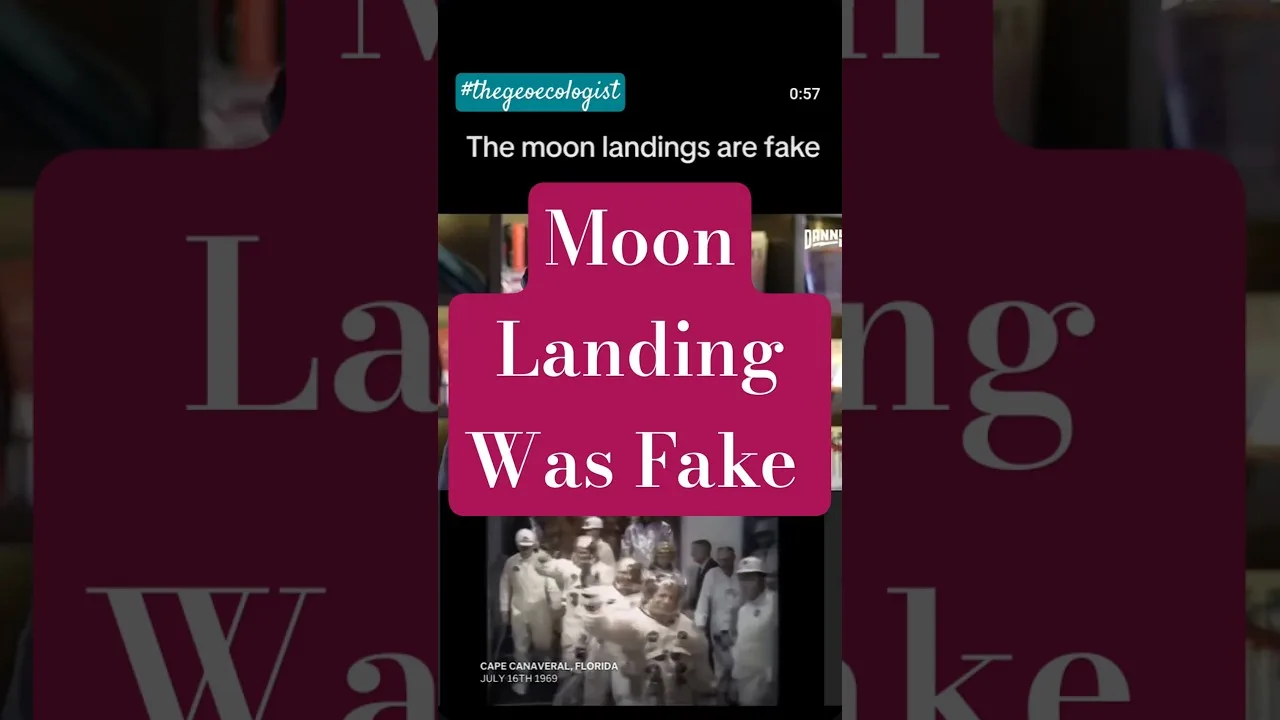
Table of Contents
- Moon Landing Conspiracy: Origins and Early Claims
- Bill Kaysing and the First Pamphlet
- Common Claims of the Moon Landing Conspiracy
- 1. No Stars Visible in Lunar Photographs
- 2. Absence of a Blast Crater Under the Lunar Module
- 3. Anomalous Shadow Angles
- 4. The "Waving" Flag
- Scientific Evidence Refuting the Moon Landing Conspiracy
- Lunar Samples
- International Tracking and Verification
- Lunar Reconnaissance Orbiter (LRO) Imagery
- Why the Moon Landing Conspiracy Endures
- Cognitive Biases and Pattern Seeking
- Distrust of Institutions
- The Role of the Internet
- Pop Culture and Entertainment
- Survey Data on Public Belief
- Addressing the Moon Landing Conspiracy: Strategies for Communicators
- Emphasize Transparency
- Leverage Analogies
- Encourage Critical Thinking
- Engage Respectfully
- Conclusion
The moon landing conspiracy has lingered in popular culture for over five decades, evolving from a fringe pamphlet into a pervasive internet meme that surfaces in forums, YouTube videos, and even mainstream debates. Despite overwhelming evidence—including 382 kg of lunar rock, independent verification by Russia, Japan, and China, and high-resolution images from the Lunar Reconnaissance Orbiter showing astronaut tracks—a surprising number of people still question whether humans ever set foot on the Moon.
- The moon landing conspiracy originated with Bill Kaysing’s 1976 self-published pamphlet
- Key allegations include missing stars, absent blast craters, and anomalous shadows in photographs
- Scientific explanations attribute these to camera exposure settings, vacuum thrust physics, and reflective lunar regolith
- Modern belief is fueled by social media echo chambers and general distrust of institutions
- Surveys show roughly one in six Britons and a similar fraction of Americans entertain the hoax idea
Moon Landing Conspiracy: Origins and Early Claims
The modern moon landing conspiracy is traceable to a single individual: Bill Kaysing, a former Rocketdyne employee who worked on Saturn V engine designs between 1956 and 1963. In 1976 he released We Never Went to the Moon: America’s Thirty Billion Dollar Swindle, a photocopied pamphlet that argued the United States lacked the technical capability to achieve a lunar landing and return. Kaysing’s “hunch” turned into a conviction after he claimed to have seen inconsistencies in NASA’s public footage, such as the absence of stars in the black sky and the lack of a visible blast crater beneath the lunar module.
Although Kaysing’s credentials were modest, his pamphlet found a receptive audience amid post-Watergate distrust of government institutions. He cited grainy photocopies, alleged studio lighting, and speculative motives—namely, a desire to win the Space Race at any cost. Over time, these claims were refined and amplified by later conspiracy theorists, forming the core of what we now recognize as the moon landing conspiracy narrative.
Bill Kaysing and the First Pamphlet
Bill Kaysing’s background in aerospace gave his assertions a veneer of credibility, even though his arguments lacked rigorous scientific methodology. He asserted that NASA’s quality control was poor and that the success of the Apollo program defied statistical odds. Kaysing continued to promote his views until his death in 2005, appearing in interviews and documentaries that kept the moon landing conspiracy alive in niche circles. According to Wikipedia’s biography of Bill Kaysing, his pamphlet sold modestly at first but gained traction during the 1970s era of institutional skepticism.
Common Claims of the Moon Landing Conspiracy
Over the years, proponents of the moon landing conspiracy have raised several recurring points. Below we outline the most frequent allegations and the scientific consensus that addresses each.
1. No Stars Visible in Lunar Photographs
Critics argue that the black sky in Apollo photos should be filled with stars, yet none appear. The explanation lies in camera exposure settings: to capture the brightly lit lunar surface and the astronauts’ white suits, photographers used fast shutter speeds and small apertures, which rendered faint stars invisible. This is analogous to trying to photograph a daylight scene with a camera set for night-time—stars simply do not register. Professional photographers and astronomers have repeatedly demonstrated this effect using identical camera settings on Earth.
2. Absence of a Blast Crater Under the Lunar Module
Some claim that the descent engine should have excavated a noticeable crater, yet the regolith appears undisturbed. In the Moon’s vacuum, the exhaust plume expands rapidly, reducing pressure at the surface. Moreover, the lunar module’s throttle was lowered well before touchdown, limiting the force exerted on the ground. Experiments and simulations confirm that under these conditions, any crater would be shallow and difficult to discern in low-resolution images. NASA’s Apollo 11 mission page provides detailed technical specifications of the lunar module descent engine that support this explanation.
3. Anomalous Shadow Angles
Observers point to shadows that seem to fall in multiple directions, suggesting artificial lighting. In reality, the Moon’s uneven terrain and the low angle of the sun create perspective effects that make parallel shadows appear to converge or diverge. This is a well-understood optical phenomenon known as perspective distortion, easily replicated by photographing objects on uneven ground during sunrise or sunset on Earth.
4. The “Waving” Flag
Footage of the American flag appearing to flutter has been cited as evidence of wind on a soundstage. However, the flag was mounted on a horizontal telescoping rod, and the apparent motion resulted from astronauts twisting the pole into the lunar soil. In the vacuum, with no air resistance to dampen movement, the flag continued to oscillate briefly after being disturbed—exactly as physics predicts.
Scientific Evidence Refuting the Moon Landing Conspiracy
The body of evidence against the moon landing conspiracy is vast, multidisciplinary, and independently verifiable. No single piece of evidence stands alone; rather, the convergence of multiple independent lines of proof makes the hoax hypothesis statistically impossible.
Lunar Samples
Between 1969 and 1972, six Apollo missions returned 382 kilograms (842 pounds) of lunar rock, core samples, pebbles, sand, and dust. These samples have been analyzed by scientists in dozens of countries for over 50 years. They contain unique isotopic signatures, lack of water-bearing minerals, and micrometeoroid impact craters that cannot be replicated on Earth. Soviet Luna missions returned 326 grams of lunar material, and their analysis corroborates the Apollo findings. In 2020, China’s Chang’e-5 mission returned 1.7 kg of samples, further confirming the geological consistency.
International Tracking and Verification
The Apollo missions were tracked by independent entities worldwide. The Soviet Union, America’s primary Cold War rival, monitored every mission with radar and telemetry and never disputed the landings. The Jodrell Bank Observatory in the UK, the Madrid Deep Space Communications Complex in Spain, and the Honeysuckle Creek Tracking Station in Australia all received live signals. More recently, Japan’s SELENE (Kaguya) orbiter, India’s Chandrayaan-1, and China’s Chang’e-2 have all photographed Apollo landing sites from lunar orbit.
Lunar Reconnaissance Orbiter (LRO) Imagery
Since 2009, NASA’s Lunar Reconnaissance Orbiter has captured high-resolution images of all six Apollo landing sites. These photographs clearly show descent stages, scientific instruments, rover tracks, and even the dark trails left by astronaut footpaths. The LRO images have a resolution of up to 0.5 meters per pixel, providing visual confirmation that cannot be explained by the moon landing conspiracy narrative. You can explore these images yourself through the LROC official website maintained by Arizona State University.
Why the Moon Landing Conspiracy Endures
If the evidence is so overwhelming, why does the moon landing conspiracy persist? Researchers in psychology, sociology, and information science have identified several interlocking factors.
Cognitive Biases and Pattern Seeking
Human brains evolved to detect patterns and agency—sometimes seeing them where none exist. Pareidolia (seeing faces in clouds) and hyperactive agency detection (assuming intentional design) predispose people to interpret anomalies as evidence of deception. The moon landing conspiracy offers a coherent narrative that resolves cognitive dissonance: it explains away complexity by attributing it to a single, comprehensible cause (a hoax).
Distrust of Institutions
The 1970s saw Watergate, the Pentagon Papers, and the Church Committee revelations about CIA abuses. This era of legitimate government deception created fertile ground for skepticism about official narratives. A 2019 YouGov survey found that 16% of Britons and 10% of Americans believe the Moon landings were probably or definitely faked. Among younger demographics, the numbers are higher, correlating with lower trust in traditional institutions.
The Role of the Internet
Social media algorithms amplify engaging content, and conspiracy theories generate high engagement. YouTube’s recommendation system has been documented to steer viewers from space content toward moon landing conspiracy videos. A 2018 study by the Annenberg Public Policy Center found that exposure to conspiracy content on social media correlates with increased belief in those conspiracies, creating a feedback loop.
Pop Culture and Entertainment
Films like Capricorn One (1978), Interstellar (2014), and documentaries such as A Funny Thing Happened on the Way to the Moon (2001) have kept the moon landing conspiracy in the cultural zeitgeist. While often presented as fiction or “just asking questions,” these works normalize the core claims for audiences who lack the scientific background to evaluate them critically.
Survey Data on Public Belief
Multiple surveys track belief in the moon landing conspiracy over time:
- Gallup (1999): 6% of Americans believed the landings were faked
- YouGov (2019): 10% of Americans, 16% of Britons
- Ipsos (2021): 7% of Americans, higher among those with less formal education
- Pew Research (2023): Belief correlates strongly with general conspiracy mentality and low science literacy
Notably, belief rates are significantly higher in countries that were not directly involved in the Space Race, suggesting cultural distance from the events plays a role.
Addressing the Moon Landing Conspiracy: Strategies for Communicators
Simply presenting facts often fails to change minds due to the backfire effect—where corrections can reinforce false beliefs. Science communicators recommend more nuanced approaches:
Emphasize Transparency
Point people to primary sources they can examine themselves: raw Apollo photographs on NASA’s archive, LRO data, lunar sample catalogs. Transparency builds trust more effectively than authority assertions.
Leverage Analogies
Use familiar comparisons: the star exposure issue mirrors why you can’t see stars from a lit city street at night. The flag motion mirrors how a shaken rug continues rippling in still air. Analogies bridge the gap between unfamiliar physics and everyday experience.
Encourage Critical Thinking
Teach the tools of evaluation: source credibility, corroboration, Occam’s razor, and falsifiability. Ask: “What evidence would change your mind?” If the answer is “nothing,” the belief is not evidence-based.
Engage Respectfully
Mockery entrenches beliefs. Acknowledge the genuine questions behind each claim (e.g., “It’s a great question why stars don’t appear—here’s the photography principle…”) before providing the explanation.
Conclusion
The moon landing conspiracy represents a fascinating case study in how misinformation originates, spreads, and persists despite overwhelming contrary evidence. From Bill Kaysing’s 1976 pamphlet to today’s algorithmically amplified videos, the core claims have remained remarkably stable while the mechanisms of distribution have transformed. The scientific rebuttals—rooted in physics, geology, optics, and independent verification—have only strengthened over time with new data from LRO, international missions, and ongoing sample analysis.
Understanding why the moon landing conspiracy endures is as important as debunking its specific claims. It reveals how cognitive biases, institutional distrust, and modern information ecosystems interact to sustain alternative narratives. For educators, communicators, and policymakers, the lesson is clear: combating misinformation requires not just facts, but empathy, transparency, and an understanding of the psychological and social needs that conspiracies fulfill.
As humanity prepares to return to the Moon through NASA’s Artemis program and international efforts, the physical evidence will only grow. New footprints will join the old ones, visible to orbiters and eventually to the astronauts themselves. The moon landing conspiracy may never fully disappear—few conspiracy theories do—but each new mission adds another layer of reality that the hoax narrative cannot accommodate.
Frequently Asked Questions
Bill Kaysing, a former Rocketdyne employee, started the modern moon landing conspiracy with his 1976 self-published pamphlet 'We Never Went to the Moon: America's Thirty Billion Dollar Swindle.'
Camera exposure settings were optimized for the brightly lit lunar surface and astronauts' white suits. Fast shutter speeds and small apertures made faint stars invisible, just as they would be in daytime photography on Earth.
Three key pieces: 382 kg of lunar samples with unique isotopic signatures analyzed worldwide for 50+ years; independent tracking by USSR, UK, Australia, Spain, Japan, India, and China; and LRO imagery showing descent stages, rover tracks, and footpaths at all six landing sites.
