Blog
Geological Time Scale: Earth’s History & Mass Extinctions Guide

Table of Contents
- Understanding the Geological Time Scale: Hierarchical Structure
- Eons: The Longest Temporal Divisions
- Eras of the Phanerozoic Eon
- Periods and Epochs: Finer Temporal Resolution
- Why the Geological Time Scale Matters for Science and Society
- The Five Major Mass Extinctions: Catastrophes That Rewrote Life's History
- 1. Ordovician-Silurian Extinction (444 Ma)
- 2. Late Devonian Extinction (375–360 Ma)
- 3. Permian-Triassic Extinction: The Great Dying (252 Ma)
- 4. Triassic-Jurassic Extinction (201 Ma)
- 5. Cretaceous-Paleogene Extinction (66 Ma)
- The Sixth Mass Extinction: The Anthropocene Crisis
- Geological Time Scale Mastery for UPSC and Competitive Examinations
- Key Takeaways for Students, Researchers, and Policy Makers
- Conclusion
The geological time scale provides a systematic framework for understanding Earth’s 4.6-billion-year history, organizing planetary events into a hierarchical chronology that geologists, paleontologists, and students rely on worldwide. From the formation of our planet during the Hadean Eon to the current Anthropocene debate, this comprehensive timescale reveals how geological forces and biological evolution have shaped the world we inhabit today. In this detailed guide, based on Dr. Krishnanand’s expert lecture for UPSC and geology aspirants, we explore every major division of the geological time scale, analyze the five catastrophic mass extinctions that reset evolutionary trajectories, and examine the ongoing sixth extinction driven by human activity.
- The geological time scale divides Earth’s history into eons, eras, periods, and epochs based on stratigraphic and fossil evidence.
- Five major mass extinctions have eliminated 70–96% of species, dramatically redirecting evolutionary pathways.
- The Permian-Triassic “Great Dying” (252 Ma) remains the most severe, wiping out 96% of marine species.
- Current biodiversity loss rates suggest a human-driven sixth mass extinction is underway.
- Mastery of the geological time scale is essential for UPSC General Studies Paper-1, geology, and geography examinations.
Understanding the Geological Time Scale: Hierarchical Structure
The geological time scale functions as Earth’s calendar, constructed through centuries of stratigraphic correlation, radiometric dating, and paleontological research. The International Commission on Stratigraphy (ICS) maintains the official International Chronostratigraphic Chart, which standardizes global geological nomenclature. This hierarchical system enables scientists to correlate rock formations across continents and reconstruct planetary history with remarkable precision. You can view the latest official chart at the International Commission on Stratigraphy website.
Eons: The Longest Temporal Divisions
Eons represent the broadest categories of the geological time scale, each spanning hundreds of millions to billions of years. Four eons are formally recognized:
- Hadean Eon (4.6–4.0 Ga): Named after Hades, this eon covers Earth’s accretion, magma ocean solidification, and the Late Heavy Bombardment. No rock record survives from this period; our knowledge comes from zircon crystals dated to 4.4 Ga and lunar samples.
- Archean Eon (4.0–2.5 Ga): The first preserved continental crust (cratons) formed, and life emerged as prokaryotes (bacteria and archaea). Stromatolites—layered microbial structures—provide the earliest fossil evidence at 3.5 Ga. The atmosphere lacked free oxygen.
- Proterozoic Eon (2.5 Ga–541 Ma): This eon witnessed the Great Oxidation Event (~2.4 Ga), when cyanobacterial photosynthesis accumulated atmospheric O₂. Eukaryotes appeared by 1.8 Ga, and the first multicellular organisms (Ediacaran biota) emerged near the eon’s end. Several “Snowball Earth” glaciations occurred between 720–635 Ma.
- Phanerozoic Eon (541 Ma–present): Meaning “visible life,” this eon encompasses the Cambrian Explosion and all subsequent complex life. It is subdivided into three eras.
Eras of the Phanerozoic Eon
The Phanerozoic Eon’s three eras mark fundamental shifts in dominant life forms and planetary conditions:
- Paleozoic Era (541–252 Ma): The “ancient life” era began with the Cambrian Explosion (~539 Ma), an unprecedented radiation of animal phyla. Fish diversified in the Ordovician and Silurian; vascular plants colonized land in the Devonian (“Age of Fishes”); amphibians evolved in the Carboniferous; and reptiles appeared in the Permian. The era ended with the Permian-Triassic extinction.
- Mesozoic Era (252–66 Ma): The “middle life” era, popularly called the Age of Dinosaurs, saw archosaurs dominate terrestrial ecosystems. The Triassic recovery gave rise to dinosaurs, pterosaurs, and early mammals. The Jurassic and Cretaceous periods witnessed peak dinosaur diversity, the origin of birds, and the rise of flowering plants (angiosperms). The era concluded with the K-Pg extinction.
- Cenozoic Era (66 Ma–present): The “recent life” era is the Age of Mammals. Following dinosaur extinction, mammals radiated into vacant niches. Primates evolved in the Paleogene, and hominins appeared in the Neogene. The Quaternary period includes the Pleistocene ice ages and the Holocene, our current interglacial.
Periods and Epochs: Finer Temporal Resolution
Each era subdivides into periods, and periods into epochs, providing the geological time scale with the resolution needed for detailed stratigraphic work. The Paleozoic contains six periods (Cambrian, Ordovician, Silurian, Devonian, Carboniferous, Permian). The Mesozoic has three (Triassic, Jurassic, Cretaceous). The Cenozoic comprises three periods (Paleogene, Neogene, Quaternary), with the Paleogene and Neogene further divided into epochs (Paleocene, Eocene, Oligocene; Miocene, Pliocene; Pleistocene, Holocene). The Wikipedia geological time scale article provides a complete tabular reference.
Why the Geological Time Scale Matters for Science and Society
The geological time scale is far more than an academic classification system. It underpins resource exploration (petroleum, minerals, groundwater), natural hazard assessment (earthquakes, volcanoes, landslides), climate change modeling, and evolutionary biology. By calibrating rates of geological processes—plate tectonics, sedimentation, erosion, speciation—it allows quantitative predictions about Earth’s future. For UPSC aspirants, questions on the geological time scale appear regularly in General Studies Paper-1 (Geography) and the Geology optional paper, testing both factual recall and conceptual understanding of deep time.
The Five Major Mass Extinctions: Catastrophes That Rewrote Life’s History
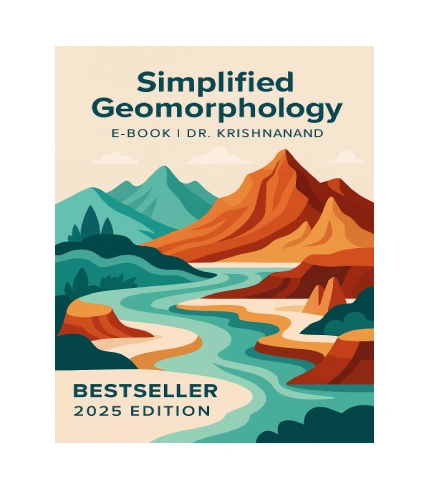
Mass extinctions are geologically brief intervals when biodiversity plummets globally. The geological time scale records five such events of exceptional magnitude, each eliminating 70–96% of species and redirecting evolutionary trajectories.
1. Ordovician-Silurian Extinction (444 Ma)
The first major extinction struck at the Ordovician-Silurian boundary, eliminating approximately 85% of marine species. Two distinct pulses correlate with the Hirnantian glaciation: a cooling phase lowered sea levels, destroying shallow-marine habitats, followed by warming and anoxia as glaciers melted. Brachiopods, bryozoans, trilobites, and conodonts suffered heavily. Recovery took 10–15 million years, setting the stage for Silurian reef ecosystems.
2. Late Devonian Extinction (375–360 Ma)
This protracted crisis, spanning perhaps 20–25 million years, comprised multiple extinction pulses (Kellwasser and Hangenberg events). Approximately 75% of species vanished, particularly affecting tropical reef communities—stromatoporoids, rugose corals, and placoderm fish. Causes likely include widespread ocean anoxia, possibly triggered by nutrient runoff from newly evolved vascular forests (the “Devonian Plant Hypothesis”), and bolide impacts (Siljan crater, Sweden). The extinction reshaped vertebrate evolution, paving the way for tetrapod diversification.
3. Permian-Triassic Extinction: The Great Dying (252 Ma)
The most catastrophic event in the geological time scale erased 96% of marine species and 70% of terrestrial vertebrates. The Siberian Traps flood basalts erupted over ~60,000 years, releasing massive CO₂ and methane, driving extreme global warming (~10°C), ocean acidification, and pervasive anoxia. Terrestrial ecosystems collapsed; coal-forming forests disappeared for 10 million years (the “coal gap”). Recovery was uniquely slow—full ecosystem complexity returned only in the Middle Triassic. This extinction cleared ecological space for archosaurs and, ultimately, dinosaurs.
4. Triassic-Jurassic Extinction (201 Ma)
Approximately 80% of species perished, including most pseudosuchians (crocodile-line archosaurs), large amphibians, and many marine reptiles. The Central Atlantic Magmatic Province (CAMP) eruptions, associated with Pangaea’s breakup, released greenhouse gases and aerosols. Dinosaurs, previously minor components of Triassic faunas, survived and rapidly diversified in the vacant niches, inaugurating their 135-million-year dominance.
5. Cretaceous-Paleogene Extinction (66 Ma)
The K-Pg extinction eliminated 76% of species, famously including all non-avian dinosaurs, pterosaurs, mosasaurs, and ammonites. The Chicxulub impactor (10–15 km asteroid) struck the Yucatán Peninsula, generating tsunamis, wildfires, and an “impact winter” from atmospheric dust and sulfates. Deccan Traps volcanism in India may have stressed ecosystems beforehand. Mammals and birds survived, radiating explosively in the Paleogene.
The Sixth Mass Extinction: The Anthropocene Crisis
Many scientists argue that a sixth mass extinction is currently underway, driven uniquely by a single species: Homo sapiens. Current extinction rates are estimated at 100–1,000 times background levels. Since 1500 CE, at least 680 vertebrate species have gone extinct; the IUCN Red List assesses over 42,100 species as threatened. Primary drivers include habitat destruction (deforestation, urbanization), overexploitation, invasive species, pollution, and anthropogenic climate change. The proposed “Anthropocene” epoch—marked by radionuclides, plastic pollution, and altered biogeochemical cycles—would formalize human dominance in the geological time scale. The Britannica entry on the geological time scale discusses the Anthropocene debate in detail.
Geological Time Scale Mastery for UPSC and Competitive Examinations
For UPSC aspirants, the geological time scale is a high-yield topic. Previous years’ questions have tested: (1) chronological order of eons/eras/periods, (2) characteristic life forms of each division, (3) major extinction events and their causes, (4) Indian stratigraphic correlates (e.g., Vindhyan, Gondwana, Deccan Traps), and (5) the Anthropocene concept. Effective preparation strategies include:
- Memorize the mnemonic “Hades Archean Proterozoic Phanerozoic” for eons.
- Create a timeline chart linking periods to key biological events (Cambrian Explosion, first fish, first land plants, first amphibians, first reptiles, first mammals, first hominins).
- Focus on the “Big Five” extinctions: know the approximate age, magnitude, and leading hypothesis for each.
- Study Indian geological formations mapped to the geological time scale (e.g., Archean Dharwar craton, Proterozoic Cuddapah/Vindhyan basins, Paleozoic Gondwana sequences, Mesozoic marine deposits in Kutch, Cenozoic Siwaliks).
- Practice map-based questions identifying geological provinces and their ages.
Key Takeaways for Students, Researchers, and Policy Makers
- The geological time scale is a dynamic, evidence-based framework continuously refined by the ICS.
- Deep time perspective reveals that Earth’s climate and biosphere have undergone radical transformations, but current rates of change are geologically unprecedented.
- Mass extinctions are not merely destructive; they create evolutionary opportunities, though recovery takes millions of years.
- Understanding past extinctions informs conservation priorities today—protecting phylogenetic diversity and ecosystem function.
- The Anthropocene concept, whether formally ratified or not, underscores humanity’s geological agency and responsibility.
Conclusion
The geological time scale</stands as one of humanity's greatest intellectual achievements—a coherent narrative stitched from rocks, fossils, and isotopes spanning 4.6 billion years. It teaches humility: our species occupies a mere sliver of the final epoch, yet our impact rivals the planetary forces that drove the "Big Five" extinctions. For students, researchers, and policymakers, fluency in deep time is not optional; it is essential for navigating the environmental challenges of the 21st century. Whether preparing for UPSC, conducting stratigraphic research, or shaping climate policy, the geological time scale provides the temporal context without which sound decisions are impossible. Master it, respect it, and let it guide our collective stewardship of this ancient, resilient, yet fragile planet.
Frequently Asked Questions
The four eons in chronological order are: Hadean (4.6–4.0 Ga), Archean (4.0–2.5 Ga), Proterozoic (2.5 Ga–541 Ma), and Phanerozoic (541 Ma–present).
The Permian-Triassic extinction (252 Ma), known as the 'Great Dying,' was the most severe, eliminating approximately 96% of marine species and 70% of terrestrial vertebrates.
As of 2024, the Anthropocene has not been formally ratified as a new epoch by the International Commission on Stratigraphy (ICS), though the Anthropocene Working Group has recommended its recognition starting circa 1950 CE based on radionuclide markers.