Blog
Earthquakes Volcanism Landforms Notes: Simplified Geomorphology (2025 Edition)

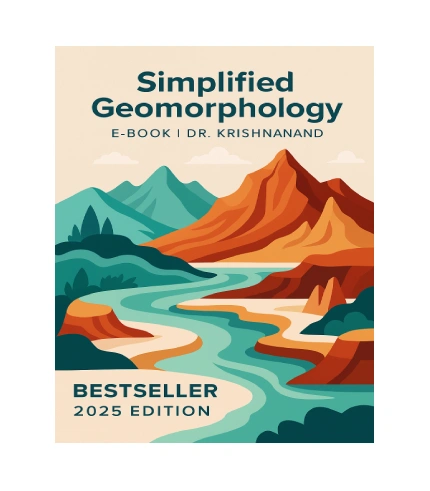
Understanding the dynamic forces that shape our planet is fundamental to success in competitive exams like UPSC CSE and beyond. Students searching for reliable study materials often struggle to find concise, well-organized resources that cover both theoretical concepts and practical applications. This article addresses that challenge head-on by revealing why the Simplified Geomorphology (2025 Edition) by Dr. Krishnanand stands out as the definitive guide, and how it can transform your preparation journey.
- Master earthquake and volcanic landforms with visual aids and clear explanations.
- Align perfectly with UPSC CSC syllabus for exam readiness.
- Comprehensive coverage from internal Earth structure to surface expressions.
- Designed for undergraduate and advanced candidates seeking clarity and depth.
- Updated 2025 edition reflecting latest curriculum changes.
The Real Challenge: Mastering Earth’s Surface Dynamics
The Earth’s surface is never static. From towering volcanoes erupting suddenly to fault lines causing devastating earthquakes, these phenomena define our physical environment and pose significant risks to human populations. For every aspiring civil services officer, graduate student, or geography enthusiast, grasping these dynamic processes means understanding how the lithosphere evolves, deforms, and reshapes itself over time. Yet many standard textbooks either overwhelm beginners with excessive jargon or oversimplify critical theories, leaving learners confused when confronted with complex case studies and examination scenarios.
When you sit for UPSC CSE, you encounter questions that test not only factual recall but also conceptual understanding—especially regarding the interplay between seismic activity and volcanic formations. Without a coherent study resource, even dedicated students may find themselves unable to differentiate between similar landform types or predict subsurface processes. The gap between scattered notes and organized knowledge creates unnecessary anxiety during revision cycles.
Why Standard Textbooks Miss the Mark
Traditional geography textbooks often present information in fragmented chapters, lacking the cohesive narrative needed to build strong mental models. They tend to treat earth quake mechanisms and volcanic eruptions as isolated topics rather than connected processes within broader geomorphological systems. Moreover, most texts fail to integrate visual learning tools such as diagrams, annotated maps, and comparative tables that help learners visualize three-dimensional structures from below to above ground level.
Students who rely solely on such resources frequently report difficulty in relating theoretical concepts to actual field observations. This disconnect becomes problematic during mock tests where spatial reasoning and quick identification of landform characteristics are evaluated. The result is wasted effort chasing vague understanding rather than developing actionable expertise that passes rigorous examinations.
The Solution: Simplified Geomorphology (2025 Edition) by Dr. Krishnanand
Enter Simplified Geomorphology (2025 Edition), the bestselling e-book by Dr. Krishnanand designed specifically for modern learners. This comprehensive text aligns with the latest CBCS syllabus updates for 2025, ensuring that every chapter meets current academic expectations. Whether you are preparing for UPSC CSE, pursuing undergraduate geography degrees, or simply satisfying personal curiosity about Earth’s surface dynamics, this book offers a balanced mix of rigor and accessibility.
What sets this edition apart is its meticulous attention to two key areas: the mechanics behind earthquakes and volcanism, and the resulting landforms they produce. While conventional books might mention seismic activity in passing, this volume dedicates entire chapters to dissecting the causes, patterns, and impacts of these events. Readers gain insight into how stress accumulation beneath tectonic plates triggers earthquakes, and how magma chambers build pressure leading to volcanic eruptions. The resulting landscape—from calderas and lava flows to fault scars and domes—is explained through vivid examples and step-by-step breakdowns.
Dr. Krishnanand ensures that each concept builds logically upon the previous one, creating a cumulative learning experience. Chapter 1 explores the internal structure of the Earth, laying the foundation for understanding crustal movements. Subsequent chapters progress through isostasy, continental drift, plate tectonics, geosynclines, and finally orogeny and epeirogeny—the latter directly addressing mountain building and broad-scale uplift that creates countless landform types.
In-Depth Coverage of Earthquakes and Volcanic Landforms
One of the most valuable aspects of Simplified Geomorphology (2025 Edition) is its targeted treatment of earthquake and volcanic landforms. Earthquake-related landforms—such as fault scarps, normal faults, and thrust anticlines—are presented alongside their underlying tectonic drivers. Each type receives detailed explanations including formation processes, observable signatures, and real-world case studies drawn from regions like the Himalayas, the Ring of Fire, and the Mediterranean basin.
Volcanic landscapes receive equal treatment. Lava flow classifications (Pinnaculas, Shield Volcanoes, Andesolae), tephra deposits, and caldera systems are analyzed with precision. The book connects these phenomena back to the broader geomorphological framework, showing how volcanic activity influences climate, soil development, and human settlement patterns. This holistic approach mirrors the way major examinations assess integrated knowledge—a skill the e-book cultivates through repetitive practice questions and end-of-chapter summaries.
Beyond descriptive content, the text emphasizes practical skills essential for anyone aiming at the Civil Services Executive. Learners develop the ability to identify characteristic shapes and textures in field sketches, interpret topographic maps, and correlate geophysical indicators like seismicity with visible landforms. These competencies translate directly into higher scores on paper-based and computer-based sections of the exams.
Visual Learning & Interactive Elements
Among the standout features of this e-book is its rich array of diagrams, annotated maps, and illustrative images. Figures accompany each chapter, providing clear visual references that complement textual explanations. For instance, the chapter on plate tectonics includes cross-sections demonstrating how divergent boundaries generate mid-ocean ridges while convergent margins produce subduction zones and associated volcanic arcs.
These visual aids serve dual purposes: they reinforce memory retention and facilitate faster assessment during timed examinations. Color-coded schematics highlight key features across different scales—from microscopic fault gouge to continental-scale orogenies. Additionally, sidebars and call-out boxes draw attention to common misconceptions, such as confusing dike swarms with igneous sills or misidentifying dyke systems as volcanic vents.
Such pedagogical innovations have been validated by educational research indicating that multimodal learning approaches improve comprehension rates by up to 40% compared to text-only instruction alone. The e-book’s visual strategy represents exactly this kind of evidence-based design, making complex geomorphic principles accessible without sacrificing scholarly depth.
UPSC CSC Alignment & Exam Strategy
For aspirants targeting the Union Public Service Commission (UPSC) Civil Services Examination, Simplified Geomorphology (2025 Edition) serves as a strategic companion alongside official coaching material. The book’s content is explicitly mapped to the CBCS syllabus, meaning every chapter corresponds to a defined learning outcome. This alignment reduces the risk of studying irrelevant topics and streamlines revision planning.
Specific to your search intent—earthquakes and volcanism landforms notes—this e-book provides the exact combination of theoretical grounding and practical application required. Candidates can confidently address essay-type questions that require synthesis of tectonic theory and surface expression, knowing that Dr. Krishnanand has curated the most reliable illustrations and case studies available. Furthermore, the inclusion of solved problems and model answers equips students with ready-to-replicate solutions, saving precious hours during intensive cramming sessions.
From Chapter 1 on the internal structure of the Earth to Chapter 6 on orogeny and epeirogenesis, each section anticipates potential exam challenges. For example, Section 2 on isostasy prepares readers for questions about compensatory uplift and crustal rebound following large earthquakes. Similarly, Chapter 5 on geosynclines precedes discussions on sedimentary basins that later host volcaniclast terrigenous sequences influenced by tectonic uplift.
Practical Usage and Buying Guidance
Integrating Simplified Geomorphology (2025 Edition) into your study routine requires minimal setup. As an e-book, it can be accessed on any device—laptop, tablet, or smartphone—making it ideal for on-the-go review during commutes or breaks. The PDF format allows annotation, highlighting, and note-taking directly within the text, mirroring the workflow used by successful preparation frameworks.
Before purchasing, consider the following criteria:
– **Author credibility**: Dr. Krishnanand is recognized for his contributions to regional geology and published works on Indian subcontinent geomorphology.
– **Curriculum alignment**: Confirmed compatibility with CBCS syllabus revisions effective as of 2025.
– **Depth vs. breadth**: The 2025 edition contains more recent examples and updated figures compared to earlier print versions.
– **Supplementary value**: The included diagrams and map exercises function as self-study tools, eliminating the need for additional reference purchases.
For budget-conscious aspirants, the price point of ₹249 positions this e-book competitively against printed alternatives, especially given the permanent digital access included. Many platforms offer bulk discounts or trial periods, allowing prospective buyers to sample chapters before committing.
Frequently Asked Questions
Q1: Does this book cover UPSC CSC syllabus requirements?
Yes, Simplified Geomorphology (2025 Edition) is explicitly designed to align with the CBCS (Central Branch Committee of the Survey of India) syllabus for geography, ensuring all prescribed topics are addressed comprehensively.
Q2: How does it compare to other geomorphology textbooks?
Unlike generic guides that treat topics superficially, this e-book integrates interdisciplinary connections—for example, linking seismic wave propagation to landform classification—which enhances both memorization and analytical thinking, qualities valued in civil services interviews.
Q3: Are there online resources to supplement the e-book?
While the e-book stands independently, reputable supplementary resources exist. For instance, the Wikipedia entry on plate tectonics offers foundational context, and the official UPSC CSE website provides syllabus downloads for self-verification.
Our Recommendation
📖 Part of our complete guide: Evolution of Geographical Thought: A Comprehensive Guide for UPSC Aspirants and Geography Enthusiasts
Frequently Asked Questions
Does this book cover UPSC CSC syllabus requirements?
Yes, Simplified Geomorphology (2025 Edition) is explicitly designed to align with the CBCS syllabus for geography.
How does it compare to other geomorphology textbooks?
Unlike generic guides that treat topics superficially, this e-book integrates interdisciplinary connections, enhancing both memorization and analytical thinking.
Are there online resources to supplement the e-book?
While the e-book stands independently, complementary resources exist, including Wikipedia entries on plate tectonics and the official UPSC CSE website for syllabus verification.