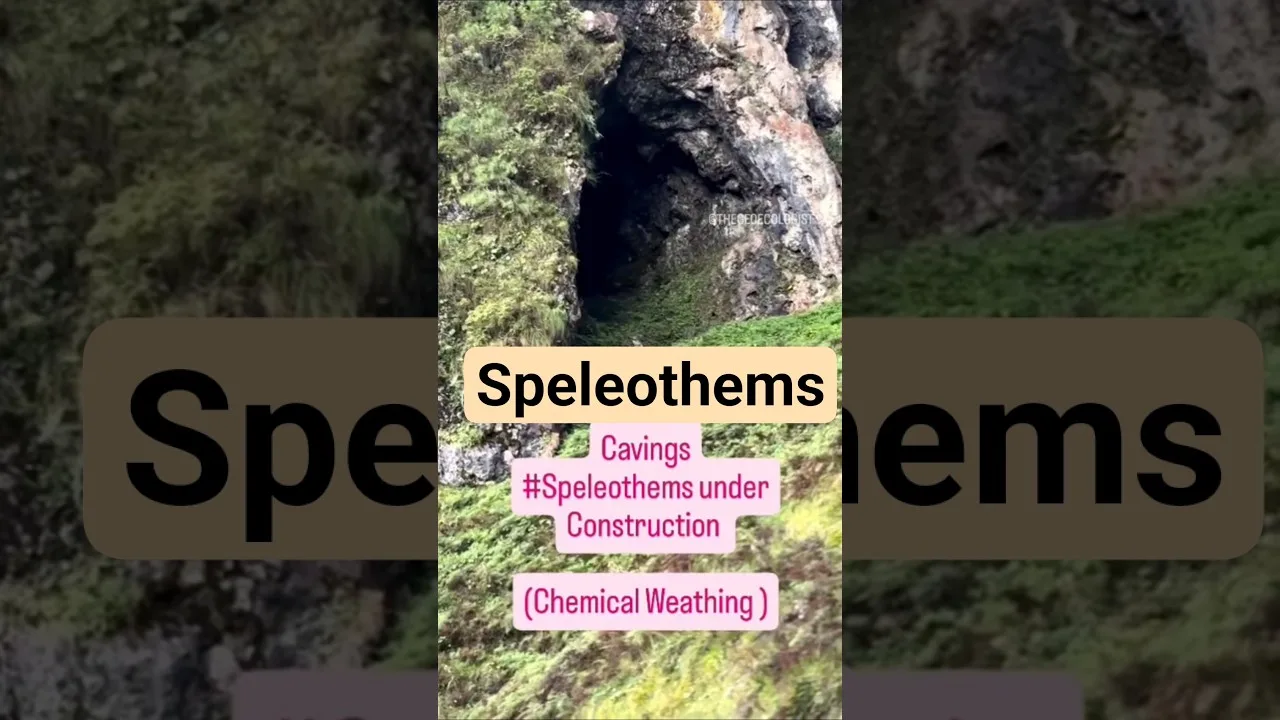
Understanding Speleothems formation #caves #weathering #thegeoecologist #shorts
Of course. Here is an article based on your request.
The Silent Artisans: How Water and Time Sculpt Caves and Create Stunning Speleothems
Deep inside the limestone caves of the Himalayas, nature is at work — drop by drop. 💧
This is not a story of brute force, but of delicate persistence. It is a tale of chemistry, geology, and time, working in concert to create the breathtaking subterranean landscapes we call caves. At the heart of this story are the cave formations themselves: the stalactites, stalagmites, and other speleothems that transform dark caverns into crystalline cathedrals.
The First Cut: Chemical Weathering
The journey to a cave begins not underground, but on the surface. Rainwater, which is naturally slightly acidic, falls through the atmosphere. As it does, it absorbs carbon dioxide (CO₂) from the air, undergoing a chemical transformation. The water (H₂O) and carbon dioxide (CO₂) combine to form a weak acid known as carbonic acid (H₂CO₃).
This weak acid is the key that unlocks the rock. As it percolates down through the soil and bedrock, it reacts with the bedrock itself. In the case of limestone caves, that rock is primarily calcium carbonate (CaCO₃) – the same material that makes up chalk, marble, and countless marine shells.
The carbonic acid reacts with the calcium carbonate, dissolving it and carving out tiny passages. This process is known as chemical weathering.
The Birth of a Cave
Over centuries, this dissolution continues. The acidic water finds the weakest points in the rock – tiny fractures, joints, and bedding planes – and begins to widen them. Year after year, drop by drop, the process continues. The water carries away the dissolved calcium carbonate, slowly, methodically hollowing out the rock from within. What begins as a microscopic fissure becomes a tunnel, then a chamber, and finally, a vast subterranean network.
But the work doesn’t stop once the cave is hollowed out.
The Art of Decoration: Speleothem Formation
When the acidic, mineral-rich water (now called dripwater) finally enters the open cavity of a cave, a new phase begins. The cave environment is different. Carbon dioxide (CO₂) in the cave air is often at a different concentration than it was in the soil above.
When the dripwater enters this new environment, it seeks equilibrium. If the concentration of CO₂ in the cave air is lower than in the water, the carbon dioxide will begin to degas, or escape, from the droplet.
This is the crucial moment. When the carbon dioxide leaves the water, it can no longer hold onto all the dissolved calcium carbonate it was carrying. The calcium carbonate (calcite) must come out of the solution. It does so by precipitating, or solidifying, on the nearest available surface.
This is where the magic happens.
- A drop hanging from the ceiling loses its CO₂ and deposits a tiny, almost invisible, ring of calcite.
- The next drop does the same, and the one after that.
- Over decades and centuries, this ring grows downward, atom by atom, into a magnificent, icicle-like stalactite (remember: t for top).
Meanwhile, on the floor below, the drops that fall from the ceiling splatter. They, too, lose their carbon dioxide and deposit their tiny load of calcite. Over centuries, this pile of precipitated calcite grows upward from the floor, forming a stalagmite ( g for ground).
Slowly, imperceptibly, the two grow towards one another, destined to one day meet and form a single, massive column.
A Story in Stone
This process, known as speleothem formation, is achingly slow. A single stalactite might grow only a fraction of an inch every century. The largest formations are tens of thousands, even hundreds of thousands of years old.
They are, in the truest sense, geological records. The shape of a stalagmite can reveal the rate of water flow into a cave. The isotopes and trace elements locked within the calcite can tell scientists about the climate and environment of the Earth at the time that layer was deposited, stretching back tens of thousands of years.
Each stalactite, stalagmite, flowstone, and helictite is a testament to patience. They are a physical record of Earth’s history, written in stone by the slow, steady hand of time and chemistry.
So the next time you see an image of a cave, remember: you are not just looking at a rock. You are looking at a clock. A calendar. A sculpture. An artwork.
All carved, drop by drop, by the most patient artist of all: time itself.
Caves #Weathering #Speleothems #TheGeoecologist #Geology #EarthScience #Speleology #Himalayas #Caving #Shorts<|begin▁of▁sentence|>
To Download E-Books & Study Material Visit The Shop Page