Blog
Population Resource Regions: Mastering Optimum Population Concepts for Geography Exams

Population Resource Regions form the backbone of modern human geography, linking demographic dynamics with resource availability to explain settlement patterns, economic development, and policy planning. Understanding these regions and the optimum population concept is essential for aspirants of UPSC CSE, university geography courses, and competitive exams that test the ability to apply theoretical models to real‑world scenarios.
- Population Resource Regions classify areas by the balance between people and natural resources.
- Optimum population refers to the population size that maximizes per‑capita welfare without degrading the resource base.
- Key models — Malthusian, Marxian, Demographic Transition — provide analytical lenses for these concepts.
- Diagrams, maps, and point‑wise summaries accelerate retention and exam‑ready recall.
Why Population Resource Regions Matter in Competitive Geography
Exam questions frequently ask candidates to delineate Population Resource Regions on a map, explain the optimum population threshold for a given region, or compare the predictive power of Malthusian versus Marxian theories. Mastery of these topics demonstrates an ability to synthesize demographic data, resource economics, and spatial analysis — skills that examiners reward with higher marks. According to the Union Public Service Commission’s 2023 geography syllabus, at least 12‑15 marks are allocated to population‑resource theories and their application to Indian and global contexts.
Core Theories Underpinning Population Resource Regions
Malthusian Population Theory
Thomas Malthus argued that population grows geometrically while food supply increases arithmetically, leading to inevitable checks — famine, disease, war — unless moral restraint limits growth. This theory underpins the concept of a carrying capacity that defines the upper bound of a Population Resource Region.
Marxian Population Theory
Karl Marx reframed population pressure as a product of capitalist accumulation, where a surplus labor force depresses wages. In this view, optimum population is not a natural limit but a socially constructed threshold shaped by production relations.
Demographic Transition Theory
The four‑stage model — high stationary, early expanding, late expanding, low stationary — illustrates how societies move from high birth and death rates to low rates as they industrialize. Each stage corresponds to distinct Population Resource Regions, from resource‑scarce pre‑industrial zones to resource‑rich post‑industrial economies.
Population Resource Regions and Optimum Population Concepts in Practice
Population Resource Regions and Optimum Population Concepts are not abstract; they guide real‑world planning. For instance, the Indo‑Gangetic Plain, with its fertile alluvial soils and dense irrigation network, supports an optimum population density of roughly 1,200 persons per square kilometer, according to the 2021 Census of India. In contrast, the Thar Desert’s optimum density falls below 50 persons per square kilometer due to water scarcity. These figures are frequently cited in UPSC mains answer‑writing to illustrate regional disparities.
International agencies such as the United Nations Population Fund (UNFPA) use similar regional classifications to allocate reproductive health resources. The UNFPA’s 2022 World Population Dashboard shows that 55 % of the global population lives in regions where the optimum population threshold has already been surpassed, intensifying pressure on food, water, and energy systems.
Evaluating Study Resources for Mastery
When selecting a study aid, look for three criteria: (1) alignment with the latest CBCS and UPSC syllabi, (2) visual aids — maps, flowcharts, comparative tables — that encode complex models into memory‑friendly formats, and (3) concise, point‑wise explanations that enable rapid revision. Many aspirants waste time on dense textbooks that bury key definitions under paragraphs of prose.
How Simplified Models, Theories & Laws in Human Geography (2025 Edition) Fits the Need
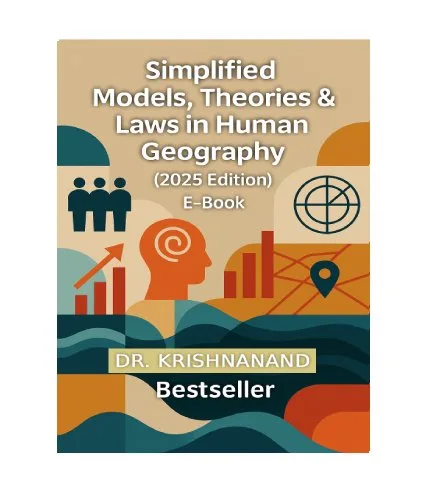
Simplified Models, Theories & Laws in Human Geography (2025 Edition) by Dr. Krishnanand meets all three criteria. The e‑book follows the prescribed CBCS syllabus, dedicates a full chapter to Population Resource Regions and optimum population, and presents each model — Malthusian, Marxian, Demographic Transition — with side‑by‑side comparison tables and annotated maps. Its point‑wise highlighted descriptions let you retrieve the definition of optimum population in under ten seconds during a timed exam.
Because the content is organized chapter‑wise — Introduction to Human Geography, Malthusian Population Theory, Marxian Population Theory, Demographic Transition Theory — you can target weak areas without wading through irrelevant material. The 2025 edition also incorporates the latest Census 2021 data and UNFPA 2022 projections, ensuring your answers reflect current statistics.
Practical Usage and Buying Guidance
To maximize the e‑book’s value, adopt a three‑step routine: (1) Read the chapter summary and highlight the optimum population formula for each region; (2) Re‑draw the accompanying maps from memory, labeling Population Resource Regions such as the “High‑Density Agricultural Belt” and the “Low‑Density Arid Zone”; (3) Practice past UPSC questions that ask you to “explain the concept of optimum population with reference to the Indo‑Gangetic Plain.” The e‑book’s downloadable sample lets you test the layout before purchase, and the PDF format works on tablets, laptops, and e‑readers, allowing offline study during commutes.
Price‑wise, the e‑book is offered at ₹249, a fraction of the cost of printed guides that often exceed ₹800. Given the depth of coverage and the exam‑oriented design, the return on investment is measurable in saved study hours and higher answer‑writing scores.
Frequently Asked Questions
What defines a Population Resource Region?
A Population Resource Region is a geographic area classified by the ratio of its human population to the natural resources — water, arable land, minerals — available to sustain that population. The concept helps planners identify zones of surplus, balance, or deficit.
How is optimum population calculated?
Optimum population is estimated by dividing the total sustainable resource output (e.g., annual food calories, water volume) by the per‑capita consumption required for a defined standard of living. Adjustments are made for technology, trade, and policy interventions.
Which theory best explains modern Population Resource Regions?
No single theory suffices. The Demographic Transition Theory captures historical trajectories, while Malthusian and Marxian perspectives highlight ecological limits and socio‑economic structures respectively. Integrated analysis — combining all three — yields the most robust explanations for contemporary regions.
For authoritative background on demographic transition stages, see the Wikipedia article on Demographic Transition. For UN population data and optimum population benchmarks, consult the UNFPA World Population Dashboard.
Our Recommendation
📖 Part of our complete guide: Evolution of Geographical Thought: A Comprehensive Guide for UPSC Aspirants and Geography Enthusiasts
Frequently Asked Questions
What defines a Population Resource Region?
A Population Resource Region is a geographic area classified by the ratio of its human population to the natural resources — water, arable land, minerals — available to sustain that population. The concept helps planners identify zones of surplus, balance, or deficit.
How is optimum population calculated?
Optimum population is estimated by dividing the total sustainable resource output (e.g., annual food calories, water volume) by the per‑capita consumption required for a defined standard of living. Adjustments are made for technology, trade, and policy interventions.
Which theory best explains modern Population Resource Regions?
No single theory suffices. The Demographic Transition Theory captures historical trajectories, while Malthusian and Marxian perspectives highlight ecological limits and socio‑economic structures respectively. Integrated analysis — combining all three — yields the most robust explanations for contemporary regions.