Blog
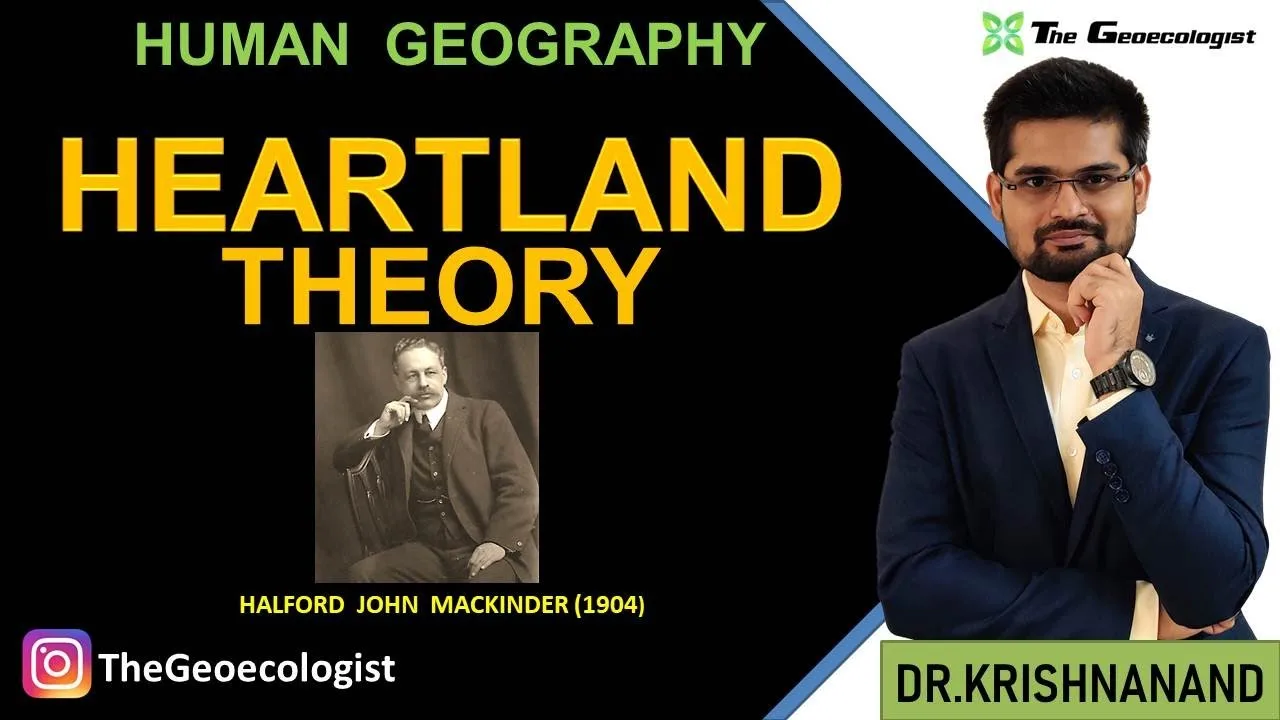
Heartland Theory | Mackinder | Heartland Theory UPSC

Heartland Theory | Mackinder | Heartland Theory UPSC
Mackinder’s Heartland Theory: A Key Concept in Geopolitics and Human Geography
Introduction
One of the most influential geopolitical theories in Human Geography is Mackinder’s Heartland Theory, proposed by British geographer Sir Halford Mackinder in 1904. This theory addresses the significance of geographical control over key regions in shaping global dominance. It is a crucial topic for UPSC Geography Optional aspirants and is also relevant for students of Political Geography and Geopolitics.
In this article, we will explore:
- The concept of the Heartland Theory
- Its implications in world politics
- Criticism and contemporary relevance
For a detailed PDF E-book on Human Geography, click here: MithilaCraft – Human Geography E-book
Mackinder’s Heartland Theory Explained
1. The Geographical Pivot of History (1904)
In his paper “The Geographical Pivot of History,” Mackinder introduced the concept of the “Heartland”—a vast, resource-rich region in Eurasia (Central Asia and Eastern Europe). He argued that whoever controlled this region could dominate global politics.
2. Key Components of the Theory
Mackinder divided the world into three zones:
The Heartland (Pivot Area):
- Located in interior Eurasia, roughly corresponding to Russia and Central Asia.
- Difficult to invade due to natural barriers (mountains, forests, harsh climate).
- Rich in minerals, energy resources, and agricultural lands.
The Inner Crescent (Rimland):
- Surrounds the Heartland, including Europe, the Middle East, South Asia, and East Asia.
- Acts as a buffer zone between the Heartland and maritime powers.
The Outer Crescent (Offshore Islands & Americas):
- Includes Britain, Japan, North America, and Australia.
- Maritime powers with naval dominance.
3. Mackinder’s Famous Quote
His theory is best summarized by his famous assertion:
“Who rules East Europe commands the Heartland;
Who rules the Heartland commands the World-Island (Eurasia);
Who rules the World-Island commands the world.”
This highlights the strategic importance of controlling Eastern Europe and Central Asia.
Geopolitical Implications
1. Influence on Cold War Politics
- The Soviet Union’s expansion into Eastern Europe was seen as an attempt to control the Heartland.
- The US containment policy (NATO, Marshall Plan) aimed at preventing Soviet dominance over Eurasia.
2. Modern Relevance
- Russia’s geopolitical ambitions in Ukraine and Central Asia reflect Mackinder’s theory.
- China’s Belt and Road Initiative (BRI) seeks to integrate the Heartland economically.
- US and NATO’s involvement in Eastern Europe (Ukraine War) aligns with preventing dominance by a single power.
Criticism of the Heartland Theory
- Overemphasis on Land Power: Mackinder underestimated the role of naval and air power (e.g., US dominance via sea control).
- Technological Advancements: Missile technology and cybersecurity reduce geographical barriers.
- Economic Globalization: Trade networks (like the EU, ASEAN) reduce the Heartland’s isolation.
Despite these criticisms, Mackinder’s theory remains a foundation for understanding geopolitical strategies.
Conclusion: Why Heartland Theory is Important for UPSC?
For UPSC Geography Optional aspirants, Mackinder’s Heartland Theory is crucial because:
- It explains historical and modern geopolitical conflicts.
- It integrates concepts of Political Geography and International Relations.
- Helps analyze contemporary issues like Russia-Ukraine war, China’s expansion, and NATO’s role.
For a comprehensive Human Geography E-book, visit: MithilaCraft
Further Learning Resources
- YouTube Video Lecture: Heartland Theory by Dr. Krishnanand
- Follow on Instagram: @thegeoecologist
- Website: TheGeoecologist
- Subscribe: THEGEOECOLOGIST YouTube Channel
#HeartlandTheory #Mackinder #Geopolitics #UPSCGeography #HumanGeography
By understanding Mackinder’s Heartland Theory, geographical scholars and UPSC aspirants gain valuable insights into the strategic importance of land power in shaping world history and contemporary politics.
To Download E-Books & Study Material Visit The Shop Page