Blog
Growth Centre & Growth Foci| R.P. Mishra |Jacques Boudeville

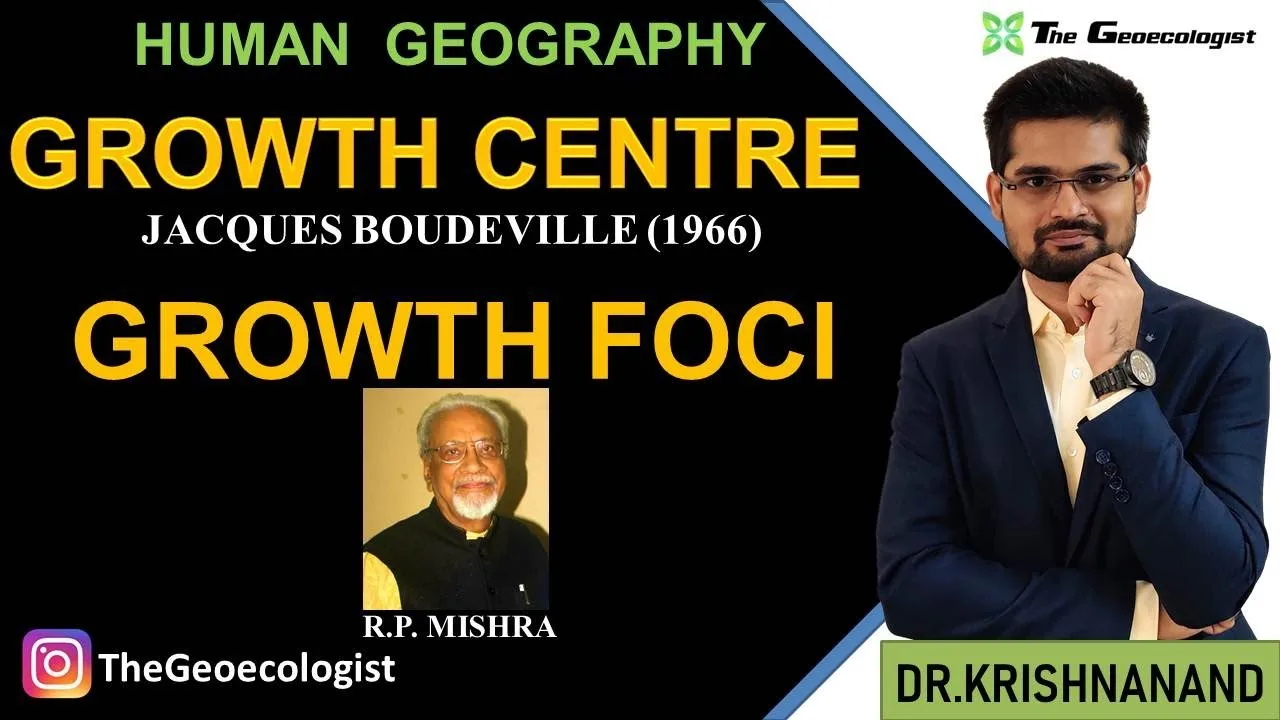
Growth Centre & Growth Foci| R.P. Mishra |Jacques Boudeville
Growth Centre and Growth Foci: Concepts by Boudeville and R.P. Mishra
Introduction
Growth poles and growth centres are fundamental concepts in regional development theories, aiming to reduce regional disparities by stimulating economic activities in underdeveloped areas. Two significant contributors to this discourse are Jacques Boudeville (Growth Centre theory) and R.P. Mishra (Growth Foci model). These theories have been widely studied in Human Geography, especially for competitive exams like the UPSC Geography Optional.
In this article, we will explore the concepts of Growth Centres (Boudeville) and Growth Foci (R.P. Mishra), their significance, and their application in regional planning.
Growth Centre Theory by Jacques Boudeville
Jacques Boudeville, a French economist, expanded François Perroux’s Growth Pole Theory into a spatial and geographical context. Boudeville emphasized that economic growth does not occur uniformly but rather concentrates in specific regions—growth centres—that subsequently spread development to surrounding areas.
Key Features of Boudeville’s Growth Centre Theory
- Spatial Dimension: Unlike Perroux, who focused on economic sectors, Boudeville incorporated geographical space, identifying nodes (centres) where industries cluster.
- Polarization and Trickle-Down Effect: Growth centres attract investments, infrastructure, and skilled labour, creating a polarized development that eventually diffuses to peripheral regions.
- Hierarchy of Centres: Boudeville classified growth centres into different tiers (metropolitan cities, regional towns, small towns), each playing a unique role in regional development.
- Linkages: Economic activities in these centres are interconnected through forward and backward linkages, enhancing productivity and employment.
Criticism
- Overemphasis on industry: Neglects rural and agricultural sectors.
- Assumed trickle-down effect: Does not always materialize in practice, leading to regional imbalances.
Growth Foci Model by R.P. Mishra
Indian geographer R.P. Mishra developed the Growth Foci model to address regional disparities in developing economies like India. Unlike Boudeville’s urban-industrial focus, Mishra emphasized rural-urban integration and multi-level growth diffusion.
Key Characteristics of Growth Foci
- Hierarchical Structure: Mishra proposed a five-tier system of growth foci:
- Village Growth Points (small service centres)
- Micro Growth Centres (larger villages with basic amenities)
- Growth Centres (small towns with agro-industries)
- Growth Points (district-level urban centres)
- Service Centres (metropolitan cities)
- Rural Development Focus: Unlike Boudeville, Mishra prioritized grassroots development to uplift rural economies before integrating them with urban centres.
- Decentralized Planning: Promoted bottom-up development by strengthening local infrastructure (roads, schools, markets) at each level.
Advantages Over Boudeville’s Model
- More inclusive, considering rural and semi-urban areas.
- Suitable for developing countries where urbanization is uneven.
- Reduces migration pressure on metros by improving local opportunities.
Challenges
- Implementation hurdles: Requires strong administrative coordination.
- Financial constraints: Many developing nations lack sufficient funds for integrated planning.
Comparative Analysis
| Aspect | Boudeville’s Growth Centre | R.P. Mishra’s Growth Foci |
|---|---|---|
| Focus | Urban-industrial growth | Rural-urban integration |
| Approach | Top-down | Bottom-up |
| Hierarchy | Industrial polarization | Village-city linkage |
| Applicability | Developed nations | Developing nations |
| Key Contribution | Spatial industrial clustering | Decentralized development |
Conclusion
Both Boudeville’s Growth Centre and R.P. Mishra’s Growth Foci theories provide vital frameworks for understanding regional development. While Boudeville’s model focuses on industrial hubs, Mishra’s approach is more balanced, emphasizing rural upliftment.
For UPSC Geography Optional aspirants, mastering these concepts is crucial for answering questions on regional planning, development models, and economic geography.
Resources
📌 E-book (PDF): Human Geography by TheGeoecologist
📌 Watch Video Lecture: YouTube – TheGeoecologist
📌 Instagram: @thegeoecologist
#growthcentre #Boudeville #growthfoci #UPSCGeography #HumanGeography
By understanding these models, students and policymakers can better analyze strategies to foster equitable and sustainable development worldwide. 🌍
To Download E-Books & Study Material Visit The Shop Page