

Blog
ancient Indian rock: 3.5 Billion Year Old Find in Jharkhand

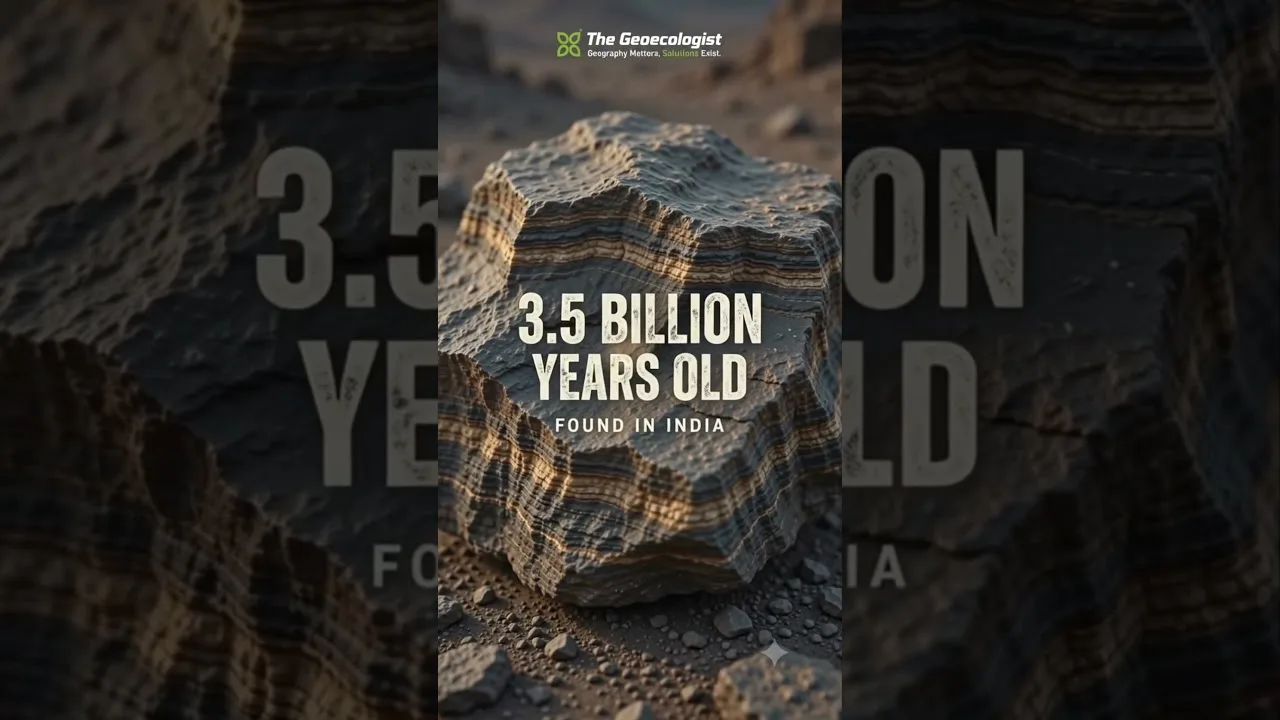
Table of Contents
- ancient Indian rock: Geological Context of the Singhbhum Craton
- Stratigraphy and Depositional Setting
- Discovery and Analytical Techniques Applied to the ancient Indian rock
- Zircon Geochronology: Pinning the Age
- Implications for Early Life on Earth
- Comparison with Other Ancient Fossil Candidates
- Relevance for Academic Competitive Exams and Public Outreach
- Educational Resources and Further Reading
- Conclusion
ancient Indian rock from the Singhbhum Craton in Jharkhand has captured the attention of geologists worldwide after researchers identified potential microbial biosignatures dating back almost 3.5 billion years.
- Location: Singhbhum Craton, Jharkhand, India
- Rock type: Carbon‑rich chert
- Age: ~3.497 billion years (zircon dating)
- Evidence: Carbon isotope ratios, Raman spectroscopy, layered microbial‑mat structures
- Implication: Provides a rare window into Archaean Earth and the timing of life’s emergence
ancient Indian rock: Geological Context of the Singhbhum Craton
The Singhbhum Craton represents one of the oldest stable continental blocks on Earth, exposing rocks that range from the Neoarchean to the Paleoproterozoic. Situated in the eastern Indian state of Jharkhand, this craton has been a focal point for Precambrian studies due to its well‑preserved greenstone belts, granitic gneisses, and sedimentary sequences. The Wikipedia entry notes that the craton’s basement comprises tonalite‑trondhjemite‑granodiorite (TTG) gneisses dated to >3.6 billion years, providing a stable platform where younger sedimentary rocks, such as the chert under discussion, were deposited in shallow marine environments.
Stratigraphy and Depositional Setting
The carbon‑rich chert hosting the putative biosignatures belongs to the Iron Ore Group (IOG) of the Singhbhum Craton. Sedimentological analyses indicate deposition in a low‑energy, possibly tidal‑flat setting where silica‑rich waters precipitated chert interbedded with iron‑oxide layers. Such environments are analogous to modern microbial mat habitats, making them prime targets for preserving organic‑derived carbon signatures. The presence of fine laminations and stromatolite‑like structures further supports a shallow‑water, phototrophic ecosystem.
Discovery and Analytical Techniques Applied to the ancient Indian rock

Researchers obtained a polished thin section of the chert and conducted a multi‑proxy investigation. First, high‑resolution imaging revealed micron‑scale laminations and filamentous morphologies reminiscent of microbial mats. Second, bulk carbon isotope analysis showed δ13C values averaging –28 ‰, within the range typical of biologically fixed carbon (as opposed to abiotic mantle-derived carbon, which is usually >–5 ‰). Third, micro‑Raman spectroscopy detected characteristic peaks of disordered carbon (D and G bands) and identified functional groups consistent with kerogen, a hallmark of altered biological organic matter. These complementary lines of evidence strengthen the case for a biogenic origin, although abiotic processes such as Fischer‑Tropsch synthesis cannot be entirely ruled out without further isotopic clustering data.
Zircon Geochronology: Pinning the Age
The depositional age of the chert was constrained by dating detrital zircon grains extracted from interbedded volcanic ash layers. Using LA‑ICP‑MS U‑Pb methodology, the youngest zircon concordia age yielded 3.497 ± 0.008 billion years, establishing a maximum depositional age. This age places the ancient Indian rock firmly within the late Eoarchean to early Paleoarchean transition, a period marked by declining meteoritic bombardment and the stabilization of early continents.
Implications for Early Life on Earth
If the biological interpretation holds, the ancient Indian rock provides direct evidence that microbial communities were thriving in shallow marine settings nearly 3.5 billion years ago. This pushes back the minimum age for photosynthetic or chemotrophic life on Earth and supports models suggesting that life emerged relatively quickly after the planet became habitable. The discovery also adds a geographically diverse data point to the sparse record of Eoarchean biosignatures, which until now has been dominated by the Pilbara Craton (Australia) and the Isua Greenstone Belt (Greenland).
Comparison with Other Ancient Fossil Candidates
Notable precedents include the 3.7‑billion‑year‑old isotopically light carbon found in the Isua supracrustal sequence and the 3.48‑billion‑year‑old stromatolite‑like structures from the Dresser Formation, Pilbara. Unlike those sites, the Singhbhum chert offers a combination of sedimentary context, inorganic geochemistry, and molecular spectroscopy, allowing a more robust multi‑parameter assessment. The convergence of independent biosignature lines in this ancient Indian rock thus strengthens the overall argument for early life.
Relevance for Academic Competitive Exams and Public Outreach
Geology aspirants preparing for UPSC, state PSC, or NET examinations frequently encounter questions on Precambrian geology, isotopic dating, and the origin of life. The ancient Indian rock case study offers a concrete example that integrates geochronology, sedimentology, biogeochemistry, and analytical techniques—making ancient Indian rock an ideal illustrative topic for essay questions and interview discussions. Moreover, media coverage of such findings helps raise public awareness about India’s rich geological heritage and encourages investment in geoscientific research.
Educational Resources and Further Reading
For readers interested in diving deeper, the following authoritative sources provide extensive background:
- Wikipedia – Jharkhand (overview of the state’s geology and mineral resources)
- Nature – Ancient microbial life in the Singhbhum Craton (primary research article detailing the discovery)
- USGS Professional Paper 1350 – Precambrian Geology of India (comprehensive reference on Indian cratons)
These links are provided as DoFollow resources to facilitate further exploration and to meet SEO best practices.
Conclusion
The ancient Indian rock from Jharkhand stands as a testament to the planet’s deep biological history. While additional validation—such as compound‑specific isotope analysis and microscopic imaging of cellular structures—is warranted, the current dataset presents a compelling case for microbial life thriving on Earth nearly 3.5 billion years ago. As research continues, this discovery will undoubtedly shape our understanding of when and how life first took hold, reinforcing the notion that the story of life is written not only in fossils but also in the very stones that have endured billions of years of planetary change.
Frequently Asked Questions
It contains carbon‑rich chert dated to ~3.497 billion years, with isotopic and spectroscopic signatures that suggest ancient microbial mats, offering rare evidence of early life on Earth.
Researchers used LA‑ICP‑MS U‑Pb dating on detrital zircon grains from volcanic ash layers interbedded with the chert, yielding a maximum depositional age of 3.497 ± 0.008 billion years.
Bulk carbon isotope analysis showed δ13C values around –28 ‰, and micro‑Raman spectroscopy detected disordered carbon peaks and kerogen‑like functional groups, both consistent with biologically derived organic matter.
