Blog
Water in the Atmosphere-NCERT Geography Class 11- Chapter 11

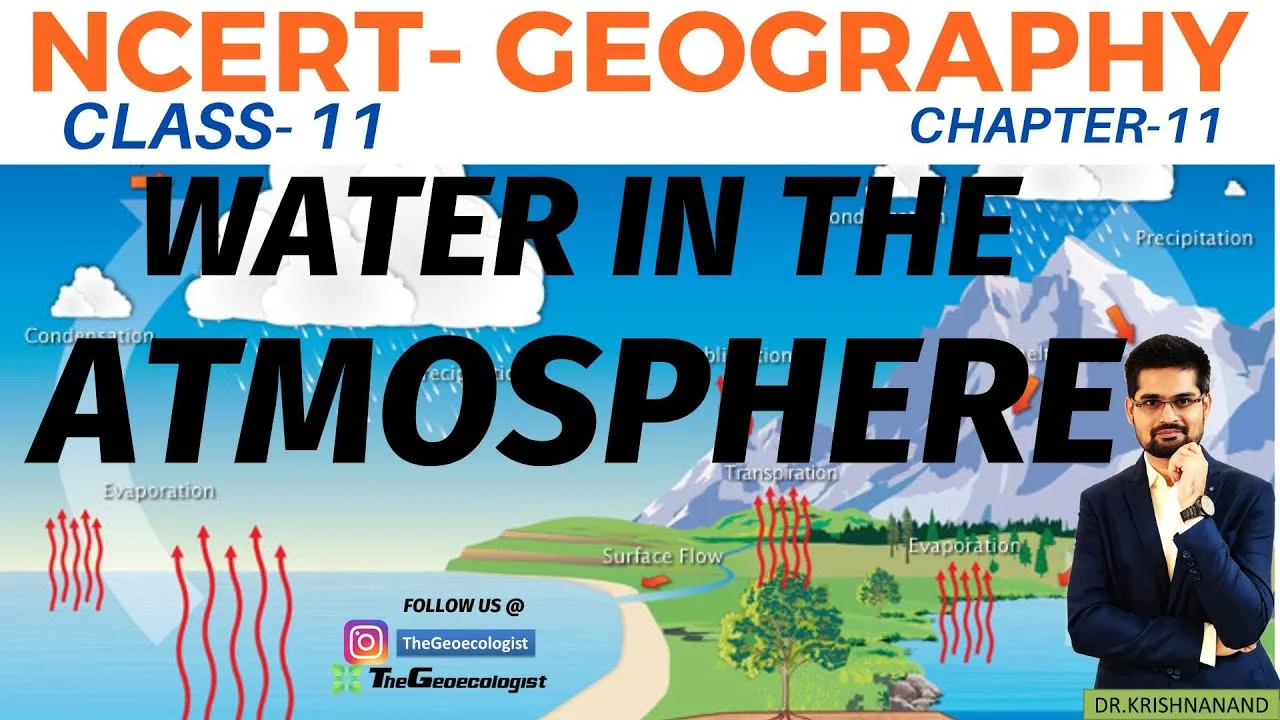
Water in the Atmosphere-NCERT Geography Class 11- Chapter 11
Understanding Water in the Atmosphere: A Comprehensive Guide for Class 11 CBSE and Competitive Exams
Water in the atmosphere plays a crucial role in shaping Earth’s weather and climate. NCERT Geography Class 11 Chapter 11, Water in the Atmosphere, simplifies these complex processes, making it essential for CBSE students and UPSC aspirants. This article breaks down key concepts from the chapter and complements insights from TheGeoecologist’s bilingual (Hindi-English) video tutorial, ensuring clarity for diverse learners.
What is Atmospheric Water?
The atmosphere contains water in three forms: gas (water vapour), liquid (raindrops, dew), and solid (snow, hail). This water undergoes a continuous cycle of evaporation, condensation, and precipitation, driving weather phenomena.
Key Concepts Explained
Humidity:
- Absolute Humidity: Total water vapour present in the air (measured in grams per cubic meter).
- Relative Humidity: Ratio of actual water vapour to the maximum amount air can hold at a given temperature. (Hint: Impacts human comfort and precipitation!)
- Tools like hygrometers measure humidity.
Evaporation & Condensation:
- Evaporation: Conversion of water into vapour, influenced by temperature, wind, and surface area.
- Condensation: Water vapour turning into liquid/solid when air cools below dew point. Forms like dew, frost, fog, and clouds emerge here.
- Clouds & Precipitation:
- Clouds form through adiabatic cooling (air expanding as it rises). Types include cirrus (wispy), cumulus (cotton-like), and stratus (sheet-like).
- Precipitation: Moisture falling as rain, snow, sleet, or hail. Mechanisms include:
- Convectional Rainfall (common in tropics, e.g., afternoon thunderstorms).
- Orographic Rainfall (windward side of mountains, e.g., Indian monsoon).
- Cyclonic/Frontal Rainfall (associated with cyclones or weather fronts).
Why is This Chapter Important?
- CBSE Exams: Direct questions on humidity, cloud types, and rainfall mechanisms.
- UPSC Preparation: Links to climatology, Indian monsoons, and disaster management (e.g., cyclones).
- Real-World Applications: Understanding weather forecasts, agriculture, and climate change impacts.
How TheGeoecologist’s Video Enhances Learning
TheGeoecologist’s bilingual video simplifies complex terms like संघनन (condensation) and वायुमंडलीय नमी (atmospheric humidity), aiding Hindi-medium students. Visual diagrams explain processes like cloud formation, while real-world examples connect theory to phenomena like monsoons.
Quick Revision Tips
- Memorize cloud types using acronyms (e.g., Cumulus = Cotton-like).
- Relate rainfall types to Indian geography:
- Convectional: Pre-monsoon summers in Kerala.
- Orographic: Cherrapunji’s heavy rains.
- Cyclonic: Bengal’s cyclones.
- Practice diagrams of the water cycle!
Final Thoughts
Mastering Water in the Atmosphere builds a strong foundation for geography and environmental science. Pair your NCERT reading with TheGeoecologist’s video for bilingual clarity, and revisit diagrams to visualize processes.
Ready to dive deeper? Enroll in specialized courses on TheGeoecologist’s Website for structured UPSC/CBSE guidance!
Follow for More Resources:
- Instagram: @thegeoecologist
- Email: krishna.geography@gmail.com
ncertclass11geography #ncertgeography #ncertrevision #upscpreparation #cbseclass11
(This article aligns with NCERT Class 11 Geography and TheGeoecologist’s pedagogical approach, ensuring exam-oriented learning!)
To Download E-Books & Study Material Visit The Shop Page