

Blog
Solar Orbiter south pole: First Historic View Reveals Solar Secrets

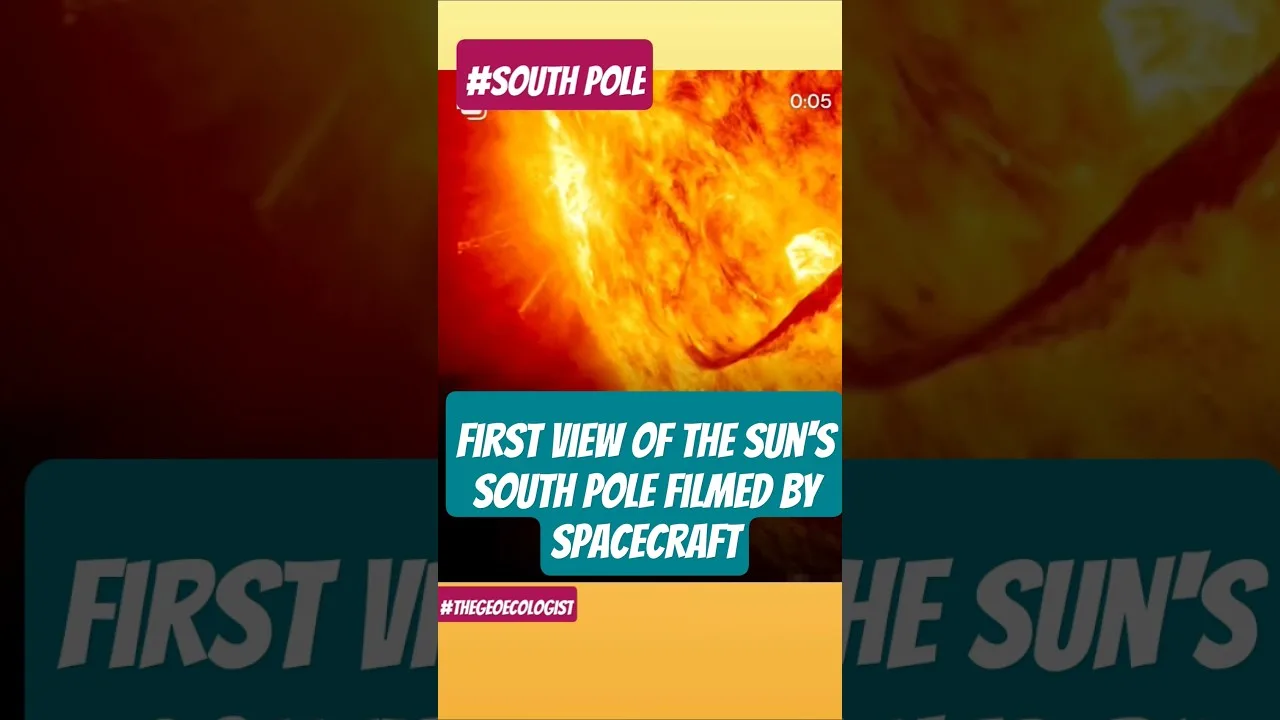
Table of Contents
- Why the Solar Orbiter South Pole View Changes Everything
- Unprecedented Resolution and Instrumentation
- The Science Behind the Solar Orbiter South Pole Mission
- Space Weather Forecasting: Protecting Our Technological Civilization
- Solar Orbiter: A Decade of Engineering Excellence
- International Partnership and Data Sharing
- What the Solar Orbiter South Pole Reveals About Solar Dynamics
- Magnetic Field Reversals and the Solar Dynamo
- Future Prospects: The Mission Continues
- Synergy with Ground-Based Observatories
- Conclusion: A New Era of Solar Exploration
For the first time in human history, the Solar Orbiter south pole has been captured in unprecedented detail, marking a monumental milestone in heliophysics. The European Space Agency’s (ESA) Solar Orbiter spacecraft has delivered breathtaking video and images of the Sun’s mysterious southern polar region, revealing a dynamic landscape of million-degree plasma and complex magnetic structures that have never been observed from this vantage point. This breakthrough observation opens an entirely new window into understanding our star’s most enigmatic regions.
- Historic First: ESA’s Solar Orbiter captured the first-ever direct images of the Sun’s south pole in March 2025.
- Extreme Temperatures: The solar corona reaches 1 million °C, while “cooler” polar coronal holes still measure 100,000 °C.
- Space Weather Impact: Polar observations are critical for predicting solar storms that threaten satellites, GPS, and power grids.
- Unique Orbit: Solar Orbiter’s highly elliptical, inclined orbit enables polar views impossible from Earth or the ecliptic plane.
- Mission Milestone: Launched in February 2020, the spacecraft completed its first dedicated polar observation campaign in early 2025.
Why the Solar Orbiter South Pole View Changes Everything
The Solar Orbiter south pole observations represent a paradigm shift in solar physics. For decades, scientists have been limited to viewing the Sun from the ecliptic plane—the flat disk where planets orbit—meaning the polar regions remained largely hidden. Ground-based telescopes and previous missions like SOHO and SDO could only glimpse the poles at oblique angles, severely limiting our understanding of polar magnetic fields, coronal holes, and the solar dynamo that drives the 11-year solar cycle.
Solar Orbiter’s unique trajectory, which uses Venus gravity assists to progressively increase its orbital inclination, finally solves this problem. By March 2025, the spacecraft reached an inclination of over 30 degrees relative to the solar equator, providing the first clear, high-resolution view of the Solar Orbiter south pole region. This achievement is comparable to the first images of the far side of the Moon—fundamentally altering our perspective of a familiar object.
Unprecedented Resolution and Instrumentation
The Solar Orbiter south pole imagery comes from the spacecraft’s Extreme Ultraviolet Imager (EUI) and Polarimetric and Helioseismic Imager (PHI). EUI captures the million-degree corona in extreme ultraviolet light, revealing intricate loop structures, polar plumes, and the boundaries of coronal holes—dark regions where magnetic field lines open into space, allowing high-speed solar wind to escape. PHI maps the magnetic field vector and line-of-sight velocity, providing the first detailed magnetograms of the solar south pole.
These instruments operate at spatial resolutions up to 200 km per pixel at perihelion, far surpassing any previous polar observations. The data reveal a surprisingly complex polar landscape: not a uniform cap, but a patchwork of magnetic concentrations, rotating supergranules, and dynamic jet-like features called “polar jets” that may contribute to the fast solar wind.
The Science Behind the Solar Orbiter South Pole Mission
Understanding the Solar Orbiter south pole is not merely an academic exercise—it has profound implications for life on Earth. The Sun’s polar regions play a crucial role in the solar dynamo, the process that generates the Sun’s magnetic field and drives the solar cycle. Every 11 years, the Sun’s magnetic poles flip, and the polar fields act as the “seed” for the next cycle. By directly observing the south pole’s magnetic evolution, scientists can test and refine dynamo models, potentially enabling long-term solar cycle predictions.
Moreover, the polar coronal holes are the primary sources of the fast solar wind—a stream of charged particles traveling at 700-800 km/s that shapes the heliosphere and influences space weather throughout the solar system. The Solar Orbiter south pole data allow researchers to trace the solar wind from its source in the corona to in-situ measurements by the spacecraft’s Solar Wind Analyser (SWA) suite, creating a complete cause-and-effect chain.
Space Weather Forecasting: Protecting Our Technological Civilization
The practical stakes are enormous. Intense solar activity—flares, coronal mass ejections (CMEs), and high-speed solar wind streams—can induce geomagnetic storms that disrupt satellite communications, degrade GPS accuracy, increase radiation exposure for astronauts and airline passengers, and even induce damaging currents in power grids. The 1859 Carrington Event and the 1989 Quebec blackout demonstrate the real-world consequences.
Current space weather models struggle with polar contributions because they lack boundary conditions at the poles. The Solar Orbiter south pole observations provide these missing pieces. By monitoring the emergence and evolution of polar magnetic flux, forecasters can better predict the onset of solar minimum and maximum, the likelihood of high-speed streams, and the trajectory of CMEs that originate at high latitudes. ESA’s Space Weather Service Network and NOAA’s Space Weather Prediction Center are already integrating Solar Orbiter data into operational models.
Solar Orbiter: A Decade of Engineering Excellence
The Solar Orbiter south pole achievement is the culmination of over a decade of international collaboration. The mission, selected in 2011 as part of ESA’s Cosmic Vision program, launched on February 10, 2020, aboard an Atlas V 411 rocket from Cape Canaveral. Built by Airbus Defence and Space in the UK, the 1,800 kg spacecraft carries ten instruments—six remote-sensing and four in-situ—designed to operate in one of the harshest environments in the solar system.
At perihelion, Solar Orbiter approaches within 0.28 AU (42 million km) of the Sun, where sunlight is 13 times more intense than at Earth. The spacecraft’s heat shield, a multi-layer titanium and carbon-fiber sandwich coated with SolarBlack—a calcium phosphate preparation derived from charred bone—protects the bus and instruments, maintaining temperatures below 50°C while the shield face reaches 500°C. This thermal engineering marvel enables the close-up, high-resolution observations that make the Solar Orbiter south pole views possible.
International Partnership and Data Sharing
Solar Orbiter is a collaboration between ESA and NASA, with contributions from European national space agencies and institutes across Europe and the United States. NASA provided the launch vehicle and the SoloHI (Solar Orbiter Heliospheric Imager) instrument, while European teams contributed the remaining nine instruments. The mission exemplifies the power of international cooperation in space science.
All Solar Orbiter south pole data are made publicly available through the ESA Solar Orbiter Archive and NASA’s Solar Data Analysis Center after a brief proprietary period. This open-data policy ensures that researchers worldwide can contribute to the scientific harvest, maximizing the mission’s return on investment. As of 2025, over 500 peer-reviewed papers have been published using Solar Orbiter data, with the polar campaign expected to generate hundreds more.
What the Solar Orbiter South Pole Reveals About Solar Dynamics
The newly released Solar Orbiter south pole footage showcases a realm of staggering beauty and violence. The solar corona— the Sun’s outer atmosphere—shimmers at temperatures exceeding 1 million degrees Celsius, its plasma sculpted by magnetic fields into towering loops, delicate filaments, and vast coronal holes. Within these holes, the magnetic field opens into interplanetary space, allowing plasma to escape as the fast solar wind.
Contrasting with the brilliant corona are darker regions of “cooler” gas—though “cool” is relative at 100,000 degrees Celsius. These are the polar coronal holes, the primary focus of the Solar Orbiter south pole campaign. Their boundaries are not static; they pulse and shift as magnetic flux emerges, cancels, and reorganizes. The EUI movies reveal ubiquitous small-scale jets—collimated ejections of plasma along open field lines—that may solve the long-standing mystery of how the fast solar wind is accelerated.
Magnetic Field Reversals and the Solar Dynamo
Perhaps the most profound scientific target of the Solar Orbiter south pole observations is the solar dynamo. The Sun’s magnetic field is generated by a complex interplay of differential rotation, convection, and meridional circulation deep in the convection zone. The polar fields are the observable surface manifestation of this deep-seated process. During solar maximum, the polar fields weaken and reverse polarity; during solar minimum, they reach peak strength.
Solar Orbiter’s PHI instrument provides the first high-resolution, full-disk vector magnetograms from an inclined orbit, allowing scientists to measure the true polar field strength—not just the line-of-sight component visible from Earth. These measurements are critical for testing flux-transport dynamo models, which predict that the polar field at solar minimum determines the amplitude of the next solar cycle. Early results from the Solar Orbiter south pole campaign suggest the south polar field is currently reversing, consistent with the ongoing solar maximum of Cycle 25.
Future Prospects: The Mission Continues
The Solar Orbiter south pole observations released in 2025 are just the beginning. The mission’s nominal phase extends to December 2026, with a likely extension to 2030. Each Venus gravity assist—occurring roughly every 6-8 months—will increase the orbital inclination further, eventually reaching 33 degrees by 2029. This will provide even more direct views of both poles, enabling stereoscopic observations when combined with Earth-based and Lagrange-point observatories.
Future Solar Orbiter south pole campaigns will coordinate with NASA’s Parker Solar Probe, which samples the solar wind even closer to the Sun (within 0.04 AU), and the upcoming ESA Vigil mission at the Sun-Earth L5 Lagrange point, which will provide side-on views of Earth-directed CMEs. Together, these missions will create a “systems observatory” for heliophysics, tracking solar eruptions from their origin in the corona to their impact at Earth.
Synergy with Ground-Based Observatories
The Solar Orbiter south pole data are also revolutionizing ground-based solar physics. The Daniel K. Inouye Solar Telescope (DKIST) in Hawaii, the world’s largest solar telescope, provides diffraction-limited imaging of the solar surface at visible and infrared wavelengths. While DKIST cannot see the poles directly, its high-resolution observations of the equatorial and mid-latitude regions provide essential context for Solar Orbiter’s polar views. Coordinated observing campaigns between DKIST, Solar Orbiter, and other facilities are now routine, maximizing the scientific return of each.
Conclusion: A New Era of Solar Exploration
The first Solar Orbiter south pole images mark the dawn of a new era in solar and heliospheric physics. By finally revealing the Sun’s hidden pole, ESA’s Solar Orbiter has filled a critical gap in our understanding of the star that sustains all life on Earth. The data will improve space weather forecasting, refine models of the solar dynamo, and illuminate the fundamental processes that heat the corona and accelerate the solar wind.
As the mission continues its daring journey, climbing ever higher above the solar equator, we can expect even more astonishing discoveries. The Solar Orbiter south pole campaign demonstrates that with ingenuity, international cooperation, and perseverance, humanity can peer into the most inaccessible regions of our cosmic neighborhood. The Sun’s secrets are being unveiled—one polar pass at a time.
Stay tuned to ESA’s official channels and the Solar Orbiter mission page for the latest updates, data releases, and scientific breakthroughs from this historic mission. For a comprehensive mission overview, visit the Solar Orbiter Wikipedia article. NASA’s perspective on the collaboration is available at the NASA Solar Orbiter mission page.
Frequently Asked Questions
The Solar Orbiter south pole discovery refers to the first-ever direct, high-resolution images and video of the Sun's southern polar region, captured by ESA's Solar Orbiter spacecraft in March 2025 from an inclined orbit 30+ degrees above the solar equator.
Solar Orbiter south pole observations are crucial for improving space weather forecasting. The polar regions drive the solar dynamo, control the fast solar wind, and influence coronal mass ejections that can disrupt satellites, GPS, power grids, and communications on Earth.
Solar Orbiter uses Venus gravity assists to tilt its orbit out of the ecliptic plane, reaching inclinations over 30 degrees. This unique trajectory provides direct views of the solar poles impossible for Earth-based telescopes or spacecraft in the ecliptic like SOHO or SDO.
