Blog
Realism in Geography: A Comprehensive Guide to Spatial Reality

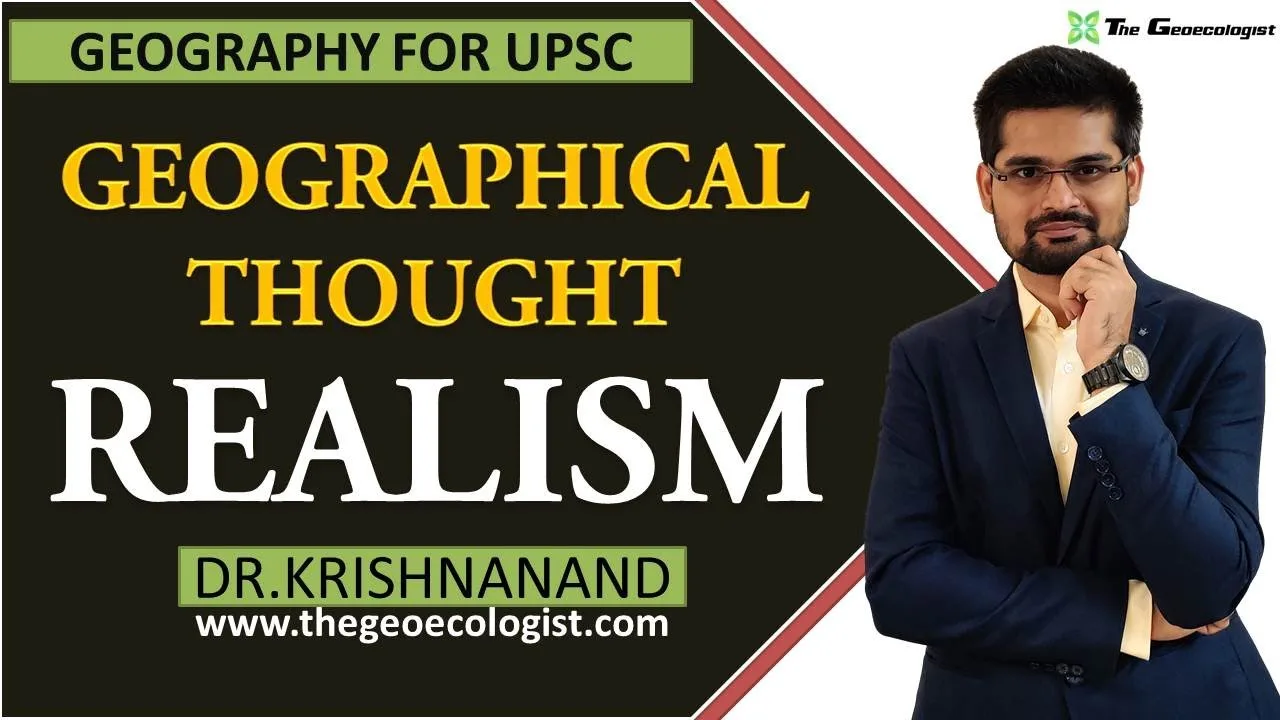
Table of Contents
- Foundations of Realism in Geography
- Philosophical Underpinnings
- Key Proponents and Their Contributions
- Richard Hartshorne
- David Harvey
- Realism in Human Geography: Practical Applications
- Urban Studies
- Political Geography
- Environmental Geography
- Case Studies and Empirical Evidence
- Climate Change Impact on Coastal Cities
- Urban Heat Islands in Megacities
- Teaching Realism: Dr. Krishnanand’s Approach
- Structured Learning Materials
- Preparing for UPSC: Why Realism Matters
- Exam Strategies
- Conclusion
Realism in Geography is a philosophical stance that insists the world exists independently of human perception, demanding that we observe, measure, and analyze spatial phenomena through empirical evidence. This approach rejects idealistic abstractions and instead grounds our understanding in observable reality, making it indispensable for scholars, policymakers, and practitioners alike. By embracing realism, geographers can generate reliable data, test hypotheses, and formulate actionable solutions for complex spatial challenges.
- Realism in Geography prioritizes empirical observation over subjective interpretation.
- It promotes objective analysis of physical and human landscapes.
- Realism aligns closely with the scientific method, encouraging systematic inquiry.
- It serves as a practical framework for UPSC preparation, especially in optional geography.
- Realism in Geography fosters interdisciplinary research across urban, political, and environmental studies.
Foundations of Realism in Geography
Realism in Geography emerged in the early 20th century as a counterpoint to the prevailing idealist and positivist paradigms. Its roots lie in the belief that geographical phenomena possess an inherent reality that can be studied objectively. The movement draws inspiration from the broader philosophical tradition of realism, which argues that reality exists independently of our thoughts or perceptions.
Philosophical Underpinnings
Unlike idealism, which posits that reality is constructed by consciousness, realism in Geography asserts that spatial patterns and processes can be discovered through observation and measurement. This stance encourages geographers to treat the environment as a system of interrelated components that can be analyzed scientifically.
Key Proponents and Their Contributions
The development of realism in Geography owes much to influential scholars such as Richard Hartshorne and David Harvey. Their work helped articulate the theoretical foundations and practical applications of the approach.
Richard Hartshorne
Richard Hartshorne championed a regional geography framework grounded in observable patterns. He argued that regions should be defined by their actual physical and human characteristics rather than by arbitrary administrative boundaries. Hartshorne’s emphasis on empirical data laid the groundwork for contemporary regional studies.
David Harvey
David Harvey integrated Marxist realism to critique spatial inequalities and capitalist influences. His analysis of urban space demonstrates how economic forces shape geographic realities, providing a robust example of realism in Geography applied to socioeconomic contexts.
Realism in Geography & Authoritative References
For deeper exploration, consult the Geography page on Wikipedia, which offers a comprehensive overview of the discipline’s evolution. Additionally, the Positivism article explains the philosophical lineage that influenced realism in Geography.
Realism in Human Geography: Practical Applications

Realism in Geography provides a pragmatic lens through which human geography problems can be understood and addressed. By focusing on tangible data, scholars can formulate insights that directly inform policy and planning.
Urban Studies
In urban studies, realism in Geography allows researchers to examine actual infrastructure, housing patterns, and socioeconomic disparities. For instance, a 2023 World Bank report indicates that 60% of the global population lives in urban areas, a statistic that can be analyzed through realist methodology to assess urban sustainability.
Political Geography
Realism in Geography aids political geography by providing factual evidence to analyze geopolitical conflicts, borders, and territorial disputes. By grounding analyses in empirical data, scholars can present nuanced arguments that reflect real-world dynamics.
Environmental Geography
Environmental geography leverages realism in Geography to study climate change, land degradation, and ecosystem health. Realist approaches enable the collection of measurable indicators such as temperature trends, deforestation rates, and biodiversity indices.
Case Studies and Empirical Evidence
Realism in Geography is best illustrated through case studies that demonstrate how empirical evidence informs spatial analysis. Consider the following examples:
Climate Change Impact on Coastal Cities
By measuring sea-level rise and storm frequency, researchers apply realism in Geography to predict future impacts on coastal infrastructure. The 2021 IPCC report provides a wealth of data that supports these analyses.
Urban Heat Islands in Megacities
Satellite imagery and ground-based temperature recordings reveal the extent of urban heat islands. Realism in Geography uses this data to guide urban planning initiatives aimed at mitigating heat-related health risks.
Teaching Realism: Dr. Krishnanand’s Approach
Dr. Krishnanand’s lecture series on the Evolution of Geographical Thought introduces realism in Geography in a clear, student-friendly manner. His 32nd lecture focuses on breaking down complex ideas into digestible segments, enabling learners to grasp core concepts without drowning in jargon.
Structured Learning Materials
Dr. Krishnanand provides structured notes, illustrative examples, and case studies that align with UPSC exam expectations. His accompanying e‑book, available through MithilaCraft, expands on the lecture content with in-depth explanations and supplemental resources.
Preparing for UPSC: Why Realism Matters
For UPSC aspirants, realism in Geography offers a pragmatic framework for tackling questions on regional planning, policy-making, and environmental management. By prioritizing empirical evidence, candidates can develop well-supported arguments that resonate with examiners.
Exam Strategies
1. Focus on data-driven case studies.
2. Emphasize the objective reality of spatial phenomena.
3. Use realistic scenarios to illustrate theoretical concepts.
Conclusion
Realism in Geography remains a cornerstone of contemporary spatial analysis. By insisting on empirical evidence and objective reality, it equips scholars and practitioners with the tools needed to address real-world challenges. Dr. Krishnanand’s accessible teachings further democratize this approach, making it a valuable asset for UPSC preparation and academic excellence.
For more resources, subscribe to THEGEOECOLOGIST and explore the official website and Instagram profile.
Frequently Asked Questions
Realism in geography is a philosophical stance that emphasizes empirical observation and objective analysis of spatial phenomena, asserting that geographical realities exist independently of human perception.
Realism provides a data-driven framework that helps UPSC candidates craft well-supported arguments on regional planning, policy-making, and environmental management, aligning with exam expectations.
Richard Hartshorne and David Harvey are prominent scholars who advanced realism in geography, focusing on regional analysis and spatial inequality respectively.