


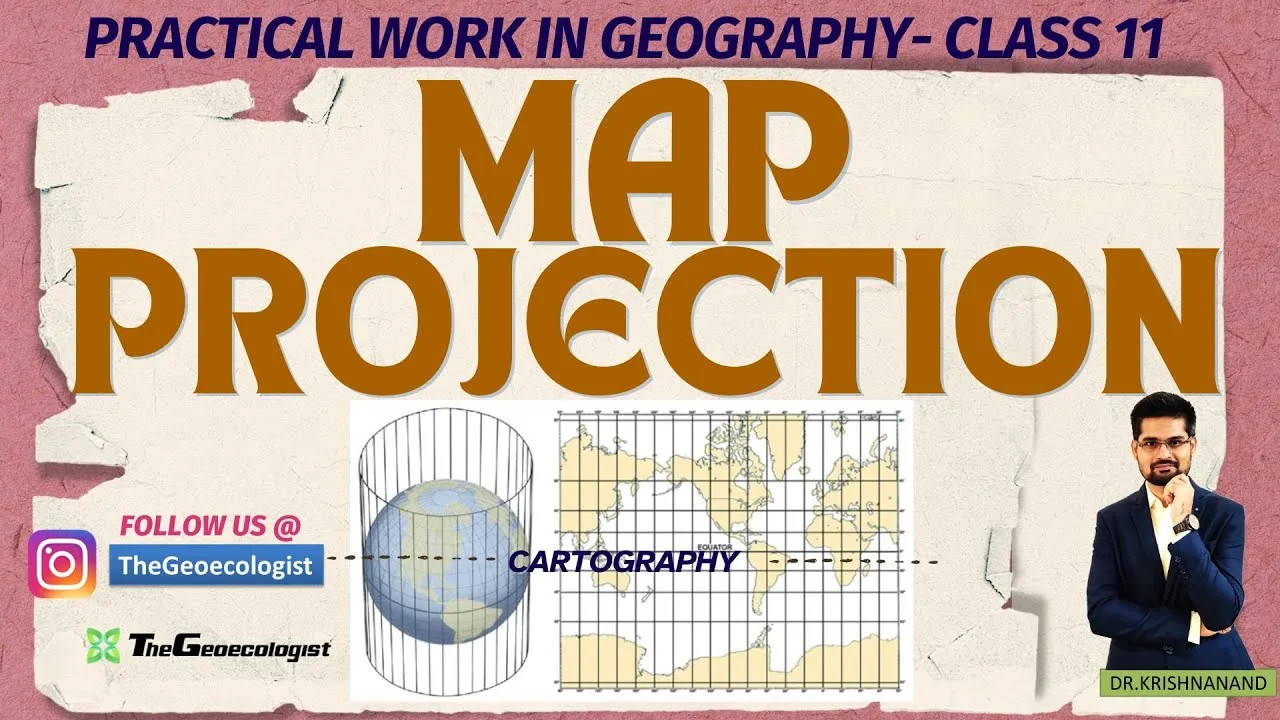
Map Projections- Chapter 4 – NCERT Class 11-TheGeoecologist
Understanding Map Projections: A Guide for NCERT Class 11 Geography & Competitive Exams
Map projections are fundamental tools in cartography, enabling us to represent the three-dimensional Earth on a two-dimensional surface. Chapter 4 of the NCERT Class 11 Geography textbook (Practical Work in Geography) delves into this vital concept, equipping students with the knowledge to interpret maps accurately. For CBSE Class 11 students and competitive exam aspirants (CUET, UGC NET JRF, UPSC), mastering map projections is essential. This article simplifies the core concepts, drawing insights from TheGeoecologist’s practical video tutorial (available in Hindi-English mixed language), to help you grasp the topic effectively.
What Are Map Projections?
A map projection is a systematic transformation of latitudes and longitudes from the Earth’s spherical surface onto a flat plane. Since no projection can perfectly replicate the globe, each method introduces distortions in shape, area, distance, or direction. The choice of projection depends on the map’s purpose, such as navigation, thematic representation, or spatial analysis.
Types of Map Projections
The NCERT Class 11 chapter classifies projections based on the developable surface used:
Cylindrical Projections:
- A cylinder wrapped around the Earth touches the equator.
- Example: Mercator Projection (used for navigation; preserves direction but exaggerates polar regions).
- Distortion: High at higher latitudes.
Conical Projections:
- A cone touches the Earth at a parallel (e.g., mid-latitudes).
- Example: Lambert Conformal Conic (used for regional maps; minimal distortion in mid-latitudes).
- Distortion: Increases away from the standard parallel.
- Azimuthal (Planar) Projections:
- A flat plane touches the Earth at a single point (e.g., poles).
- Example: Polar Stereographic Projection (used for polar routes; preserves direction from the center).
- Distortion: Increases radially outward.
Key Properties of Map Projections
Four primary properties determine a projection’s utility:
- Conformality: Preserves local angles and shapes (e.g., Mercator).
- Equivalence: Maintains accurate area proportions (e.g., Peters Projection).
- Equidistance: Accurately represents distances from specific points.
- Azimuthality: Retains true direction from a central point.
Trade-offs: No projection achieves all four properties. For instance, the Mercator is conformal but distorts area, while the Peters Projection is equivalent but distorts shape.
Why Are Map Projections Important for Exams?
- CBSE Class 11: Practical questions often involve identifying projection types based on distortions or use cases.
- CUET/UPSC: Questions test conceptual clarity, e.g., “Which projection is best suited for comparing country sizes?”
- UGC NET JRF: Focuses on technical aspects like projection equations or historical significance.
TheGeoecologist’s Practical Approach
TheGeoecologist’s video simplifies complex ideas using bilingual explanations (Hindi-English), making it accessible to diverse learners. Key highlights include:
- Visual demonstrations of distortions using real-world maps.
- Tips to memorize projections through acronyms (e.g., “C-C-A” for Cylindrical, Conical, Azimuthal).
- Exam-oriented examples and common pitfalls (e.g., confusing Mercator with Gall-Peters).
Conclusion
Map projections bridge the gap between the Earth’s geometry and practical mapmaking. For students and aspirants, understanding their types, properties, and applications is crucial not just for exams but also for real-world geographic analysis. Revisit NCERT diagrams, practice identifying distortions, and leverage resources like TheGeoecologist’s courses (visit thegeoecologist.com) for structured learning.
Boost Your Preparation!
Enroll in TheGeoecologist’s paid courses for in-depth guidance on geography topics. Stay updated via:
- Instagram: @thegeoecologist
- Email: krishna.geography@gmail.com
practicalgeography #cartography #ncertclass11geography #ncertgeography #ncertrevision
Master map projections and conquer your exams with confidence! 🌍✨
To Download E-Books & Study Material Visit The Shop Page