


Topographical Maps-Chapter 5- NCERT Class 11-TheGeoecologist
Understanding Topographical Maps: A Comprehensive Guide for CBSE Class 11 and Competitive Exams
Topographical maps are indispensable tools in geography, offering detailed insights into the Earth’s physical and cultural features. Chapter 5 of NCERT Class 11 Practical Work in Geography introduces these maps, emphasizing their role in terrain analysis. Combined with TheGeoecologist’s bilingual video resource (Hindi-English), this guide simplifies complex concepts for students and competitive exam aspirants. Let’s explore the key aspects of topographical maps and their significance.
What Are Topographical Maps?
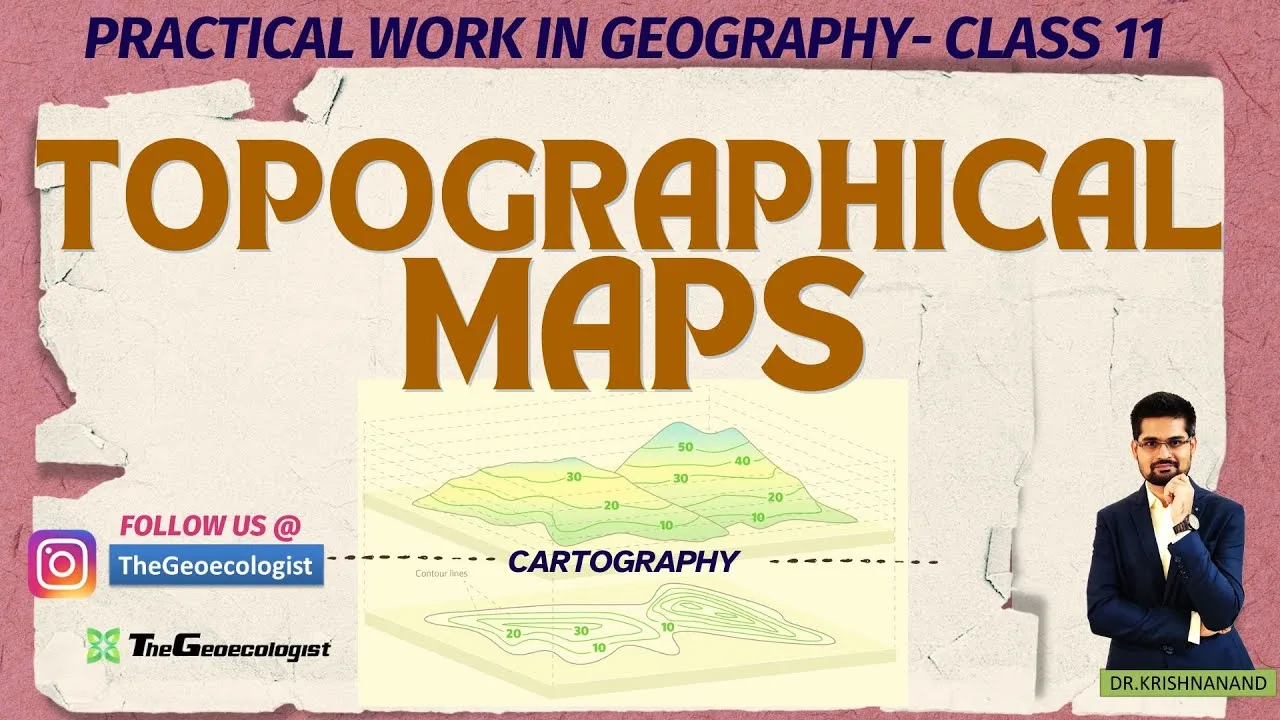
Topographical maps are large-scale representations of natural and human-made features, such as mountains, rivers, roads, and settlements. They use standardized symbols, contour lines, and color codes to depict elevation, slope, and spatial patterns. Key components include:
- Scale: Expressed as a ratio (e.g., 1:50,000), it defines ground distance versus map distance. Converting scales (e.g., RF to verbal) is vital for interpreting distances.
- Contour Lines: Lines connecting points of equal elevation. Closely spaced contours indicate steep slopes, while wider gaps suggest flat terrain.
- Grid References: A system of eastings and northings to pinpoint locations (e.g., finding grid 0423).
- Symbols: Universal icons for vegetation, infrastructure, and water bodies.
How to Read Topographical Maps
Identify Key Features:
- Landforms: Contours reveal valleys (V-shaped), ridges (U-shaped), and plateaus.
- Water Bodies: Blue lines for rivers, dashed lines for seasonal streams.
- Human Features: Black lines for roads, red for highways, and brown for contour labels.
Calculate Gradient:
Use the formula: Gradient = Vertical Interval (VI) / Horizontal Equivalent (HE). This helps assess slope steepness, crucial for engineering or hiking routes.- Cross-Section Drawing:
Plot elevation profiles to visualize terrain. TheGeoecologist’s video demonstrates this with practical examples, aiding visual learners.
Why Are Topographical Maps Important for Exams?
- CBSE Class 11: Directly tied to NCERT Chapter 5, questions focus on map symbols, contour interpretation, and grid references.
- CUET & UGC NET: Tests analytical skills through map-based MCQs. Proficiency in scale conversion and feature identification is key.
- UPSC: Geography Optional candidates often face questions on contour patterns, landform identification, and map scales.
Exam Tips & Common Pitfalls
- Practice Grid References: Misaligned eastings/northings are a common error. Double-check coordinates.
- Memorize Symbols: TheGeoecologist’s video uses visual mnemonics to simplify this.
- Focus on Contour Intervals: Understand how spacing correlates with slope (e.g., dense contours = cliffs).
Leverage TheGeoecologist’s Resources
TheGeoecologist’s Hindi-English blended video breaks down Chapter 5 into digestible segments, ideal for bilingual learners. Topics like contour diagrams and Survey of India map conventions are explained with real-world examples.
For Course Details: Visit https://thegeoecologist.com/ to explore paid courses tailored for UPSC, CUET, and NET/JRF.
Conclusion
Mastering topographical maps unlocks success in academics and competitive exams. By integrating NCERT fundamentals with TheGeoecologist’s practical demonstrations, students can confidently tackle map-based questions. Regular practice, symbol familiarity, and gradient calculations are the keys to excellence.
Follow for Updates:
- Instagram: @thegeoecologist
- Email: krishna.geography@gmail.com
practicalgeography #cartography #ncertclass11geography #ncertrevision
Enhance your geographical skills today—decode the language of maps and ace your exams! 🌍🗺️
To Download E-Books & Study Material Visit The Shop Page