Blog
Latitude, Longitude and Time-Chapter 3 NCERT- Class 11

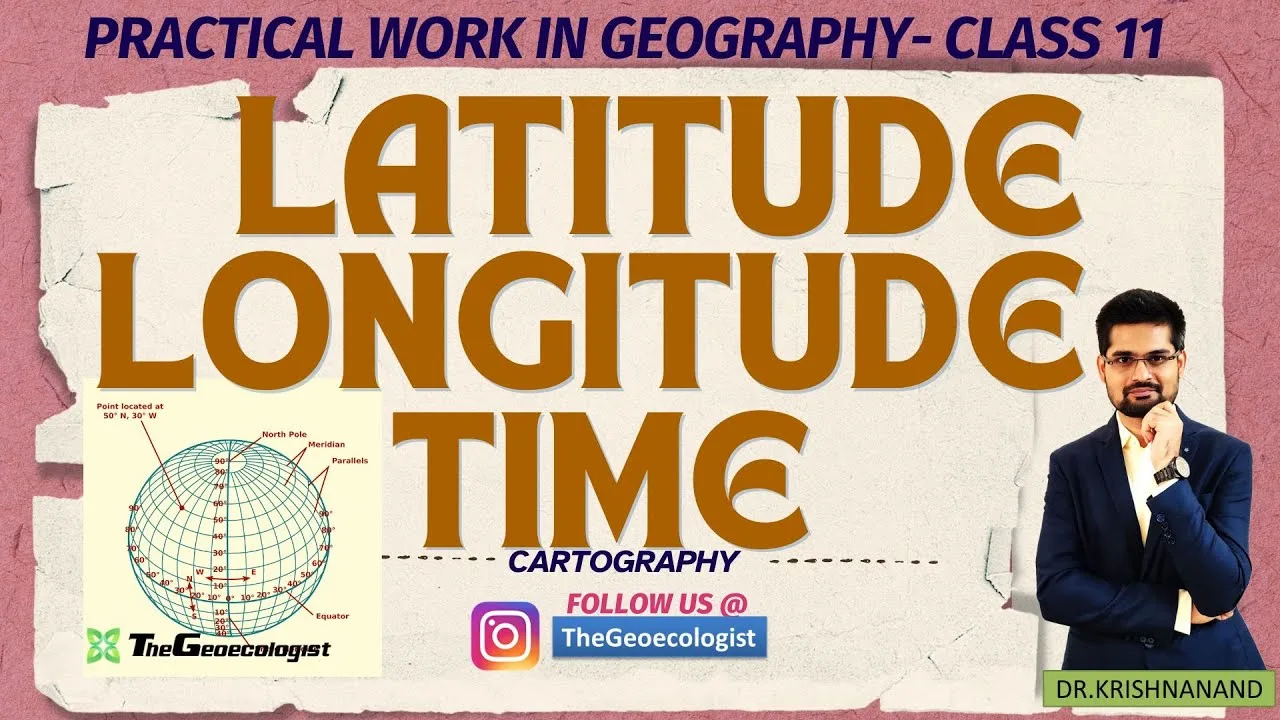
Latitude, Longitude and Time-Chapter 3 NCERT- Class 11
Understanding Latitude, Longitude, and Time: A Comprehensive Guide for Class 11 and Competitive Exams
Navigating the complexities of geography begins with mastering fundamental concepts like latitude, longitude, and time. Chapter 3 of the NCERT Class 11 Geography textbook, part of Practical Work in Geography, lays the groundwork for these essential topics. This article simplifies the concepts while aligning with the NCERT curriculum and insights from TheGeoecologist’s Hindi-English video tutorial, making it ideal for CBSE students and competitive exam aspirants.
1. Latitude: The Horizontal Lines of Reference
Latitude refers to the angular distance of a location north or south of the Equator (0°). These imaginary horizontal lines circle the Earth parallel to the Equator, ranging from 0° at the Equator to 90°N at the North Pole and 90°S at the South Pole. Key points:
- Significance: Latitudes help identify heat zones (Torrid, Temperate, Frigid) and influence climate patterns.
- Practical Use: Navigators use latitude to determine their position relative to the Equator.
2. Longitude: The Vertical Lines of Measurement
Longitude measures the angular distance east or west of the Prime Meridian (0°), which passes through Greenwich, England. These vertical lines converge at the poles and range up to 180°E or 180°W. Key points:
- Time Connection: Earth completes a 360° rotation in 24 hours, meaning each 15° longitude represents a 1-hour time difference.
- Indian Standard Time (IST): India uses 82.5°E as its standard meridian, making IST UTC+5:30.
3. The Link Between Longitude and Time
Local time varies with longitude, but standard time ensures uniformity across regions. For example:
- Time Zones: The globe is divided into 24 zones, each spanning 15° longitude.
- International Date Line (IDL): Located at 180°, it marks the transition between calendar days. Crossing it eastward subtracts a day, while westward adds a day.
4. Why This Matters for Exams
Understanding these concepts is crucial for:
- CBSE Class 11: NCERT questions often involve calculating time differences (e.g., “If it’s 12 PM at 82.5°E, what’s the time at 90°E?”).
- Competitive Exams: UPSC, CUET, and UGC NET JRF frequently test topics like time zones, IST, and the IDL.
5. Enhancing Learning with TheGeoecologist’s Video
TheGeoecologist’s bilingual (Hindi-English) video simplifies Chapter 3 through:
- Visual Demos: Animated explanations of latitude-longitude grids.
- Problem Solving: Step-by-step time calculation exercises.
- Exam Tips: Highlighting frequently asked questions.
6. Conclusion: Build Your Foundation
Latitude, longitude, and time form the bedrock of practical geography. For CBSE students, this knowledge is vital for exams and real-world applications like map-reading. Competitive aspirants gain an edge by mastering these basics.
Boost Your Preparation!
For in-depth learning, enroll in TheGeoecologist’s paid course at https://thegeoecologist.com/. Follow on Instagram for updates.
practicalgeography #cartography #ncertclass11geography #ncertgeography #ncertrevision
Master the Earth’s coordinates and timekeeping to excel in academics and beyond! 🌍⏰
To Download E-Books & Study Material Visit The Shop Page