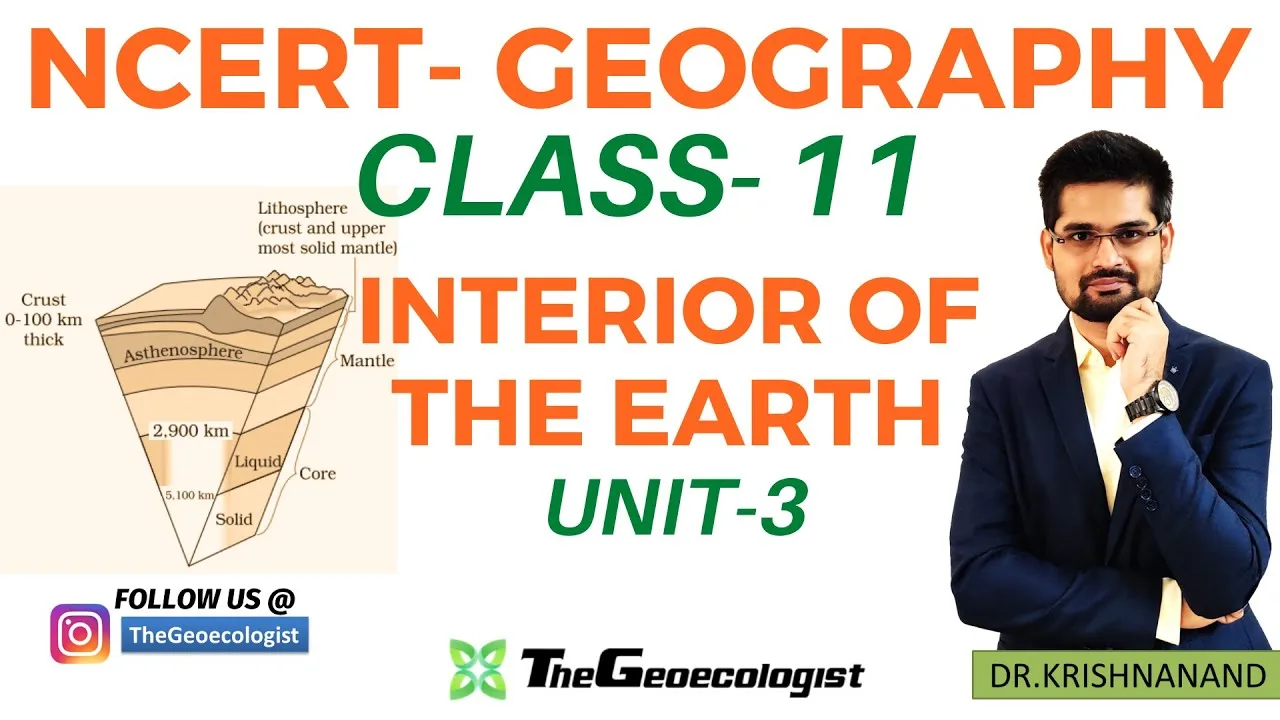
Interior of the Earth-NCERT Geography-Class 11- Unit 3-TheGeoecologist
Unlocking the Secrets of Earth’s Interior: NCERT Class 11 Geography Insights
Understanding the Earth’s interior is a fascinating journey into the depths of our planet, revealing its hidden layers and dynamic processes. For CBSE Class 11 students and competitive exam aspirants like those targeting UPSC, NCERT Geography’s Unit 3, Interior of the Earth, serves as a cornerstone. This article synthesizes key concepts from the NCERT textbook and insights from TheGeoecologist’s bilingual (Hindi-English) video tutorial, offering a concise yet comprehensive guide.
Why Study the Earth’s Interior?
Though we cannot physically explore beyond the crust, the Earth’s interior influences surface phenomena like earthquakes, volcanoes, and mountain-building. Knowledge of its structure aids in resource exploration and understanding planetary evolution—a recurring theme in UPSC and CBSE exams.
Sources of Information
Scientists rely on direct and indirect sources to study Earth’s layers:
- Direct Sources:
- Volcanic eruptions: Reveal molten material from the mantle.
- Mining and drilling: The deepest drill (Kola Superdeep Borehole) reached ~12 km, offering clues about crustal composition.
- Indirect Sources:
- Seismic waves: P-waves (travel through solids/liquids) and S-waves (only solids) change speed/direction with density, helping map layers.
- Meteorites: Provide clues about Earth’s core composition.
- Gravity and magnetic field: Variations hint at density differences and the liquid outer core’s role in geomagnetism.
Layers of the Earth
1. The Crust
- Oceanic Crust: Thinner (5-10 km), denser basaltic rocks (sima: silicon + magnesium).
- Continental Crust: Thicker (30-70 km), less dense granitic rocks (sial: silicon + aluminium).
- Moho Discontinuity: Boundary separating crust from the mantle.
2. The Mantle
- Extends to 2,900 km depth, divided into upper mantle (includes ductile asthenosphere driving plate tectonics) and lower mantle (solid, rich in olivine).
- Gutenberg Discontinuity: Marks the mantle-core boundary.
3. The Core
- Outer Core: Liquid iron-nickel alloy, generates Earth’s magnetic field through convection currents.
- Inner Core: Solid due to extreme pressure, temperatures ~5,500°C.
- Lehmann Discontinuity: Separates outer and inner core.
Seismic Waves & Shadow Zones
- P-waves refract at the core-mantle boundary, creating a shadow zone between 105°–140° from the earthquake epicenter.
- S-waves cannot traverse the liquid outer core, disappearing beyond 105°. These phenomena confirm the core’s liquid state.
Exam Focus: Key Takeaways
- CBSE Class 11: Memorize layer depths, compositions, and discontinuities. Diagrams of seismic wave paths are crucial.
- UPSC/Competitive Exams:
- Explain how shadow zones prove the outer core’s liquidity.
- Contrast oceanic vs. continental crust.
- Role of the core in Earth’s magnetism.
Conclusion
The Earth’s interior, with its complex layers and dynamic processes, is integral to understanding geological events and Earth’s history. Mastering this topic strengthens foundational knowledge for higher studies and competitive exams.
Enhance Your Preparation!
For in-depth explanations, enroll in TheGeoecologist’s paid courses at https://thegeoecologist.com/. Stay updated via Instagram @thegeoecologist or email krishna.geography@gmail.com.
ncertclass11geography #ncertgeography #ncertrevision
Dive deeper into Geography with bilingual resources tailored for clarity and success! 🌍✨
To Download E-Books & Study Material Visit The Shop Page