Blog
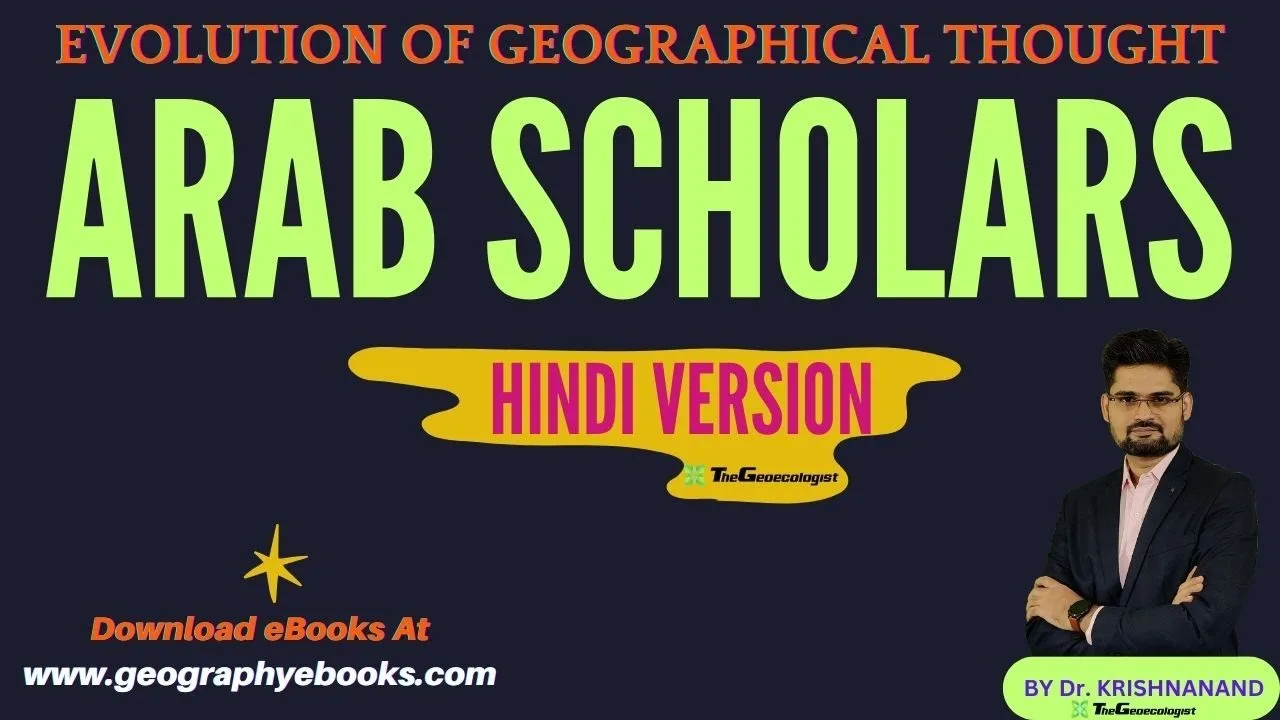
Arab Scholars-Geographical Thought(Hindi)-TheGeoecologist

Arab Scholars-Geographical Thought(Hindi)-TheGeoecologist
The Contribution of Arab Scholars to Geographical Thought
Welcome to TheGeoecologist! In this article, we delve into the remarkable contributions of Arab scholars to the evolution of geographical thought. This topic holds immense significance for UPSC aspirants, geography students, and anyone with a keen interest in the history of geography. Arab scholars played a pivotal role in conserving and expanding ancient Greek and Roman geographical knowledge, bridging the gap between antiquity and the modern era. Let’s explore their multifaceted contributions in detail.
Conservation and Expansion of Ancient Knowledge
During the Islamic Golden Age (8th to 13th centuries), Arab scholars became the torchbearers of ancient Greek and Roman geographical works. They translated and preserved texts from scholars like Ptolemy, Aristotle, and Strabo, ensuring their survival during a time when Europe was experiencing intellectual stagnation. Arab geographers not only conserved these works but also critically analyzed and expanded upon them, adding new insights and observations.
Notable Arab Scholars and Their Contributions
Al-Idrisi: One of the most celebrated geographers of his time, Al-Idrisi is best known for his masterpiece, Tabula Rogeriana (The Book of Roger). Commissioned by King Roger II of Sicily, this work was a comprehensive world map and geographical text that combined knowledge from Arab and European sources. Al-Idrisi’s maps were remarkably accurate for their time and laid the foundation for modern cartography.
Ibn Battuta: Known as the “Traveler of Islam,” Ibn Battuta’s extensive travels spanned over 30 years and covered nearly the entire Islamic world and beyond. His travelogue, Rihla, provides invaluable geographical, cultural, and historical insights into the regions he visited. Ibn Battuta’s observations on trade routes, climate, and human geography remain a vital resource for understanding the medieval world.
- Al-Masudi: Often referred to as the “Herodotus of the Arabs,” Al-Masudi integrated geography with history in his works. His book, Muruj adh-Dhahab (The Meadows of Gold), is a rich blend of geographical descriptions, historical events, and ethnographic observations. Al-Masudi’s holistic approach to geography laid the groundwork for interdisciplinary studies in the field.
Development During the Islamic Golden Age
The Islamic Golden Age was a period of unparalleled intellectual and scientific advancement. Arab scholars made significant contributions to various branches of geography, including physical geography, human geography, and cartography. Their works incorporated observations from trade, navigation, and exploration, leading to a more comprehensive understanding of the world.
Trade and Navigation: Arab scholars played a crucial role in advancing navigation techniques. They developed detailed maps and navigational instruments, such as the astrolabe, which enabled sailors to traverse the seas with greater accuracy. Their knowledge of trade routes and wind patterns facilitated the exchange of goods and ideas across continents.
- Scientific Perspective: Arab geographers adopted a scientific approach to studying the Earth. They conducted experiments, made precise measurements, and developed theories to explain natural phenomena. This empirical method significantly influenced later European geographers and contributed to the Scientific Revolution.
Influence on Modern Geography
The legacy of Arab scholars extends far beyond their time. Their works were instrumental in shaping modern geography and cartography. During the Renaissance, European scholars rediscovered Arab geographical texts, which became foundational for their own explorations and studies.
Conclusion
The contributions of Arab scholars to geographical thought are a testament to their intellectual prowess and curiosity about the world. From preserving ancient knowledge to making groundbreaking discoveries, they played a vital role in the evolution of geography. Understanding their work not only enriches our knowledge of history but also highlights the interconnectedness of human civilizations.
🔔 Subscribe to TheGeoecologist channel for more insightful content on geography, environmental studies, and related subjects. Don’t forget to like, share, and leave your thoughts in the comments section!
Visit our website for online geography courses: thegeoecologist.com
Follow us on Instagram: @thegeoecologist
Join our YouTube channel for exclusive perks: TheGeoecologist