Blog
Dynamic Equilibrium Theory of Landform Development | JT HACK THEORY | Dynamic Equilibrium of JT HACK

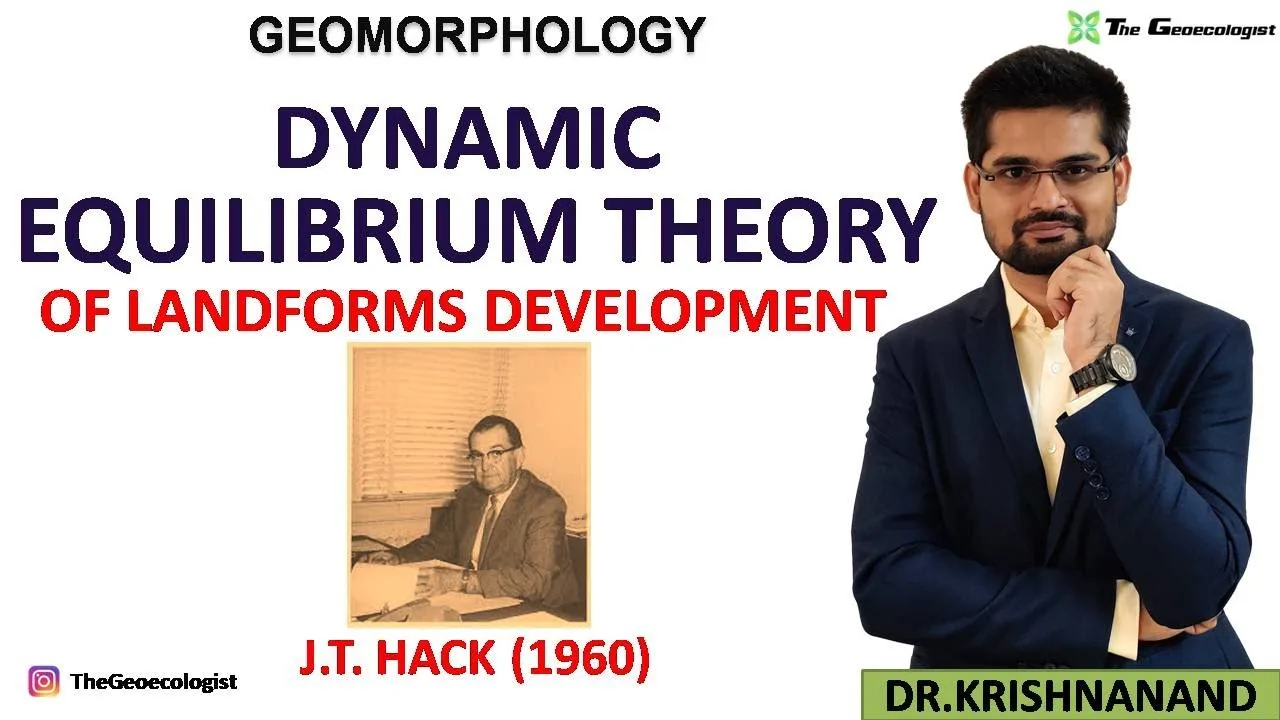
Dynamic Equilibrium Theory of Landform Development | JT HACK THEORY | Dynamic Equilibrium of JT HACK
Dynamic Equilibrium Theory of Landform Development by JT Hack: A Simplified Overview
Introduction
Landform development is a complex process influenced by various geological, climatic, and environmental factors. Among the prominent theories explaining landform evolution, the Dynamic Equilibrium Theory proposed by John T. Hack (JT Hack) in 1960 stands out as a significant contribution to geomorphology. This theory provides a holistic understanding of how landforms adjust and maintain balance under changing external forces.
For UPSC aspirants (Geography Optional) and geography students, grasping this concept is crucial, as it forms a key part of physical geography studies. In this article, we will explore the Dynamic Equilibrium Theory, its principles, and its relevance in modern geomorphological studies.
Understanding Dynamic Equilibrium Theory
The Dynamic Equilibrium Theory builds upon the foundational ideas of William Morris Davis (Cycle of Erosion) and G.K. Gilbert (Graded Stream Concept), but introduces a more flexible approach. JT Hack argued that landforms are not static but exist in a state of continuous adjustment.
Key Principles of JT Hack’s Theory:
Steady-State Equilibrium:
- Landforms are in a state of balance between uplift (tectonic forces) and erosion (denudational forces).
- Any change (e.g., climate shift or tectonic activity) leads to adjustments to restore balance.
Time-Independent Evolution:
- Unlike Davis’ Cycle of Erosion, Hack emphasized that landforms do not follow a fixed evolutionary sequence.
- Landforms adjust dynamically rather than passing through youth, maturity, and old age stages.
Graded Slope Concept:
- Landscapes evolve to achieve a balance where erosion and deposition rates are equal.
- This graded condition ensures that landforms remain relatively stable unless external forces disrupt equilibrium.
Feedback Mechanisms:
- Natural systems self-regulate through feedback loops.
- For example, increased erosion leads to sediment deposition, which eventually balances erosion rates.
Relevance in Modern Geomorphology
Hack’s theory is widely applied in understanding:
✔ Fluvial Geomorphology – River channel adjustments due to sediment load and discharge.
✔ Hill-Slope Processes – How slopes adjust to resist erosion or landslides.
✔ Tectonic Geomorphology – Interaction of uplift and erosion in mountain building.
Why is JT Hack’s Theory Important for UPSC Geography Optional?
For UPSC aspirants, Hack’s Dynamic Equilibrium Theory is significant because:
- It challenges traditional geomorphological models like Davis’ Cycle of Erosion.
- It provides a framework for analyzing present-day landform changes rather than just historical evolution.
- It is frequently asked in UPSC Mains (Geography Optional) in questions related to landform development and geomorphic processes.
E-Book & Further Learning Resource
For an in-depth explanation of JT Hack’s Dynamic Equilibrium Theory and other geomorphology concepts, Dr. Krishnanand’s Simplified Geomorphology E-Book (PDF) is highly recommended. This e-book is specifically designed for UPSC Geography Optional aspirants and provides concise yet comprehensive coverage of geomorphic theories.
📥 Download the E-Book Here: Simplified Geomorphology E-Book
Conclusion
JT Hack’s Dynamic Equilibrium Theory revolutionized geomorphology by introducing a more dynamic and flexible perspective on landform development. Unlike older theories that saw landscapes evolving in fixed stages, Hack emphasized continuous adjustment, making his model more adaptable to real-world observations.
For UPSC aspirants, mastering this concept is essential for tackling geography optional questions effectively. Coupled with Dr. Krishnanand’s e-book and lectures, candidates can gain a strong conceptual foundation in geomorphology.
#JT_Hack_Theory #Dynamic_Equilibrium #Geomorphology #UPSCGeography #GeographyOptional
Subscribe to TheGeoecologist for more insightful lectures on geography!
Follow for updates:
🌐 Website: https://thegeoecologist.com/
📸 Instagram: @thegeoecologist
To Download E-Books & Study Material Visit The Shop Page