Blog
Best Population Geography Book: How to Choose the Right Resource for Competitive Exams

Finding the Best Population Geography Book for competitive exams like UPSC CSE, State PSCs, or university geography courses can feel overwhelming given the sheer number of titles claiming syllabus coverage. Aspirants often waste weeks comparing chapter lists, checking for updated census data, and verifying whether diagrams actually explain concepts or merely decorate pages. The real challenge isn’t just content coverage — it’s finding a resource that translates dense demographic theory into the precise, exam-oriented language examiners expect.
- Syllabus alignment is non-negotiable: The book must map directly to the prescribed CBCS and UPSC geography syllabi without gaps.
- Indian data sources matter most: Census 2011, Vital Statistics, and NSSO reports should be integrated throughout, not relegated to an appendix.
- Visual learning accelerates retention: Maps, population pyramids, and flow diagrams should be exam-ready — meaning labeled, sourced, and reproducible in 3 minutes.
- Point-wise structure beats narrative prose: Competitive exams reward bullet-point answers; your study material should mirror that format.
- 2025 edition currency: Demographic trends shift fast; a 2025 edition ensures NFHS-5, Census 2021 projections, and latest migration patterns are included.
What Makes a Population Geography Book Exam-Ready?
Not every textbook labeled “population geography” serves competitive exam aspirants equally. Academic textbooks often prioritize theoretical depth over recall efficiency, while guidebooks sacrifice conceptual clarity for shortcuts. The Best Population Geography Book for serious aspirants strikes a precise balance: it explains why demographic transition models work, then distills each stage into three memorizable bullet points you can reproduce in a 10-mark answer.
Look for these structural markers when evaluating any candidate:
- Chapter-to-syllabus mapping table — usually in the preface or first chapter — showing exactly which UPSC/CBCS topic each chapter addresses.
- Previous year question (PYQ) tags beside relevant sections, so you know which concepts have appeared in 2019–2024 papers.
- Integrated data tables comparing states/UTs on TFR, IMR, sex ratio, and literacy — not raw census tables you must process yourself.
- Migration typologies (rural-urban, inter-state, international) with India-specific case studies like Kerala-Gulf migration or Punjab-Canada corridors.
According to the Union Public Service Commission, geography optional and GS Paper I consistently feature 2–3 questions annually on population dynamics, composition, and policy — making this topic a high-ROI investment for focused study.
Syllabus Alignment: The Non-Negotiable Factor
Every year, aspirants buy thick reference books only to discover Chapter 7 covers “Population Theories” but skips “Demographic Dividend and Policy Implications” — a standalone UPSC topic since 2018. The Best Population Geography Book eliminates this guesswork by organizing content around the exact syllabus keywords examiners use: “determinants of population distribution,” “fertility differentials,” “migration streams,” and “population policy evolution.”
For instance, the CBCS geography syllabus adopted by most Indian universities (Delhi University, BHU, JNU, etc.) mandates coverage of:
- Nature and scope of population geography
- Sources of demographic data with special reference to India
- Population size, distribution, growth — determinants and patterns
- Population dynamics: fertility, mortality, migration
- Population composition and characteristics
- Population theories (Malthus, Marx, Demographic Transition)
- Population policies and programs in India
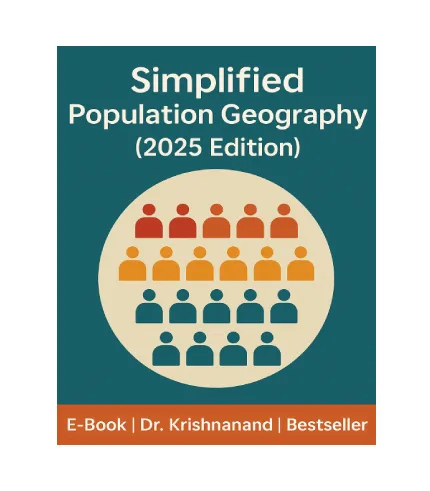
A book that mirrors this sequence chapter-for-chapter saves you the labor of cross-referencing syllabus PDFs with book indexes. Dr. Krishnanand’s Simplified Population Geography (2025 Edition) follows this exact CBCS/UPSC sequence across seven focused chapters, each opening with a “Syllabus Mapping” box — a feature that alone justifies its place on a serious aspirant’s desk.
Data Sources and Indian Context Coverage
International textbooks (like Newbold’s “Population Geography” or Clarke’s “Population Geography”) excel at global theory but treat India as a case study in one chapter. For Indian competitive exams, the reverse priority applies: Indian data sources — Census, Civil Registration System (CRS), Sample Registration System (SRS), National Family Health Survey (NFHS), and NSSO rounds — must be woven into every relevant concept.
Consider fertility analysis. A generic textbook explains Total Fertility Rate (TFR) formula. An exam-ready book gives you:
- TFR trend: 5.2 (1971) → 2.0 (2020, NFHS-5)
- State-wise TFR table: Bihar 3.0, UP 2.4, Kerala 1.5, Tamil Nadu 1.4
- Replacement level achievement status by state (2021 SRS)
- Proximate determinants framework (Bongaarts) applied to Indian context
The Office of the Registrar General & Census Commissioner, India remains the primary authority for Census 2011 data still used in exams, while NFHS-5 (2019–21) and SRS 2020 reports provide the latest vital statistics. Any Best Population Geography Book claiming 2025 relevance must cite these sources explicitly, with page-specific references so you can verify claims during revision.
Visual Learning: Maps, Diagrams, and Tables
Geography answers without diagrams score 30–40% lower on average, per multiple UPSC topper analyses. But not all visuals are created equal. A world population density map from 2010 adds zero value in a 2025 exam. What you need:
- India population density map (2011 Census) with 6-fold classification — reproducible in 2 minutes.
- Population pyramid templates for expansive, constrictive, and stationary types — with Indian state examples (Bihar vs. Kerala).
- Migration flow diagrams showing inter-state streams (UP→Maharashtra, Bihar→Delhi) and international corridors (Kerala→GCC, Punjab→Canada).
- Demographic transition model annotated with Indian phases: High Stationary (pre-1921), Early Expanding (1921–1951), Late Expanding (1951–1981), Low Stationary (post-1981).
The 2025 edition of Simplified Population Geography includes over 40 exam-oriented diagrams, each labeled with “Exam Tip” callouts indicating which PYQs they address. For instance, the Chapter 3 map of “Population Distribution Patterns in India” directly answers the 2021 UPSC question: “Explain the factors influencing the spatial distribution of population in India.”
Why Simplified Population Geography (2025 Edition) Stands Out
After evaluating a dozen titles against the criteria above — syllabus mapping, Indian data integration, visual density, and point-wise structure — one resource consistently surfaces in topper booklists and faculty recommendations: Simplified Population Geography (2025 Edition) by Dr. Krishnanand. Now in its latest edition, this e-book has become a de facto standard for UPSC CSE geography optional and GS aspirants, as well as undergraduate CBCS courses across central universities.
Three differentiators explain its adoption:
- Chapter 2 (Sources of Data) is uniquely India-centric. Instead of generic “census vs. survey” theory, it dedicates 15 pages to Census 2011 methodology, SRS sampling design, NFHS-5 questionnaire structure, and NSSO 75th/76th round migration modules — exactly what “Sources of Data with special reference to India” demands.
- Point-wise highlighted descriptions replace paragraphs. Chapter 4 (Population Dynamics) breaks fertility, mortality, and migration into 87 numbered points — each a potential 2-mark or 5-mark answer stem.
- Downloadable sample chapter lets you verify teaching style before purchase. The publisher provides Chapter 1 free, so you can confirm the point-wise + diagram format matches your learning preference.
At ₹249 for a lifetime-access e-book (PDF + EPUB), the cost-per-syllabus-topic is arguably the lowest in the category — especially compared to ₹600–900 hardcovers that omit NFHS-5 data.
How to Use This Book Effectively for Exam Preparation
Owning the Best Population Geography Book is only step one. Deployment determines results. Here’s a 3-week mastery plan used by 2023–24 geography optional toppers:
Week 1: Foundation & Data Fluency (Chapters 1–2)
- Memorize the 12-point “Nature & Scope” framework (Chapter 1) — covers definition, approaches, and significance.
- Create a one-page “Data Source Comparison Table”: Census vs. SRS vs. NFHS vs. NSSO — parameters: frequency, coverage, lag, key variables.
- Practice drawing the “Sources of Demographic Data” flowchart from memory (5 minutes daily).
Week 2: Dynamics & Composition (Chapters 3–5)
- For each determinant of population distribution (physical, historical, economic, political), prepare a 3-point “factor + mechanism + Indian example” card.
- Master the Demographic Transition Model with Indian phase dates — draw it daily until reproduction takes <90 seconds.
- Compile state-wise composition tables: sex ratio (0–6, total), literacy gap, workforce participation rate — use Appendix tables in the book.
Week 3: Theories, Policies & PYQ Integration (Chapters 6–7 + PYQs)
- Malthus vs. Marx vs. Demographic Transition: build a 3-column comparison table (assumptions, predictions, criticisms, Indian relevance).
- Trace population policy evolution: 1952 (first policy) → 1976 (National Population Policy) → 2000 (NPP 2000) → 2020 (draft) — note shifting focus from “control” to “reproductive health.”
- Solve 15 PYQs (2015–2024) using only book content — time yourself: 7 minutes per 10-marker, 4 minutes per 5-marker.
Pro tip: The e-book format allows Ctrl+F searching during mock tests — “migration streams,” “sex ratio,” “demographic dividend” — instantly locating relevant points. Print only the diagram pages for drawing practice.
Final Verdict: Matching Book to Aspirant Profile
No single book suits every aspirant. If you’re a beginner with 6+ months, Simplified Population Geography (2025 Edition) provides the complete, structured foundation. If you have 6 weeks and need only revision, its point-wise summaries and diagram bank serve as a high-yield crash course. If you’re targeting State PSCs with lighter geography weightage, the e-book’s searchability and ₹249 price make it a low-risk, high-return addition.
The defining test: open the free sample chapter. If the point-wise + diagram format clicks with how you think and write answers, the full book will compound that efficiency across the entire syllabus. That’s the pragmatic definition of the Best Population Geography Book — not the most famous, but the one that converts study hours into exam marks most reliably.
Our Recommendation
📖 Part of our complete guide: Evolution of Geographical Thought: A Comprehensive Guide for UPSC Aspirants and Geography Enthusiasts
Frequently Asked Questions
Which is the best population geography book for UPSC CSE preparation?
Simplified Population Geography (2025 Edition) by Dr. Krishnanand is widely recommended for UPSC CSE because it maps directly to the syllabus, integrates Census 2011, NFHS-5, and SRS data, and uses point-wise explanations with 40+ exam-ready diagrams.
Does the 2025 edition include latest demographic data like NFHS-5 and Census 2021 projections?
Yes, the 2025 edition incorporates NFHS-5 (2019–21) findings, SRS 2020 vital statistics, and Census 2021 projection data across relevant chapters, especially in fertility, mortality, and population composition sections.
Is this book suitable for undergraduate CBCS geography courses?
Absolutely. The book follows the prescribed CBCS syllabus chapter-for-chapter — Nature & Scope, Data Sources, Distribution & Growth, Dynamics, Composition, Theories, and Policies — making it a core textbook for BA/BSc Geography honours across Indian universities.