Blog
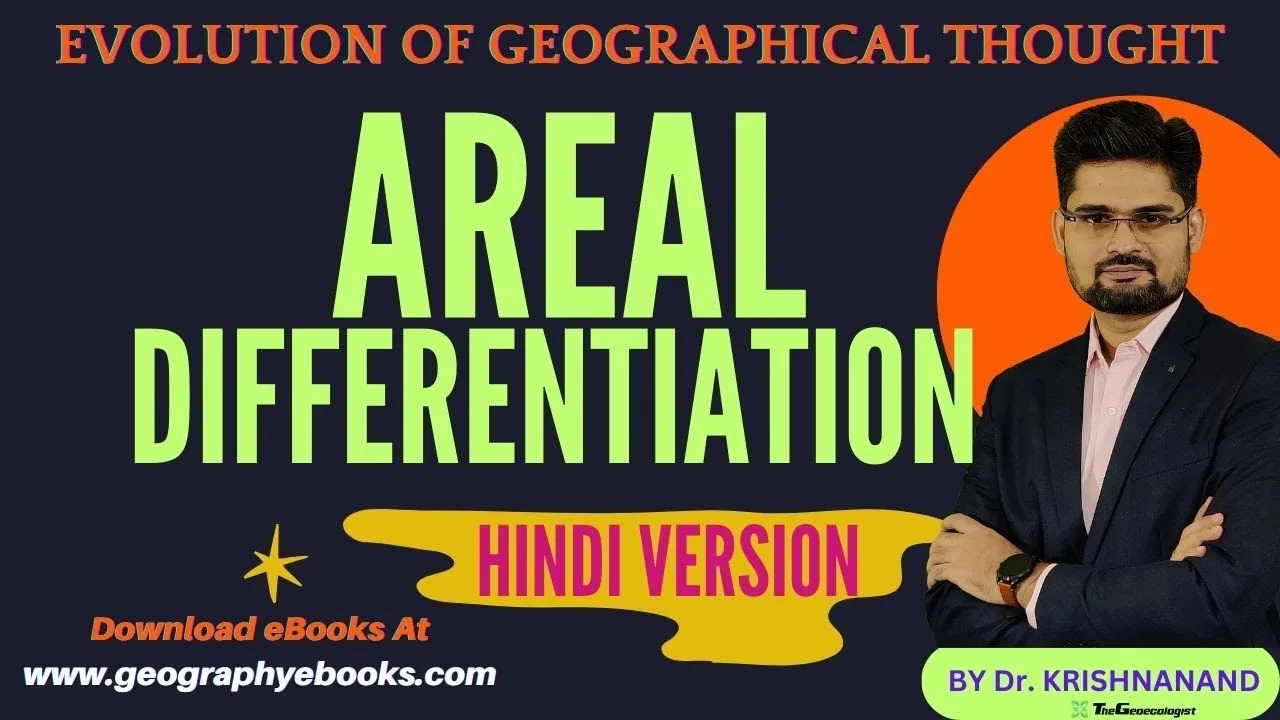
Areal Differentiation Richard Hartshorne-TheGeoecologist

Areal Differentiation Richard Hartshorne-TheGeoecologist
Understanding Areal Differentiation: Richard Hartshorne’s Cornerstone Contribution to Geography
Geography, as a discipline, thrives on its ability to unravel the diversity and interconnectedness of the world. Among its foundational concepts lies Areal Differentiation, a framework popularized by Richard Hartshorne—one of the most influential geographers of the 20th century—which remains indispensable for students of UGC NET Geography, UPSC Geography Optional, and university-level courses. This article delves into Hartshorne’s pioneering work, exploring its relevance in modern geography and its enduring impact on regional studies.
Who Was Richard Hartshorne?
Richard Hartshorne (1899–1992) revolutionized geographical thought through his seminal book, The Nature of Geography (1939). Rejecting the notion of geography as a mere compilation of facts, he positioned the discipline as a science focused on understanding the uniqueness of places. He argued that geography’s essence lies in answering “what is where, why there, and why care?”—a mantra still central to geographical inquiry.
Defining Areal Differentiation
Areal Differentiation refers to the systematic study of spatial variations across Earth’s surface. Hartshorne emphasized that each region possesses distinctive traits shaped by the interplay of physical, cultural, economic, and political factors. Unlike other sciences seeking universal laws, geography embraces an idiographic approach, prioritizing the detailed description and interpretation of regions.
For example, the Ganges Delta differs from the Sahara Desert not just in climate but in socio-cultural practices, livelihood patterns, and environmental challenges. Hartshorne’s framework trains geographers to identify, compare, and explain these contrasts, cementing regional geography as a vital sub-discipline.
Hartshorne’s Contributions to Geography
- Regional Synthesis: Hartshorne integrated physical and human geography, rejecting artificial divides. He viewed regions as dynamic “total composites” shaped by natural landscapes and human activities.
- Focus on Uniqueness: He challenged the reductionist trends of his era, advocating for in-depth regional studies over broad generalizations.
- Bridge Between Approaches: While critics pitted idiographic (place-specific) against nomothetic (law-seeking) methods, Hartshorne argued for their complementary roles, urging geographers to balance uniqueness with broader patterns.
Areal Differentiation vs. Spatial Analysis
The mid-20th century saw a shift toward spatial analysis, which employs quantitative models to study patterns (e.g., population distribution or trade networks). Hartshorne’s Areal Differentiation, however, remained grounded in qualitative, place-based inquiry:
- Areal Differentiation: Asks “why is this region distinct?”
- Spatial Analysis: Asks “how are phenomena arranged in space?”
While spatial analysis dominates modern GIS-driven research, Hartshorne’s legacy reminds us that context matters. For instance, understanding Kerala’s high literacy rate requires examining its history, policies, and cultural norms—not just statistical data.
Modern Relevance of Areal Differentiation
Hartshorne’s ideas remain critical in tackling contemporary issues:
- Climate Change Adaptation: Regional vulnerabilities vary—coastal Bangladesh faces rising sea levels, while Mongolia grapples with desertification.
- Cultural Preservation: Indigenous knowledge and practices (e.g., Himalayan water management) highlight place-based wisdom.
- Globalization’s Paradox: Despite interconnectedness, local identities persist (e.g., Basque Country in Spain).
For competitive exams like UPSC or UGC NET, mastering Areal Differentiation sharpens analytical skills in papers on regional planning, human-environment interactions, and geographical thought.
Conclusion
Richard Hartshorne’s Areal Differentiation reshaped geography by centering the significance of place. As TheGeoecologist’s lectures emphasize (https://thegeoecologist.com), this concept remains vital for aspirants and scholars alike, bridging classical theories and modern applications. In a world of homogenizing forces, Hartshorne’s call to celebrate regional uniqueness resonates louder than ever.
Explore Further:
- Online Geography Courses (UPSC/UGC NET): TheGeoecologist
- Study Materials: Geography eBooks
Subscribe to TheGeoecologist YouTube channel for detailed lectures on geographical concepts!
To Download E-Books & Study Material Visit The Shop Page