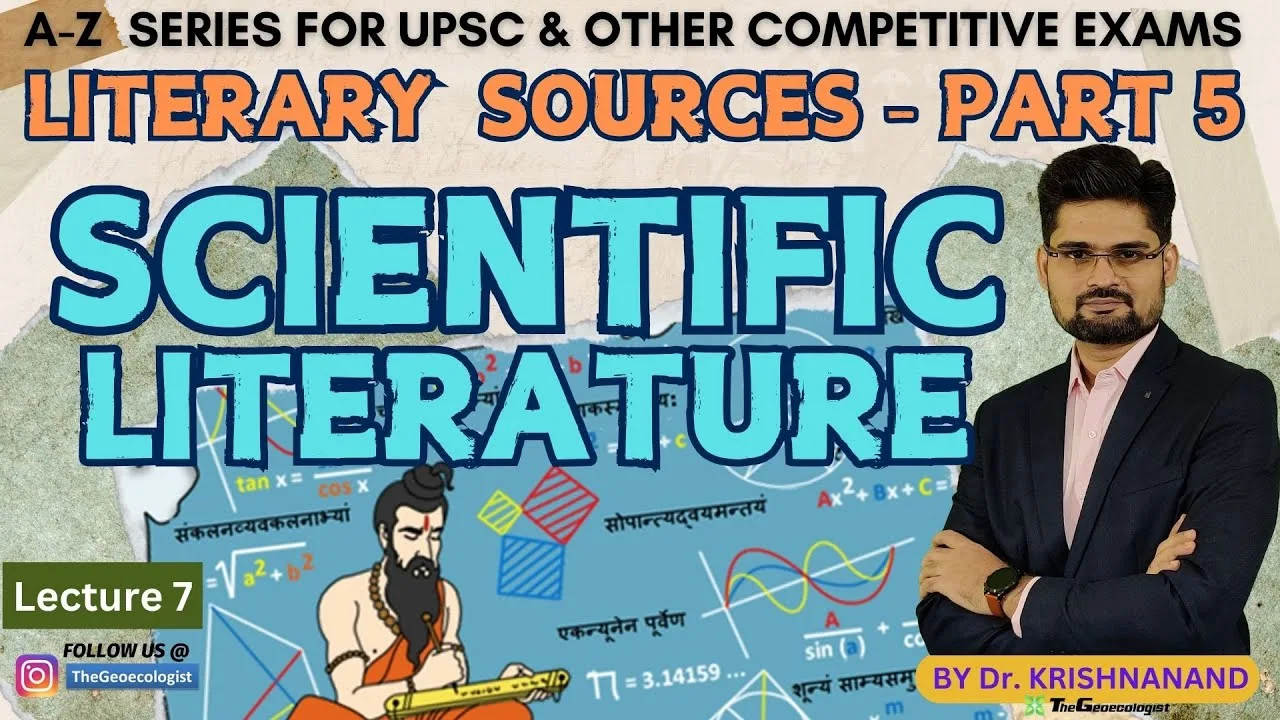
Scientific Literature-Literary Sources of Ancient India (Part 5)
Title: The Scientific Legacy of Ancient India: Foundations of Modern Knowledge
Introduction
Ancient India’s intellectual landscape was a vibrant tapestry of scientific inquiry, philosophical depth, and technological innovation. Long before the rise of modern laboratories, scholars and sages in the Indian subcontinent made groundbreaking contributions to mathematics, astronomy, medicine, and metallurgy. These advancements, preserved in texts like the Vedas, Upanishads, and specialized treatises, not only shaped their era but also laid the groundwork for contemporary science. This article explores the enduring legacy of ancient Indian science, highlighting key figures, texts, and innovations that continue to inspire the world.
Mathematics: The Birth of Zero and Decimal System
The foundations of modern mathematics owe much to ancient India. The concept of shunya (zero), first articulated in the 5th century CE by Aryabhata in his Aryabhatiya, revolutionized numerical systems globally. His work introduced place-value notation and the decimal system, which later traveled to the Arab world and Europe, becoming the basis of modern arithmetic. The Sulba Sutras (800–500 BCE), Vedic geometrical manuals, detailed precise calculations for constructing altars, showcasing early applications of the Pythagorean theorem and algebraic principles. Aryabhata also calculated π (pi) to four decimal places, a feat unmatched in his time.
Astronomy: Celestial Insights and Heliocentrism
Ancient Indian astronomers blended observation with mathematical rigor. Aryabhata proposed a heliocentric model of the solar system, asserting that Earth rotates on its axis and orbits the sun—a idea later echoed by Copernicus. His calculations on planetary positions, eclipses, and the sidereal year (365.26 days) remain remarkably accurate. The Vedanga Jyotisha (12th century BCE), one of the earliest astronomical texts, systematized timekeeping and calendric science. These works influenced Islamic and European astronomy, bridging ancient and modern cosmological understanding.
Medicine: Ayurveda and Surgical Pioneering
The Sushruta Samhita (6th century BCE), attributed to the sage Sushruta, is a cornerstone of medical literature. It details over 300 surgical procedures, including cataract surgery, cesarean sections, and plastic reconstruction, using 125 specialized instruments. Sushruta’s emphasis on anatomy, sterilization, and patient care predates Hippocratic principles. Similarly, the Charaka Samhita by Charaka (3rd century BCE) laid the foundations of Ayurveda, advocating holistic health through diet, herbal remedies, and preventive care. Modern integrative medicine increasingly recognizes Ayurveda’s value, particularly in wellness and chronic disease management.
Metallurgy: The Iron Pillar and Advanced Alloys
Ancient India’s metallurgical prowess is epitomized by the Iron Pillar of Delhi (4th century CE), a corrosion-resistant marvel that defies rusting even after 1,600 years. Texts like the Arthashastra describe advanced smelting techniques for creating high-quality steel (“wootz”), later traded as “Damascus steel.” These innovations in alloy production and metalworking laid the groundwork for modern materials science.
Philosophy and Science: The Vedas and Upanishads
The Vedas and Upanishads (1500–500 BCE) intertwined spiritual inquiry with proto-scientific exploration. The Rig Veda’s cosmological hymns ponder the origins of the universe, while the Upanishads delve into the nature of consciousness and matter, foreshadowing quantum physics’ mind-matter debates. The Nyaya and Vaisheshika schools systematized logic and atomic theory, proposing that matter comprises indivisible particles (paramanu).
Relevance in Modern Science
Ancient India’s legacy thrives today. Mathematicians celebrate the zero’s digital-age indispensability, while Ayurveda gains global traction as a complementary healthcare system. NASA honors Aryabhata through its first satellite’s name, and metallurgists study ancient alloys for sustainable materials. These contributions underscore a timeless truth: curiosity and innovation transcend eras.
Conclusion
The scientific heritage of ancient India is not a relic of the past but a living tradition that continues to inform and inspire. For UPSC aspirants and history enthusiasts, understanding these achievements offers profound insights into India’s role as a cradle of knowledge. As we decode ancient texts with modern tools, we rediscover a civilization that saw no divide between the empirical and the existential—a vision as relevant today as it was millennia ago.
#History #AncientScience #UPSC #IndianHeritage #ScienceAndPhilosophy
Explore this rich legacy in our latest video, where history and science converge to illuminate the genius of ancient India!
To Download E-Books & Study Material Visit The Shop Page