


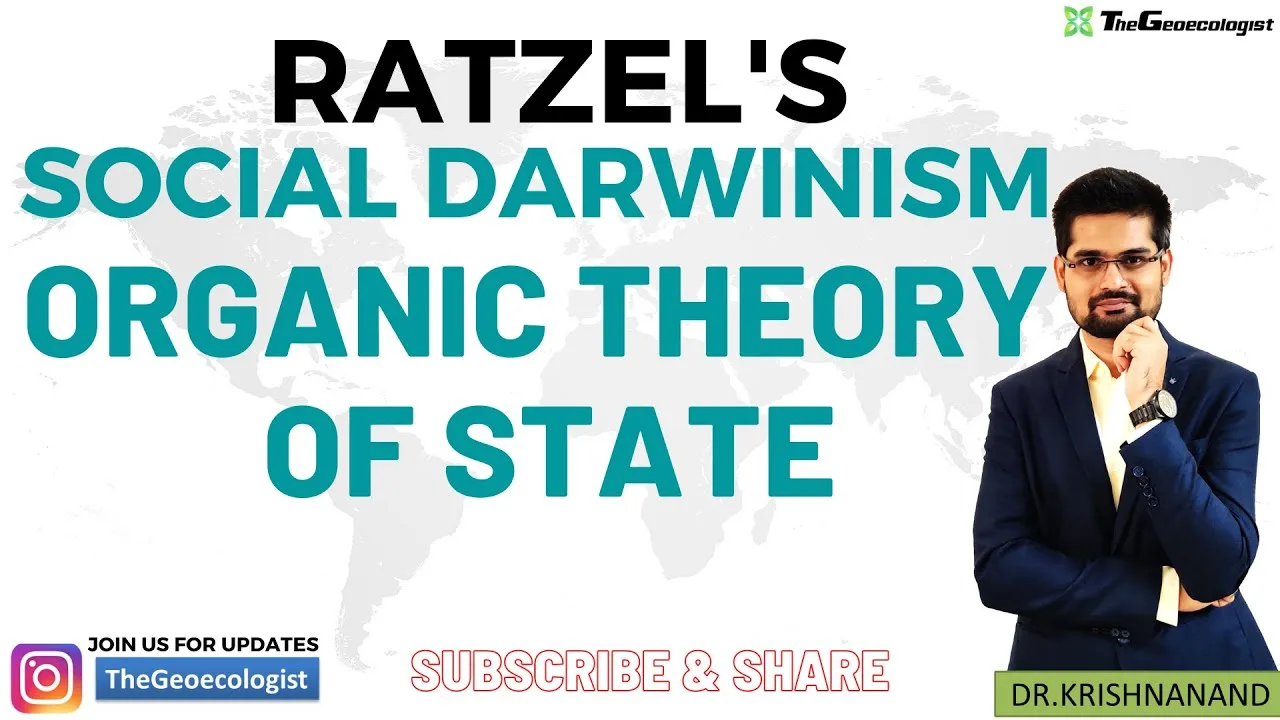
Organic Theory of State -Social Darwinism – Friedrich Ratzel
Friedrich Ratzel’s Organic Theory of State and Social Darwinism: A Comprehensive Overview
The Organic Theory of State and its association with Social Darwinism, conceptualized by German geographer Friedrich Ratzel in the late 19th and early 20th centuries, remain pivotal in the study of political geography. These ideas, though controversial, offer profound insights into how states function, expand, and interact, making them essential for students preparing for competitive exams, as well as undergraduate and postgraduate geography courses worldwide.
Who Was Friedrich Ratzel?
Friedrich Ratzel (1844–1904) was a German geographer and ethnographer often regarded as one of the founding figures of political geography. Influenced by the scientific advancements of his time, including Charles Darwin’s theory of evolution, Ratzel sought to apply biological principles to human societies and political entities. His seminal work, Politische Geographie (1897), laid the groundwork for understanding states as dynamic, living organisms.
Understanding the Organic Theory of State
The core of Ratzel’s theory lies in the analogy between a state and a biological organism. According to him:
- States are Living Entities: Like living beings, states are born, grow, decline, and die.
- Need for Space (Lebensraum): Just as organisms require nutrients to survive, states need territorial expansion to sustain their growth. This concept of Lebensraum (living space) became central to his theory.
- Seven Laws of State Growth: Ratzel outlined principles governing state expansion, emphasizing that stronger states naturally absorb weaker ones through territorial conquest.
Ratzel argued that a state’s survival depends on its ability to adapt to its environment and expand its boundaries, prioritizing geopolitical strength over static borders.
Link to Social Darwinism
Ratzel’s ideas intersect with Social Darwinism, an ideology applying Darwin’s “survival of the fittest” to human societies. Key aspects include:
- Competition Between States: Powerful states, akin to dominant species, outcompete weaker ones through expansion and colonization.
- Hierarchy of Civilizations: European imperial powers framed their colonial exploits as a “natural” process of civilizing “inferior” societies.
- Justification for Imperialism: The scramble for Africa and Asia in the 19th century was rationalized using Ratzel’s theories, portraying colonization as inevitable and biologically justified.
Criticisms and Controversies
While groundbreaking, Ratzel’s theories faced backlash for their deterministic and Eurocentric nature:
- Ethical Concerns: Social Darwinism was misused to legitimize racism, eugenics, and imperial exploitation.
- Oversimplification: Critics argue that reducing state behavior to biological laws ignores cultural, economic, and diplomatic factors.
- Link to Nazi Ideology: The Lebensraum concept was infamously co-opted by Nazi Germany to justify territorial aggression in World War II.
Relevance in Modern Political Geography
Despite their flaws, Ratzel’s theories remain influential:
- Geopolitical Analysis: Modern scholars reference the Organic Theory to examine territorial disputes, state sovereignty, and resource conflicts.
- Environmental Determinism: Debates on how geography shapes political power owe much to Ratzel’s foundational ideas.
- Connection to Later Theories: Halford Mackinder’s Heartland Theory and Nicholas Spykman’s Rimland Theory build on Ratzel’s emphasis on territorial control.
Why Study Ratzel Today?
For students of geography and political science, understanding Ratzel is crucial because:
- Exam Relevance: Topics like the Organic Theory frequently appear in UPSC, NET, and other competitive exams.
- Critical Thinking: Analyzing these theories encourages reflection on the ethical dimensions of geopolitics.
- Historical Context: They provide insight into the ideological drivers of 19th-century imperialism and 20th-century conflicts.
Conclusion
Friedrich Ratzel’s Organic Theory of State and its ties to Social Darwinism represent a turning point in political geography, blending biology, history, and geopolitics. While these ideas have been misused, they remain indispensable for understanding state behavior and the historical roots of modern geopolitical thought. For students and aspirants, mastering these concepts offers both academic rigor and a lens to critically evaluate global power dynamics.
For further insights, watch Dr. Krishnanand’s video on the Organic Theory and Social Darwinism on TheGeoecologist YouTube channel. Follow @thegeoecologist on Instagram and visit thegeoecologist.com for courses and study materials!
ratzel #organictheoryofstate #socialdarwinism
Keywords: Friedrich Ratzel, Organic Theory of State, Social Darwinism, Political Geography, UPSC Geography, Geopolitics, Lebensraum, Competitive Exams.
To Download E-Books & Study Material Visit The Shop Page