Blog
Minerals and Rocks -NCERT Geography Class 11-Chapter 5 -TheGeoecologist

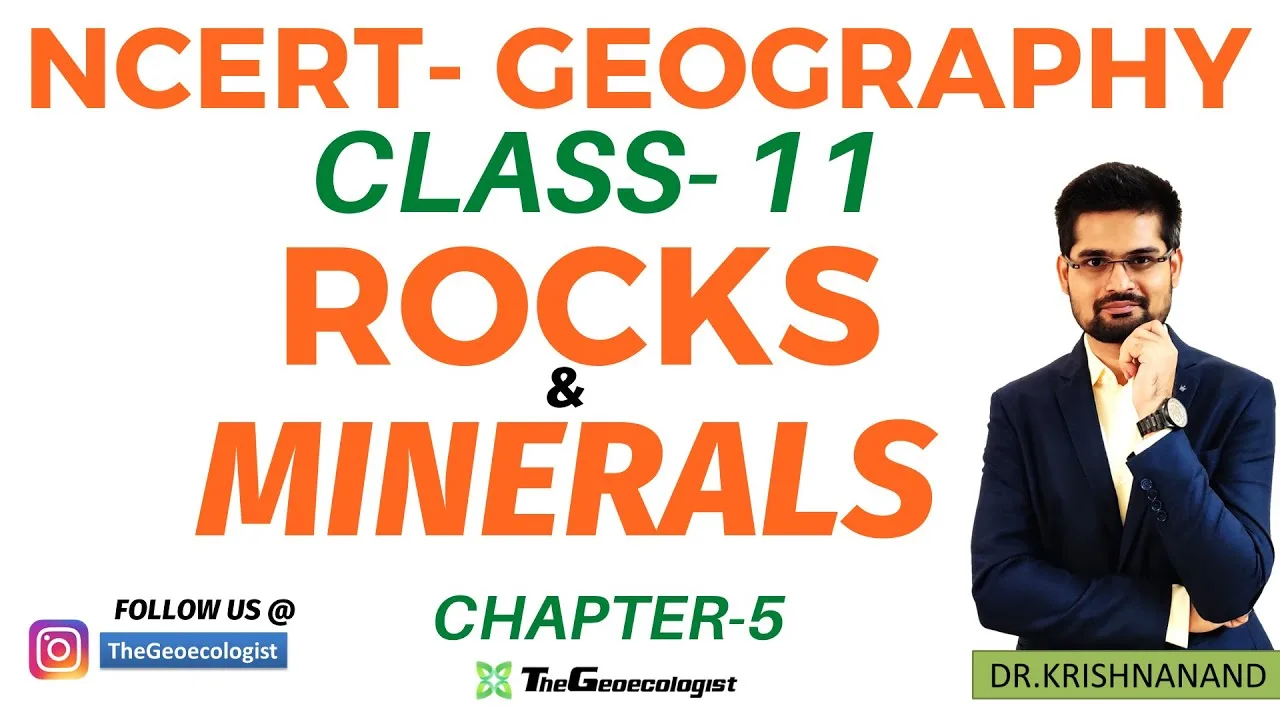
Minerals and Rocks -NCERT Geography Class 11-Chapter 5 -TheGeoecologist
Understanding Minerals and Rocks: NCERT Geography Class 11 – Chapter 5
Your Gateway to Excelling in CBSE and Competitive Exams
Minerals and rocks form the foundation of Earth’s structure, making them a critical topic in NCERT Class 11 Geography (Chapter 5). This article simplifies key concepts using insights from TheGeoecologist’s bilingual (Hindi-English) video, aiding both CBSE students and UPSC aspirants. Let’s dive in!
What are Minerals?
Minerals (खनिज) are naturally occurring, inorganic substances with a definite chemical composition and crystalline structure. They are classified into:
- Metallic Minerals: Contain metals (e.g., iron, bauxite).
- Non-Metallic Minerals: Lack metals (e.g., mica, limestone).
- Energy Minerals: Used for power (e.g., coal, petroleum).
Physical Properties like color, streak, hardness (Mohs scale), and cleavage help identify minerals. For instance, quartz is hard (7 on Mohs scale), while talc is the softest (1).
Types of Rocks
Rocks (चट्टानें) are aggregates of minerals. They are categorized based on formation:
Igneous Rocks (आग्नेय चट्टानें):
- Formed from cooling magma.
- Intrusive: Slow cooling inside Earth (e.g., granite).
- Extrusive: Rapid cooling on the surface (e.g., basalt).
Sedimentary Rocks (अवसादी चट्टानें):
- Formed by compaction of sediments.
- Often layered (e.g., sandstone, coal).
- Fossils are commonly found here.
- Metamorphic Rocks (कायांतरित चट्टानें):
- Formed under heat/pressure on existing rocks.
- Examples: Marble (from limestone), slate (from shale).
The Rock Cycle (चट्टान चक्र)
This continuous process explains how rocks transform:
- Weathering/Erosion: Rocks break into sediments.
- Deposition/Compaction: Sediments form sedimentary rocks.
- Heat/Pressure: Sedimentary/igneous rocks become metamorphic.
- Melting/Cooling: Metamorphic rocks melt to form magma, restarting the cycle.
Why Is This Chapter Important?
- CBSE Exams: Focus on rock types, mineral properties, and the rock cycle diagram.
- UPSC: Link concepts to India’s mineral distribution (e.g., coal in Jharkhand, mica in Andhra Pradesh).
- TheGeoecologist’s Tips: Use mnemonics like I-S-M (Igneous-Sedimentary-Metamorphic) for quick revision. The video emphasizes visualizing processes through simple flowcharts.
Key Terms in Hindi & English
- अग्नेय चट्टानें (Igneous Rocks)
- अवसादी चट्टानें (Sedimentary Rocks)
- ज्वालामुखी (Volcano) – Linked to igneous rock formation.
Prepare Effectively!
- Practice Diagrams: Sketch the rock cycle and mineral classification charts.
- Map Work: Mark India’s mineral-rich regions (e.g., Rajasthan for zinc).
- Watch TheGeoecologist’s Video: The Hindi-English mix simplifies complex terms.
Boost Your Preparation!
Explore detailed lessons on minerals, rocks, and more with TheGeoecologist’s Paid Courses. Visit https://thegeoecologist.com/ for structured resources tailored for CBSE and UPSC.
Stay Updated:
- Email: krishna.geography@gmail.com
- Instagram: @thegeoecologist
ncertclass11geography #ncertgeography #ncertrevision
Master these concepts to build a strong geological foundation – essential for acading exams and understanding Earth’s dynamic processes! 🌍✨
To Download E-Books & Study Material Visit The Shop Page