Blog
Distribution of Oceans and Continents- NCERT Geography Class 11-Chapter 4-TheGeoecologist

Distribution of Oceans and Continents- NCERT Geography Class 11-Chapter 4-TheGeoecologist
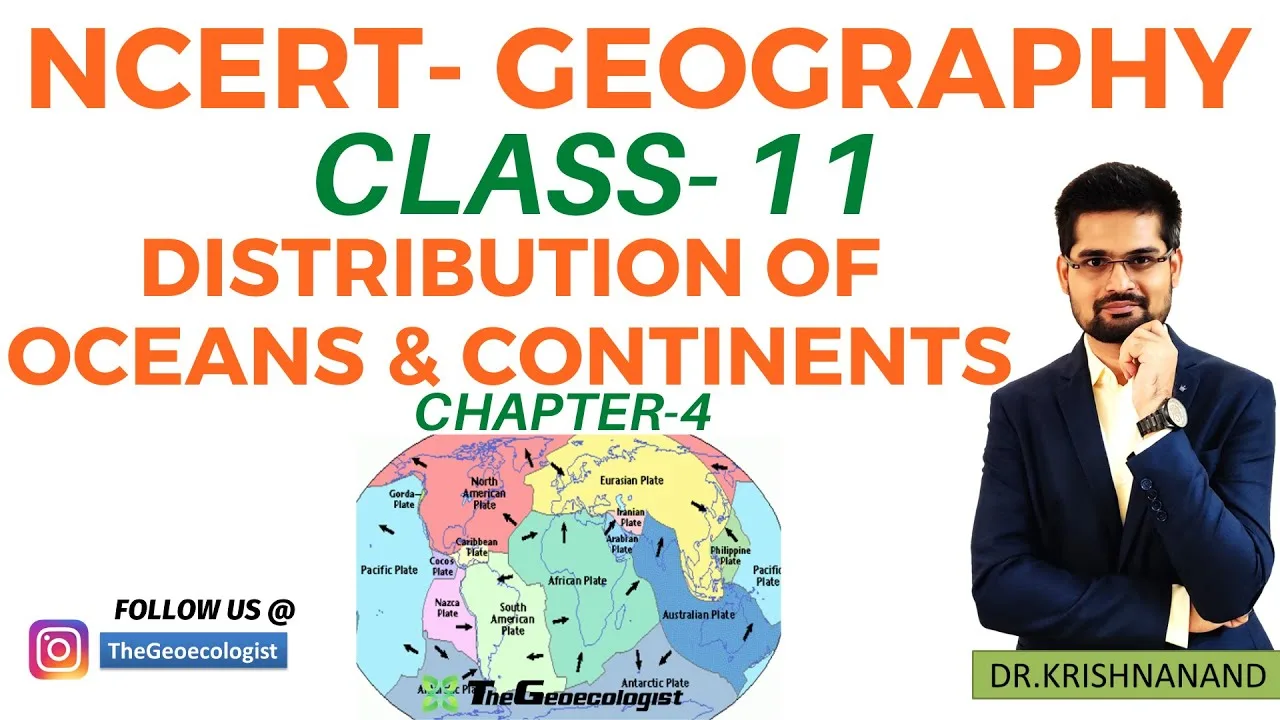
Understanding the Distribution of Oceans and Continents: NCERT Geography Class 11 (Chapter 4)
The dynamic nature of Earth’s surface, with its vast oceans and sprawling continents, has always fascinated geographers and geologists. Chapter 4 of NCERT Class 11 Geography, Distribution of Oceans and Continents, delves into the evolutionary processes that shaped the planet’s current geography. This article simplifies key concepts from the chapter, alongside insights from TheGeoecologist’s bilingual (Hindi-English) video tutorial, to aid CBSE students and UPSC/competitive exam aspirants.
Theories Explaining Continental and Oceanic Distribution
Understanding Earth’s surface requires exploring theories that explain the past and present arrangement of continents and oceans.
1. Continental Drift Theory (Alfred Wegener, 1912)
- Key Idea: Wegener proposed that all continents formed a single landmass called Pangaea, surrounded by a mega-ocean, Panthalassa. Over time, Pangaea split into Laurasia (northern continents) and Gondwanaland (southern continents), which further drifted to their current positions.
- Evidences:
- Jigsaw Fit: Coastlines of South America and Africa align.
- Fossil Evidence: Similar fossils (e.g., Mesosaurus) found across continents.
- Rock Formations: Matching geological structures in Brazil and South Africa.
- Paleoclimatic Evidence: Glacial traces in warm regions like India.
Criticism: Wegener couldn’t explain the mechanism behind continental movement.
2. Convectional Current Theory (Arthur Holmes, 1930s)
Holmes suggested that thermal convection currents in Earth’s mantle caused continental movement. This idea later influenced the Plate Tectonics Theory.
3. Seafloor Spreading (Harry Hess, 1961)
- Mid-oceanic ridges (e.g., Mid-Atlantic Ridge) were identified as zones where new oceanic crust forms due to magma rising from the mantle.
- Evidences:
- Younger Rocks near ridges and older rocks near continents.
- Magnetic Striping: Alternating bands of magnetic polarity in oceanic crust.
4. Plate Tectonics Theory
- Earth’s lithosphere is divided into tectonic plates (major plates: Pacific, Indo-Australian, Eurasian).
- Types of Plate Boundaries:
- Divergent: Plates move apart (e.g., mid-ocean ridges).
- Convergent: Plates collide, forming mountains or subduction zones.
- Transform: Plates slide past each other (e.g., San Andreas Fault).
Evolution of Continents
- Pangaea broke into Gondwanaland and Laurasia ~200 million years ago.
- Further splitting led to today’s continents, with the Atlantic Ocean still widening.
Why This Matters for Exams
- CBSE Class 11: Focus on diagrammatic representations of Pangaea, seafloor spreading, and plate boundaries.
- UPSC/Competitive Exams: Questions often link plate tectonics to earthquakes, volcanoes, and mountain formation (e.g., Himalayas).
TheGeoecologist’s Insights
The video simplifies complex concepts using bilingual explanations, flowcharts, and maps, making it ideal for visual learners. Key highlights:
- Emphasis on connecting historical theories to contemporary geography.
- Mnemonics to remember evidence for continental drift.
- Real-world examples (e.g., the active Himalayas) to explain plate interactions.
Conclusion
From Wegener’s groundbreaking hypothesis to modern plate tectonics, Chapter 4 underscores the ever-changing nature of Earth. Mastering these concepts equips students to tackle questions on geological processes in both academic and competitive exams.
Enhance Your Preparation:
- Explore detailed lessons and practice quizzes on TheGeoecologist’s Website.
- Follow on Instagram for daily geography updates.
#ncertclass11geography #ncertgeography #ncertrevision
For doubts or paid courses, contact: krishna.geography@gmail.com
Crack your exams with clarity—understand the Earth’s story, one chapter at a time! 🌍
To Download E-Books & Study Material Visit The Shop Page