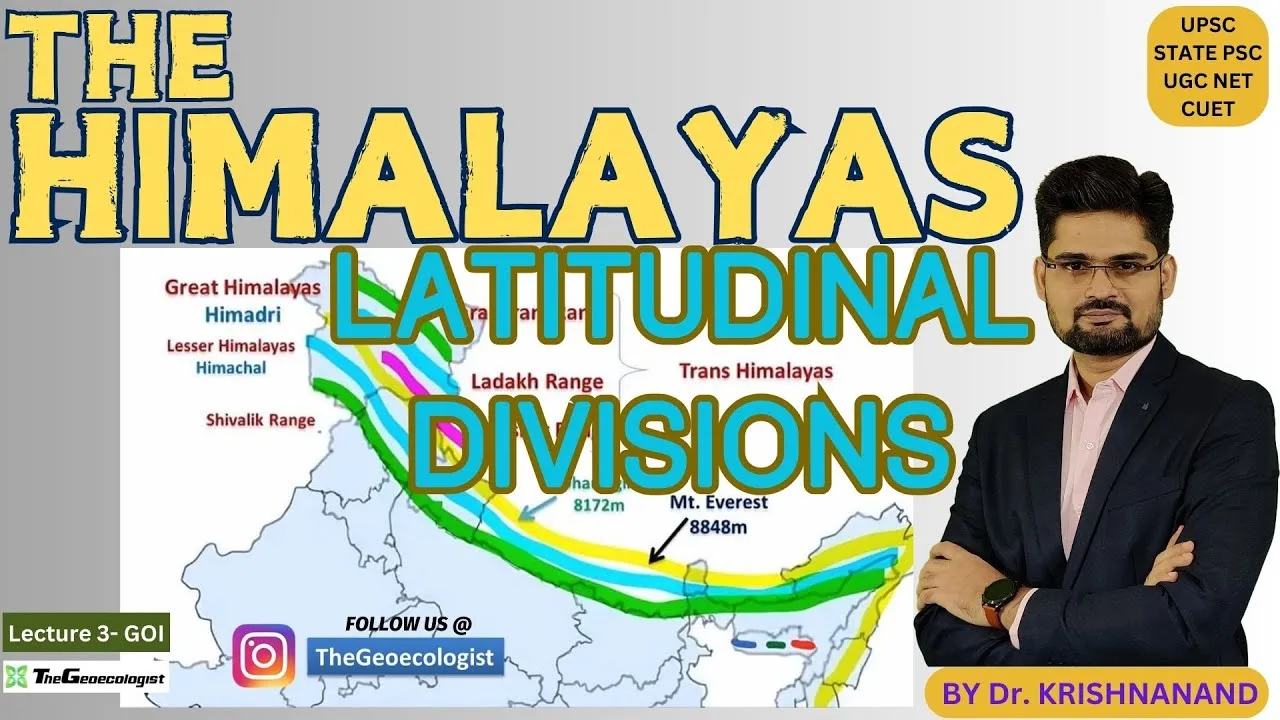
Latitudinal Divisions of the Himalayas-TheGeoecologist #upsc
Understanding the Latitudinal Divisions of the Himalayas: A Guide for UPSC Aspirants
The Himalayas, often referred to as the "abode of snow," are one of the most awe-inspiring mountain ranges in the world. Stretching across five countries and encompassing diverse ecological and geological features, this majestic range is a vital topic for UPSC aspirants, particularly in geography and geology. To unravel its complexity, renowned geologists Sidney Gerald Burrard and August Gansser classified the Himalayas into three primary latitudinal divisions: the Greater Himalayas (Himadri), the Lesser Himalayas (Himachal), and the Outer Himalayas (Shiwaliks). Let’s delve into these divisions and their significance.
1. The Greater Himalayas (Himadri): Peaks that Touch the Sky
The northernmost and loftiest division, the Greater Himalayas, is characterized by towering peaks like Mount Everest, K2, and Kangchenjunga, many exceeding 7,000 meters. These mountains are perennially snow-capped and house massive glaciers such as Gangotri and Siachen. Formed by intense tectonic collisions between the Indian and Eurasian plates, the Himadri acts as a climatic barrier, influencing monsoons and preserving unique alpine ecosystems. Sidney Burrard’s studies highlighted its role in the geological evolution of the subcontinent, while August Gansser emphasized its metamorphic rocks and thrust faults, critical for understanding tectonic activity.
2. The Lesser Himalayas (Himachal): A Biodiversity Hotspot
South of the Himadri lies the Lesser Himalayas, a region of moderate elevations (3,700–4,500 meters) featuring picturesque valleys like Kashmir, Kullu, and Kangra. This zone is renowned for its rich biodiversity, with dense forests of pine, oak, and rhododendron. Geologically, it comprises highly folded and faulted rocks, including shale, limestone, and quartzite. Burrard’s surveys identified the Main Central Thrust (MCT), a major fault separating the Greater and Lesser Himalayas, while Gansser’s work revealed how tectonic uplift shaped its intricate topography. This region is also vital for hydropower projects and agriculture.
3. The Outer Himalayas (Shiwaliks): The Youngest Geological Frontier
The southernmost division, the Shiwaliks, consists of newly formed, low-altitude hills (900–1,500 meters) composed of unconsolidated sediments like gravel and alluvium. These hills are highly prone to landslides and earthquakes due to ongoing tectonic stress. The Shiwaliks act as a transitional zone between the Himalayas and the plains, hosting diverse flora and fauna, including the Terai-Duar savanna. Gansser’s research underlined their role in understanding the Himalayan foreland basin, while Burrard’s mapping emphasized their significance in sediment transport and drainage systems.
Tectonic Forces: Shaping the Himalayas
The Himalayas owe their existence to the collision of tectonic plates that began 50 million years ago. This ongoing convergence causes seismic activity, uplifting newer layers and shaping the three latitudinal divisions. The Main Boundary Thrust (MBT) and Himalayan Frontal Thrust (HFT) are critical fault lines influencing the region’s dynamic landscape.
Why This Matters for UPSC
Understanding these divisions is crucial for tackling questions on physical geography, ecology, and disaster management in the UPSC exam. The classification by Burrard and Gansser provides a framework to analyze the Himalayas’ geomorphic processes, climate interactions, and resource distribution.
Conclusion
The Himalayas are not just a mountain range but a living laboratory for geologists and geographers. By studying the latitudinal divisions—Himadri, Himachal, and Shiwaliks—we gain insights into Earth’s tectonic forces, ecological diversity, and the delicate balance of nature. For UPSC aspirants, mastering this topic is key to excelling in geography and related subjects.
Enhance Your Preparation!
For a deeper dive, watch TheGeoecologist’s detailed video on the Himalayas’ latitudinal divisions, featuring expert analyses of Burrard and Gansser’s work. Subscribe to our channel for more educational content on geology, geography, and UPSC-centric topics.
Visit our website for structured geography courses: https://thegeoecologist.com/
Himalayas #Geology #LatitudinalDivisions #SidneyBurrard #AugustGansser #UPSC #GeographyOptional #NaturalWonders #HimalayanGeology #EducationalVideo
To Download E-Books & Study Material Visit The Shop Page