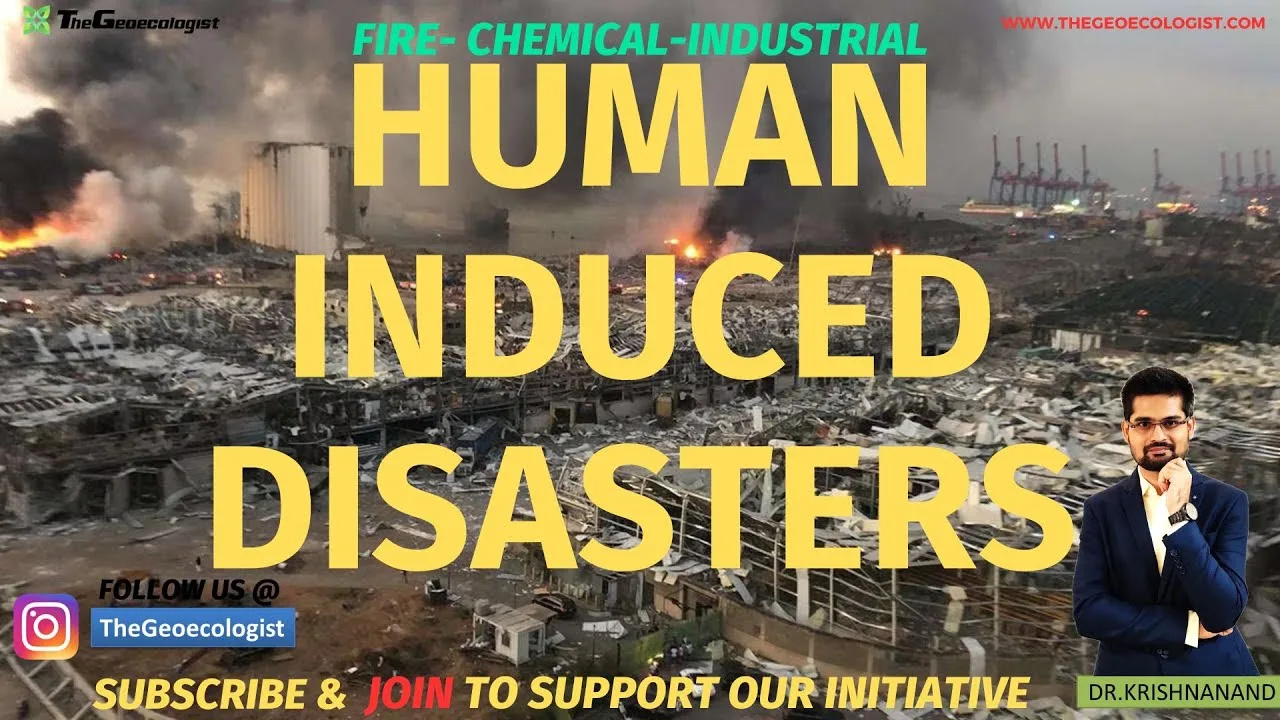
Human Induced Disasters: Fire Hazards, Chemical & Industrial Accidents- TheGeoecologist
Understanding Human-Induced Disasters: Fire Hazards and Chemical & Industrial Accidents
Insights for UPSC Geography Optional Aspirants
Human-induced disasters, unlike natural calamities, stem directly from human activities, technological failures, or negligence. Among these, fire hazards and chemical & industrial accidents pose significant threats to lives, economies, and ecosystems. This article, inspired by Dr. Krishnanand’s lecture on TheGeoecologist, simplifies these concepts for UPSC Geography Optional aspirants, offering a global perspective with a focus on India.
Fire Hazards: Causes and Consequences
Fire hazards arise from unchecked urban growth, industrial activities, and poor safety protocols. Key factors include:
- Urbanization: High-density settlements and unsafe electrical systems (e.g., Mumbai slum fires).
- Industrial Negligence: Flammable material mismanagement in factories.
- Forest Fires: Often caused by human activities like farming (e.g., Amazon fires, Uttarakhand forest fires).
Case Studies:
- India: The 1997 Uphaar Cinema Fire in Delhi (59 deaths due to electrical faults) underscores inadequate safety norms.
- Global: The 2019–20 Australian Bushfires, exacerbated by climate change and land mismanagement, burned 18 million hectares.
Chemical & Industrial Accidents: A Silent Menace
These disasters involve toxic chemical releases, explosions, or leaks, often due to outdated infrastructure or poor regulatory enforcement.
Key Incidents:
- Bhopal Gas Tragedy (1984): The world’s worst industrial disaster, killing over 3,800 people due to a methyl isocyanate leak.
- Vizag Gas Leak (2020): A styrene gas leak from LG Polymers in Andhra Pradesh highlighted lax safety in India’s industrial zones.
- Beirut Port Explosion (2020): Improper storage of ammonium nitrate killed 218 and devastated Lebanon’s capital.
Impact:
- Health: Long-term respiratory and neurological disorders.
- Environment: Soil and water contamination (e.g., Bhopal’s groundwater remains polluted).
- Economy: Loss of livelihoods and rehabilitation costs.
Disaster Management: Mitigation Strategies
- Policy Frameworks:
- India’s National Disaster Management Authority (NDMA) guidelines for chemical accidents and fire safety.
- Global agreements like the Kyoto Protocol to reduce industrial emissions.
- Technology: Early warning systems, GIS for hazard mapping, and IoT-based fire detectors.
- Community Preparedness: Regular drills and awareness campaigns in vulnerable areas.
Why This Matters for UPSC Aspirants
The Geography Optional syllabus emphasizes human-environment interactions and disaster management. Understanding these disasters aids in answering questions on:
- Case studies with socio-economic implications.
- Policy analysis (e.g., NDMA’s role).
- Sustainable development goals linked to industrial safety and urban planning.
Key Takeaways from Dr. Krishnanand’s Lecture
- Interlinkages: How urbanization and industrialization amplify disaster risks.
- Global vs. Local: Comparative analysis of incidents in India and the world.
- Solutions: Integrating traditional knowledge with modern tech for resilience.
Enhance Your Preparation
For detailed explanations, watch Dr. Krishnanand’s lecture on TheGeoecologist YouTube Channel. Explore courses at thegeoecologist.com and follow @thegeoecologist for updates.
Keywords: Human-induced disasters, UPSC Geography, Bhopal Gas Tragedy, disaster management, NDMA.
Empower your UPSC journey with strategic insights into human-induced disasters—where geography meets real-world challenges! 🌍🔥
To Download E-Books & Study Material Visit The Shop Page