


Continental Drift Theory Timelapse #continentaldrifttheory #craton #viralvideo #shorts
The Fascinating Story of Continental Drift: From Hypothesis to Scientific Fact
Continental Drift Theory – A Journey Through Time
One of the most groundbreaking ideas in geology, the Continental Drift Theory, explains how Earth’s continents have moved across the planet over millions of years. First proposed in the early 20th century, this concept radically changed our understanding of Earth’s dynamic nature.
The Origins of the Theory
The idea that continents were not always in their current positions dates back to Abraham Ortelius in 1596, who speculated about the fit between South America and Africa. However, it wasn’t until 1912 that Alfred Wegener, a German meteorologist and geophysicist, presented a detailed argument in his book “The Origin of Continents and Oceans”.
Wegener noticed that:
- Coastlines of continents (like Africa and South America) matched like puzzle pieces.
- Fossil records of identical species were found on separate continents.
- Similar rock formations and ancient mountain ranges appeared on distant landmasses.
Despite compelling evidence, the scientific community initially dismissed his theory—mainly because he couldn’t explain what force could move continents.
The Turning Point: Plate Tectonics
In 1931, English geologist Arthur Holmes suggested mantle convection as the driving force behind continental movement. His idea proposed that heat from Earth’s interior causes the mantle to flow, pushing and pulling the rigid outer layer (crust) along.
By the 1960s, advancements in ocean-floor mapping and discoveries like mid-ocean ridges and seafloor spreading confirmed Wegener’s theory. The concept evolved into plate tectonics, explaining not just drifting continents but also earthquakes, volcanoes, and mountain formation.
Watch the Earth Transform in a Timelapse!
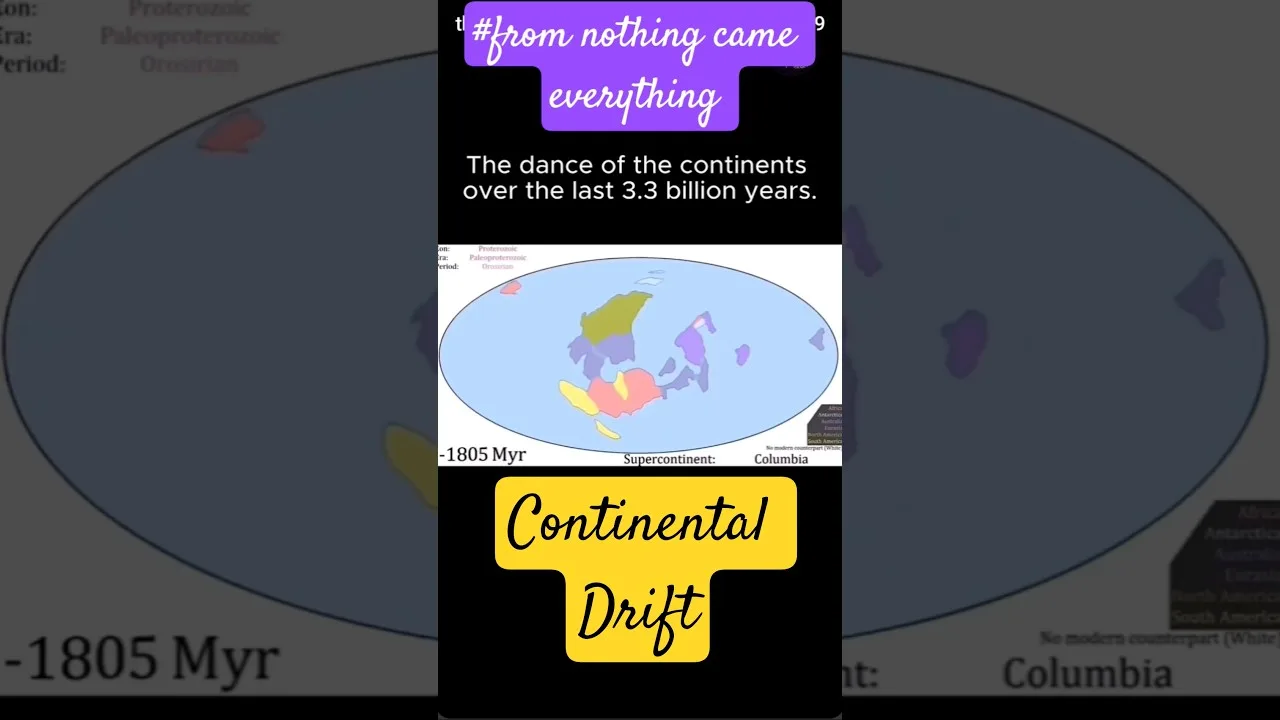
Modern technology allows us to visualize this incredible journey. A timelapse of continental drift (like in viral videos and #shorts) shows how Earth’s landmasses shifted from Pangaea (the supercontinent ~300 million years ago) to today’s geography. Some key stages include:
- Pangaea (~335-175 million years ago)
- Laurasia & Gondwana (after Pangaea split)
- Modern continents (still moving at ~2.5 cm per year!)
Why This Matters Today
The Continental Drift Theory is now fundamental in geology, helping scientists predict earthquake zones, volcanic activity, and even mineral deposits. Ancient cratons (Earth’s oldest stable landmasses) provide clues about Earth’s early history.
Final Thought
What was once a controversial idea is now a cornerstone of Earth sciences. The next time you see a world map, remember—the continents are still drifting, shaping the future of our planet!
#ContinentalDriftTheory #Craton #ViralVideo #Shorts #PlateTectonics #Pangaea
Would you like more details on any aspect of this topic? Let us know in the comments! 🔥🌍
To Download E-Books & Study Material Visit The Shop Page