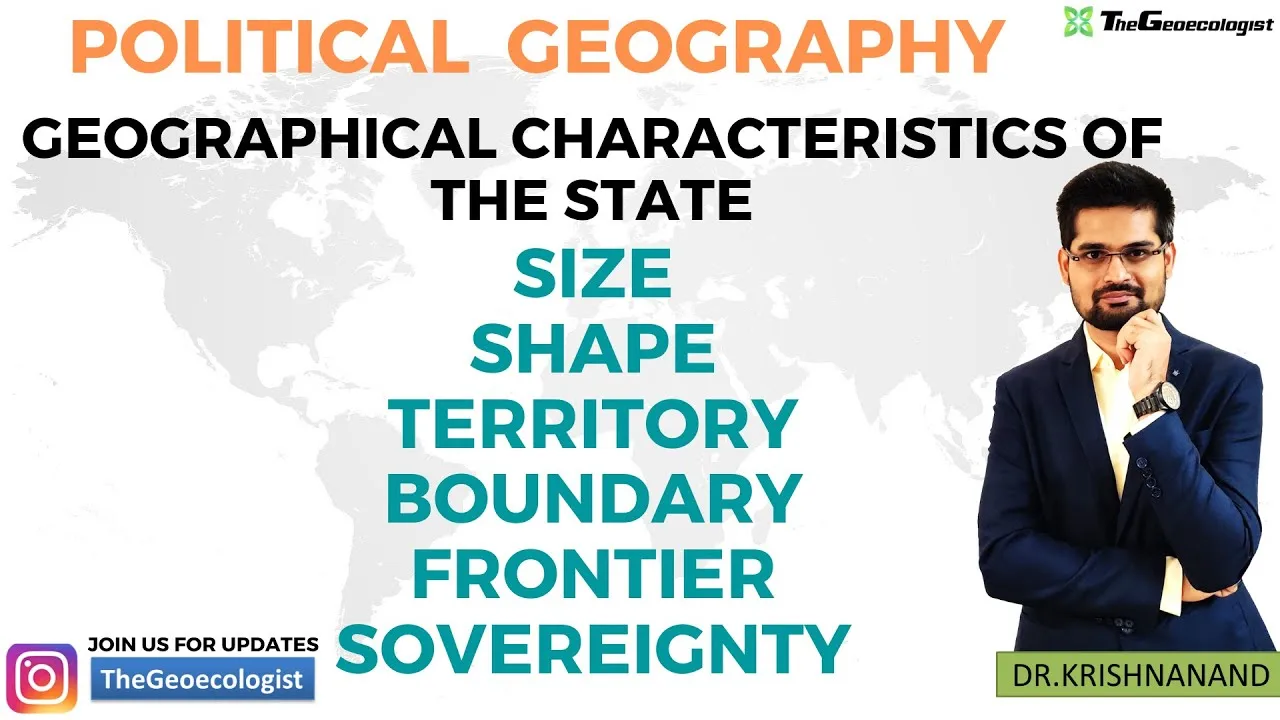
Geographical Characteristics of State- Political Geography
Understanding the Geographical Characteristics of the State in Political Geography
Political geography, a vital sub-discipline of human geography, explores the spatial aspects of political processes and the relationship between territory, power, and governance. Among its core themes, the geographical characteristics of the state hold significant importance for students preparing for competitive exams like UPSC, state PSCs, or university-level courses. This article simplifies key concepts related to the state’s geographical attributes, their implications, and their relevance in political geography.
Defining the State in Political Geography
A state is a politically organized territory with a permanent population, defined borders, a sovereign government, and international recognition. It is distinct from a nation (a group of people sharing cultural, ethnic, or historical ties) and a nation-state (where state boundaries align with a single nation’s identity). Understanding these distinctions is critical, as geopolitical conflicts often arise from mismatches between states and nations.
Key Geographical Characteristics of the State
Size and Shape:
- The territorial expanse of a state influences its resources, administrative efficiency, and defense strategies. For example, large states like Russia face logistical challenges, while compact states (e.g., Bhutan) may have cohesive governance.
- Shapes such as compact, fragmented, elongated, or perforated (e.g., South Africa surrounding Lesotho) impact connectivity and political control.
Location:
- Absolute location (latitude/longitude) determines climate and resource distribution.
- Relative location (proximity to other states or strategic waterways) shapes trade and diplomatic ties. Landlocked states, like Nepal, often face economic constraints.
Boundaries:
- Natural (rivers, mountains) or artificial (surveyed lines) boundaries define territorial sovereignty. Disputes over boundaries, such as India-China disagreements in the Himalayas, are common geopolitical issues.
Topography and Natural Resources:
- Mountainous terrain (e.g., Switzerland) can act as a natural defense but hinder infrastructure.
- Resource-rich states (e.g., Saudi Arabia with oil) gain economic and strategic leverage, while resource-poor states rely on imports or innovation.
- Climate:
- Arid climates may limit agriculture, forcing states to depend on technology or imports. Tropical climates, while agriculturally productive, may pose health challenges.
Evolution of Political Geography
Political geography evolved from early thinkers like Friedrich Ratzel, who compared states to organisms requiring lebensraum (living space), to modern concepts like critical geopolitics. Colonialism, the Cold War, and globalization reshaped how states exert influence, emphasizing territorial control, alliances, and soft power.
Why Study Geographical Characteristics of the State?
For UPSC aspirants and geography students, analyzing these traits helps in:
- Understanding geopolitical conflicts (e.g., Ukraine-Russia tensions over Crimea).
- Evaluating economic policies based on resource distribution.
- Addressing challenges like climate change, migration, and border security.
Enhance Your Learning with TheGeoecologist
For a detailed visual explanation, watch Dr. Krishnanand’s video on Geographical Characteristics of the State on YouTube. His simplified lectures cater to competitive exams and university curricula, making complex topics accessible.
Stay Connected
- Follow us on Instagram: https://www.instagram.com/thegeoecologist/
- Explore courses on our website: https://thegeoecologist.com/
Conclusion
The geographical characteristics of a state are foundational to its political, economic, and strategic identity. Mastery of these concepts equips students to analyze global issues, making them indispensable for academic and competitive success.
Keywords: Geographical characteristics, political geography, state, nation, nation-state, evolution of political geography.
Join Dr. Krishnanand’s channel for more insights and subscribe to THEGEOECOLOGIST for updates on geography optional courses.
To Download E-Books & Study Material Visit The Shop Page