Blog
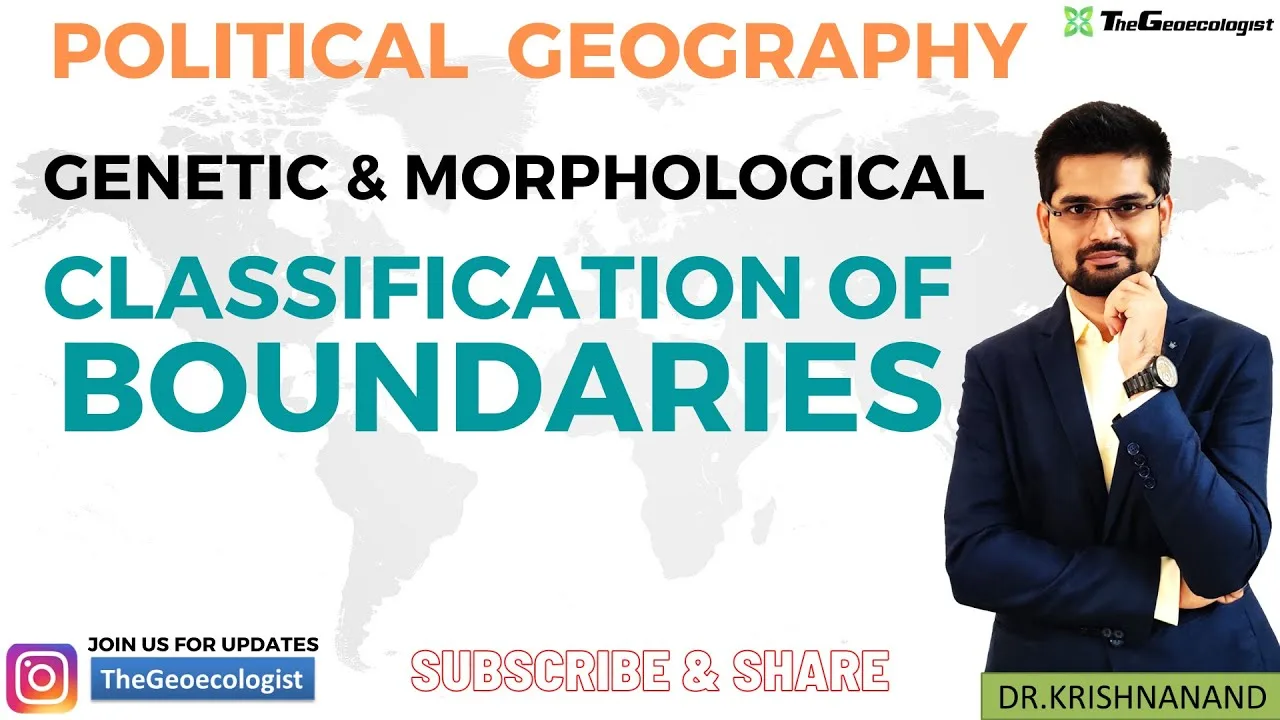
Genetic Classification of Boundaries-Hartshorne-Geoecologist

Genetic Classification of Boundaries-Hartshorne-Geoecologist
Understanding Genetic and Morphological Classification of Boundaries in Political Geography: A Hartshorne Perspective
Introduction to Political Geography and Boundaries
Political geography explores the spatial dimensions of political processes, focusing on the relationship between land, population, and governance. Central to this discipline is the study of boundaries—legal, physical, and cultural lines that define territorial limits. Boundaries shape international relations, resource distribution, and cultural identities. Dr. Richard Hartshorne, a seminal figure in political geography, introduced a Genetic Classification of Boundaries, offering a framework to analyze their origins and evolution. This article simplifies Hartshorne’s theory and the morphological classification of boundaries, aiding UPSC aspirants, university students, and geography enthusiasts globally.
Hartshorne’s Genetic Classification of Boundaries
Hartshorne’s genetic classification categorizes boundaries based on their historical development and relationship with human settlement:
Antecedent Boundaries
- Definition: Established before significant cultural landscape development.
- Example: The USA-Canada border along the 49th parallel, drawn prior to extensive colonization.
- Significance: Minimizes conflicts by avoiding overlaps with existing cultural groups.
Subsequent Boundaries
- Definition: Formed after cultural landscapes are established, often through negotiation.
- Example: The India-Bangladesh border, shaped post-Partition to reflect linguistic and ethnic divisions.
- Significance: Addresses demographic realities but may lead to disputes if poorly demarcated.
Superimposed Boundaries
- Definition: Imposed by external powers, disregarding cultural or environmental factors.
- Example: Colonial borders in Africa (e.g., the Congo Basin) created by European powers, leading to post-independence tensions.
- Significance: Often sources of instability due to ethnocultural mismatches.
- Relic Boundaries
- Definition: Non-functional boundaries retaining historical/cultural significance.
- Example: The Berlin Wall, now a symbol of Cold War division.
- Significance: Serve as reminders of geopolitical history.
Morphological Classification of Boundaries
This classification focuses on the physical and geometric characteristics of boundaries:
Physical/Natural Boundaries
- Definition: Follow natural features like rivers, mountains, or deserts.
- Example: The Himalayas between India and China or the Rio Grande between the U.S. and Mexico.
- Advantages: Clearly visible and less disputable.
- Geometric Boundaries
- Definition: Straight lines based on latitude/longitude or arbitrary lines.
- Example: The Egypt-Sudan border (22nd parallel) or the Green Line in Cyprus.
- Challenges: May ignore cultural or environmental realities, leading to conflicts.
Relevance for Competitive Exams and Geopolitics
Hartshorne’s framework helps analyze contemporary issues, such as:
- The Israel-Palestine conflict, involving superimposed and subsequent boundaries.
- Ukraine’s borders reflecting Soviet-era demarcations.
- Arctic territorial disputes driven by climate change and resource accessibility.
For UPSC aspirants, understanding these classifications is crucial for topics like India’s border management, Sino-Indian disputes, and historical partitions. University students gain tools to dissect global territorial dynamics, enhancing research and critical thinking.
Conclusion
Boundaries are not just lines on maps but dynamic entities shaped by history, power, and geography. Hartshorne’s genetic classification and morphological analysis provide a robust lens to decode their complexities. For in-depth insights, explore Dr. Krishnanand’s video lectures on TheGeoecologist YouTube channel and access curated courses at TheGeoecologist Website. Follow @thegeoecologist for daily geography updates.
Keywords: Genetic Classification, Hartshorne, Political Geography, UPSC, Morphological Boundaries, Geoecologist.
Enhance your preparation with structured learning—subscribe to TheGeoecologist and transform your understanding of political geography! 🌍
To Download E-Books & Study Material Visit The Shop Page