


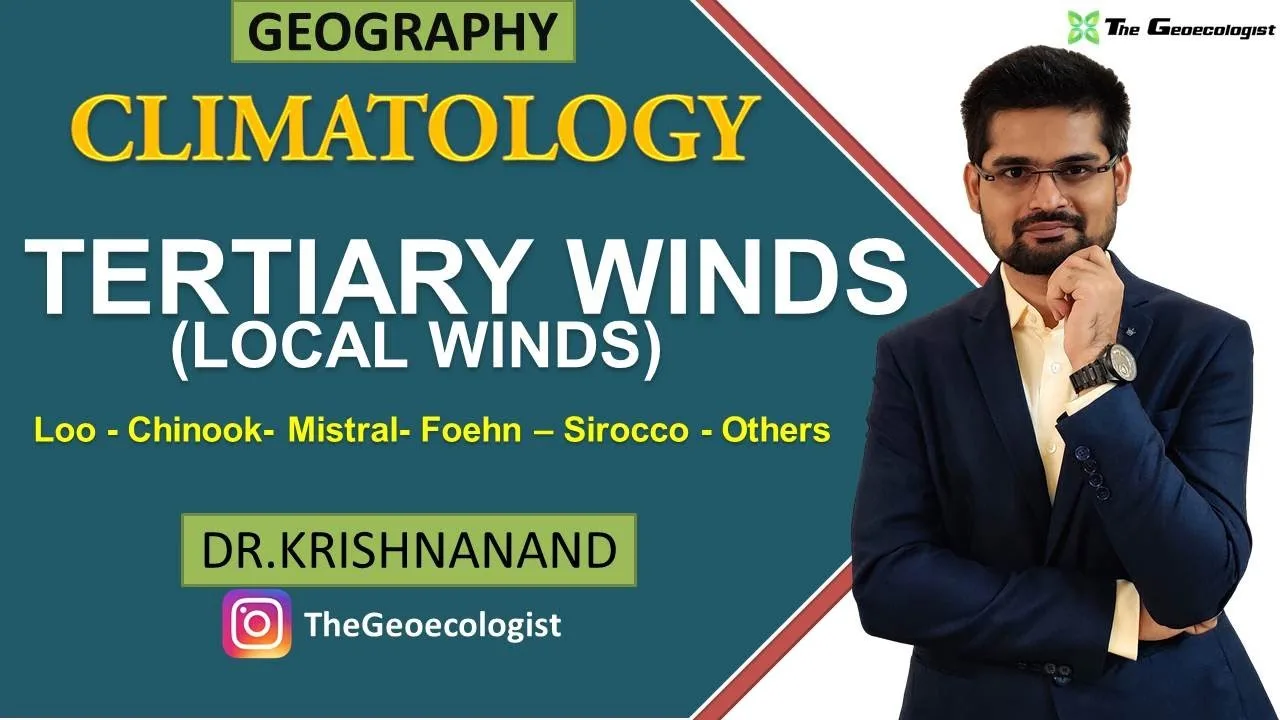
Tertiary Winds | Local Winds | Climatology | Dr. Krishnanand
Understanding Tertiary (Local) Winds in Climatology
Introduction
Climatology, a key branch of geography, examines atmospheric phenomena that shape weather patterns. Among various wind systems, tertiary or local winds play a significant role in influencing microclimates. These winds develop due to localized geographic conditions such as topography, temperature variations, and pressure differences. Dr. Krishnanand, the founder of TheGeoecologist, provides a simplified explanation of tertiary winds in his lecture series, catering to UPSC aspirants and geography students.
What Are Tertiary (Local) Winds?
Unlike primary (global) winds (e.g., trade winds, westerlies) and secondary (periodic) winds (e.g., monsoons), tertiary winds are small-scale, localized wind systems affecting specific regions. These winds are short-lived but significantly impact daily weather conditions, agriculture, and human activities.
Types and Examples of Local Winds
Hot Local Winds
- Sirocco (Southern Europe): A hot, dry wind from the Sahara, bringing dust storms to Mediterranean regions.
- Harmattan (West Africa): A dry, dusty wind blowing from the Sahara towards the Gulf of Guinea.
Cold Local Winds
- Mistral (France): A cold, strong wind flowing from the Alps to the Mediterranean coast.
- Bora (Adriatic coast): A chilly wind descending from the Dinaric Alps towards the Adriatic Sea.
Moist Local Winds
- Chinook (Rocky Mountains): A warm, dry wind descending eastern slopes, causing rapid snowmelt.
- Foehn (Alps): Similar to Chinook, it warms valleys after descending mountains.
Factors Influencing Local Winds
- Relief and Topography: Mountains and valleys channel winds (e.g., Anabatic & Katabatic winds).
- Temperature Differences: Land-sea breezes result from differential heating.
- Pressure Gradients: Localized high and low-pressure zones drive wind direction.
Importance for UPSC and Geography Students
Studying tertiary winds is crucial for:
✔ Understanding microclimatic variations.
✔ Analyzing regional agriculture and settlement patterns.
✔ Answering climatology-based questions in UPSC Geography Optional.
Enhance Your Knowledge with Dr. Krishnanand’s E-Book
For a detailed explanation of climatology topics, including tertiary winds, refer to:
📖 Simplified Climatology E-Book: https://mithilacraft.com/product/simplified-climatology-ebook/
Subscribe & Follow for More Updates
- YouTube: THEGEOECOLOGIST
- Instagram: @thegeoecologist
- Website: https://thegeoecologist.com/
Conclusion
Tertiary winds may be localized, but their impact is profound. Dr. Krishnanand’s simplified approach helps students and UPSC aspirants grasp these concepts effectively. For deeper insights, refer to his climatology e-book and stay updated via his educational platforms. 🌍📚
#Climatology #TertiaryWinds #LocalWinds #UPSCGeography #DrKrishnanand
To Download E-Books & Study Material Visit The Shop Page